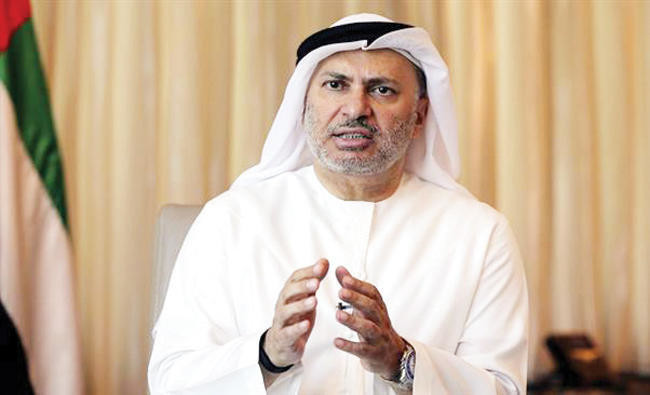
DUBAI: A senior United Arab Emirates official said on Saturday Turkey's policy towards Arab states was not reasonable and advised it to respect their sovereignty.
Relations between the two countries have been strained by Ankara’s support for Qatar after Saudi Arabia, the UAE, Bahrain and Egypt imposed sanctions on Doha last year over its alleged support for extremist groups.
"It is no secret that Arab-Turkish relations aren't in their best state," UAE Minister of State for Foreign Affairs Anwar Gargash tweeted.
"In order to return to balance, Ankara has to respect Arab sovereignty and deal with its neighbors with wisdom and rationality," he said.
The UAE sees itself as a bulwark against extremist groups like the Muslim Brotherhood. Abu Dhabi has long been uneasy with Turkish President Recep Tayyip Erdogan's ruling AK party and its support for such groups.
The two countries were drawn into a quarrel in December over a retweet by the Emirati foreign minister that Erdogan called an insult.
UAE Foreign Minister Sheikh Abdullah bin Zayed shared a tweet at the time that accused Turkish troops of looting the holy city of Medina a century ago, prompting Erdogan to lash out saying that the minister had been spoiled by oil money.
Turkey then renamed the street in Ankara where the UAE Embassy is located after the Ottoman military commander who Sheikh Abdullah had appeared to criticize.

UAE asks Turkey to respect Arab states’ sovereignty
UN chief warns Israel’s actions in West Bank are eroding prospects for a two-state solution
- Secretary-General Antonio Guterres ‘gravely concerned’ by new rules that tighten Israeli control of the territory and make it easier for Israeli settlers to buy land there
- He calls on Israel to reverse the decision, urges all parties to safeguard what he describes as the only viable path to lasting peace: a negotiated two-state solution
NEW YORK CITY: UN Secretary-General Antonio Guterres warned on Monday that the approval by Israeli authorities of new administrative and enforcement measures in the West Bank undermine the prospects for a two-state solution.
Israel’s Security Cabinet this weekend approved new rules designed to strengthen control over the occupied West Bank, make it easier for Israeli settlers to buy land there and give Israeli officials stronger powers to enforce laws on Palestinians.
Guterres said he was “gravely concerned” by the reported decision to authorize the new measures in Areas A and B of the West Bank, warning that the current trajectory of developments on the ground was eroding the possibility of a negotiated settlement between Israelis and Palestinians.
He reiterated that all Israeli settlements in the occupied West Bank, including East Jerusalem, lack legal validity and constitute a “flagrant violation of international law.”
Such actions, including Israel’s continuing presence in the occupied Palestinian territory, were destabilizing and unlawful, he added, as recalled by the International Court of Justice.
Guterres called on Israeli authorities to reverse their decision and urged all parties to safeguard what he described as the only viable path to lasting peace: a negotiated two-state solution in line with international law and Security Council resolutions.
Israel has rejected international criticism of its settlement policies and disputes claims that they violate international law.