Search is on for the best summit site for Trump, Kim

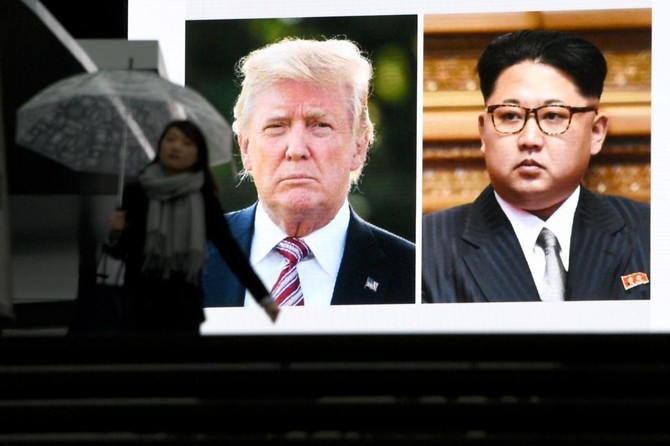
A pedestrian walks in front of a huge screen flashing a news report relating to US President Donald Trump and North Korean leader Kim Jong agreeing to meet for talks in Tokyo on March 9, 2018. (AFP)
Updated 10 March 2018
Follow

Search is on for the best summit site for Trump, Kim

WASHINGTON: Ronald Reagan and Mikhail Gorbachev chose Reykjavik, Iceland. Franklin Roosevelt, Winston Churchill and Josef Stalin huddled at Yalta. Dwight Eisenhower and Soviet leader Nikita Khruschev will always have Paris.
So where should President Donald Trump and Kim Jong Un meet up for the first face-to-face talks between a US and North Korean president?
The Demilitarized Zone between North and South Korea is one possibility. Sweden has offered to help. And there’s always neutral Geneva, Switzerland.
Someplace in Asia perhaps — such as Beijing — hasn’t been ruled out. Nor, for that matter, has a ship in international waters.
The question crackled through diplomatic and government circles Friday, one day after a South Korean official announced in the dark on a White House driveway that the two heads of state who had threatened mutual obliteration for months would take a meeting.
It’s not clear what location is suitable for leaders who have sniped at each other — “Little Rocket Man” vs. “senile dotard” — in nerve-rattling Twitter exchanges about nuclear war.
“It’s all about optics, from their first handshake,” said Lisa Collins, a Korea scholar and fellow at the Center for Strategic and International Studies. “There are 70 years of historical baggage between the two countries ... so to have the meeting in a place that’s a safe location and one that doesn’t overly highlight the differences between the two countries would probably be the best.”
The White House wasn’t offering suggestions in the hours after the announcement.
Trump, a former reality TV star, understands well the value of “optics.” But symbolism, security and practicality also come into play. Holding talks in either the US or North Korea seem unlikely. Traveling to North Korea risks conferring legitimacy on Kim and his country.
As for Kim: Except for schooling in Switzerland and perhaps some vacations during that time, it’s not clear that Kim has left North Korea. So Mar-a-Lago, the president’s Florida estate that was good enough for Chinese President Xi Jinping last April, probably won’t do this time.
More likely is the no-man’s-land of Peace Village in the DMZ’s Panmunjom. There is a building there with a line through the middle that marks the border — and was the site of the 1953 armistice. Theoretically, Kim could shake Trump’s hand by reaching over the line without ever setting foot outside North Korea. And Trump’s been wanting to visit the DMZ, anyway. A shrouded-in-secrecy stop there during Trump’s tour of Asia last year was scrubbed due to bad weather.
In April, the leaders of North and South Korea are to meet there for their own historic bilateral talks.
Swedish Prime Minister Stefan Lofven, meanwhile, has offered to help, given that his nation has an embassy in Pyongyang. “We are a non-aligning country,” Lofven pointed out during a press conference with Trump this week. “If the president decides, the key actors decide if they want us to help out, we’ll be there.”
History offers some lessons in bilateral summitry.
Sometimes, talks fail. In diplomatic circles, Reykjavik, Iceland’s frosty capital, refers President Ronald Reagan and Soviet leader Mikhail Gorbachev’s hastily arranged arms reduction talks in 1986. They failed to produce a deal, but did result in iconic photos of the two leaders smiling together in the final years of the Cold War.
Other times, they blow up. “Peaceful coexistence” was the goal, but not the immediate result, of a summit in Paris between Khruschev and Eisenhower. The talks were tense over the Soviet downing of a U-2 plane in 1960 that Eisenhower was forced to admit had been spying on Russia. The Russian leader stalked out of the meeting, cooling any thoughts of a lasting peace for awhile.
It’s good to have a backup venue: What were to be talks in 1989 between President George H.W. Bush and Gorbachev aboard a ship near Malta turned into the “seasick summit” when seven-foot waves forced the leaders to cancel some meetings.
Talks and the most powerful images sometimes go only so far. Egyptian President Anwar Sadat stunned the world when he set foot in Israel in 1977 and addressed the Israeli parliament. The visit set the tone for the Camp David peace summit and treaty in 1979. The Egyptian-Israeli agreement has remained intact and laid the groundwork for other Mideast summits. But the peace process has stalled in recent years.


Bangladesh votes in world’s first Gen Z-inspired election

Updated 51 min 24 sec ago
Follow

Bangladesh votes in world’s first Gen Z-inspired election

  • Ousted PM Hasina’s Awami League party banned
  • BNP, Jamaat in close race with big economic, geopolitical stakes

DHAKA: For years under former Prime Minister Sheikh Hasina, Bangladesh’s opposition had little presence on the streets during elections, either boycotting polls or being sidelined by mass arrests of senior leaders. ​Now, ahead of Thursday’s vote, the roles have reversed.
Hasina’s Awami League is banned, but many young people who helped oust her government in a 2024 uprising say the upcoming vote will be the Muslim-majority nation’s first competitive election since 2009, when she began a 15-year-rule.
The Bangladesh Nationalist Party (BNP) is widely expected to win, although a coalition led by the Islamist Jamaat-e-Islami is putting up a strong challenge. A new party driven by Gen-Z activists under the age of 30 has aligned with Jamaat after failing to translate its anti-Hasina street mobilization into an electoral base.
BNP chief Tarique Rahman told Reuters his party, which is contesting 292 of the 300 parliamentary seats at stake, was confident of winning “enough to form a government.”

Bangladesh Nationalist Party (BNP) chairman Tarique Rahman speaks during an election campaign rally, ahead of the national election at Pallabi, in Dhaka, Bangladesh, on February 8, 2026. (Reuters)

Analysts say a decisive result in the February 12 vote, instead of a fractured outcome, is vital for restoring ‌stability in the nation of ‌175 million after Hasina’s ouster triggered months of unrest and disrupted major industries, including ‌the garments ⁠sector ​in the ‌world’s second-largest exporter.
The verdict will also affect the roles of rival regional heavyweights China and India in the South Asian nation.
“Opinion polls suggest the BNP has an edge, but we must remember that a significant portion of voters are still undecided,” said Parvez Karim Abbasi, executive director at Dhaka’s Center for Governance Studies.
“Several factors will shape the outcome, including how Generation Z — which makes up about a quarter of the electorate — votes, as their choices will carry considerable weight.”
Across Bangladesh, black-and-white posters and banners bearing the BNP’s “sheaf of paddy” symbol and Jamaat’s “scales” hang from poles and trees and are pasted on roadside walls, alongside those of several independent candidates. Party shacks on street corners, draped in their emblems, blare campaign songs.
It marks a sharp ⁠contrast with past elections, when the Awami League’s “boat” symbol dominated the landscape.
Opinion polls expect the once-banned Jamaat, which had opposed Bangladesh’s India-backed 1971 independence from Pakistan, to have its best electoral ‌performance even if it does not win.

China’s influence increases as India’s wanes
The election verdict ‍will also influence the roles of China and India in Bangladesh ‍in coming years, analysts have said. Beijing has increased its standing in Bangladesh since Hasina was seen as pro-India and fled to ‍New Delhi after her ouster, where she remains.
While New Delhi’s influence is on the wane, the BNP is seen by some analysts as being relatively more in tune with India than the Jamaat.
A Jamaat-led government might tilt closer to Pakistan, a fellow Muslim-majority nation and a long-standing rival of Hindu-majority India, analysts say. Also, Jamaat’s Gen-Z ally has said “New Delhi’s hegemony” in Bangladesh is one of its main concerns and its leaders met Chinese diplomats recently.
Jamaat, which calls ​for a society governed by Islamic principles, has said the party is not inclined toward any country.
BNP’s Rahman has said if his party formed the government it would have friendly relations with any nation that “offers what is suitable for ⁠my people and my country.”
Bangladesh, one of the world’s most densely populated countries with high rates of extreme poverty, has been hit by high inflation, weakening reserves and slowing investment, which has pushed it to seek large-scale external financing since 2022, including billions of dollars from the International Monetary Fund and the World Bank.

Bangladesh Nationalist Party (BNP) chairman Tarique Rahman attends an election campaign rally, ahead of the national election at Pallabi, in Dhaka 

Corruption is the biggest concern among the 128 million voters, followed by inflation, according to a survey by Dhaka-based think tanks Communication & Research Foundation and Bangladesh Election and Public Opinion Studies.
Analysts say Jamaat’s clean image is a factor in its favor, much more than its Islamic leanings.
“Voters report high intention to participate, prioritize corruption and economic concerns over religious or symbolic issues, and express clear expectations for leaders who demonstrate care, competence and accountability,” said the survey.
Nevertheless, BNP’s Rahman, son of former Prime Minister Khaleda Zia, is seen as the frontrunner to lead the next government. But if the Jamaat-led coalition emerges ahead, its chair, Shafiqur Rahman, could be in line for the top job.
Mohammad Rakib, 21, who is set to vote for the first time, said he hoped the next government would allow people to express their views and exercise their franchise freely.
“Everyone ‌was tired of (Hasina’s) Awami League. People couldn’t even vote during national elections. People had no voice,” he said. “I hope the next government, whoever comes into power, will ensure this freedom of expression.”