Popular Mobilization Forces militias formally inducted into security forces

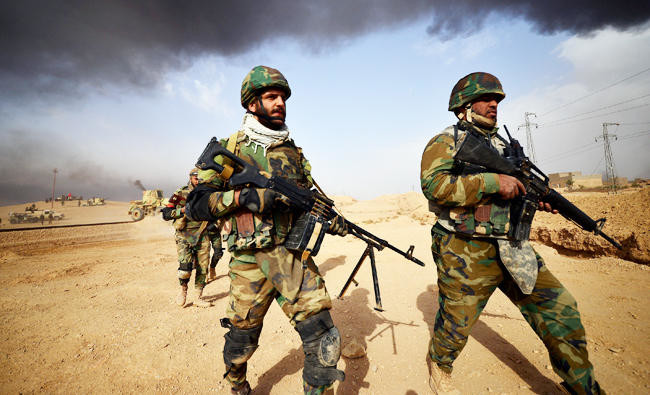
Shi'ite Popular Mobilization Forces (PMF) carrying their weapons, advance towards the city of Al-Qaim, Iraq, in this November 3, 2017 file photo. (REUTERS)
Updated 10 March 2018
Follow

Popular Mobilization Forces militias formally inducted into security forces

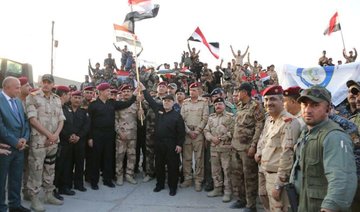
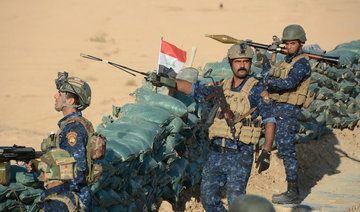
BAGHDAD: Iraqi Prime Minister Haider Abadi has issued a decree formalizing the inclusion of Shiite paramilitary groups in the country’s security forces.
According to the decree, members of the Shiite militias, an assortment of militia groups known collectively as the Popular Mobilization Forces (PMF), which are mostly backed and trained by Iran, will be granted many of the same rights as members the military.
Paramilitary members will be given equivalent salaries to those members of the military under the Ministry of Defense’s control, the decree said. They will also be subject to the laws of military service and will gain access to military institutes and colleges.
The decree had been expected for some time and comes two months ahead of a high-stakes general election. The PMF commands popular support among Iraq’s Shiite population and is expected to sway voters.
Tens of thousands of Iraqis heeded a call to arms in 2014 after Daesh seized a third of the country’s territory, forming the PMF. The paramilitaries supported Iraq’s military in ejecting Daesh from areas the militants overran in 2014, when Iraqi military and police divisions deserted en masse.
Iraq declared victory over the militants in December, but the militias, estimated to comprise more than 60,000 fighters, are still deployed in many of the predominantly Sunni areas which saw heavy fighting during the three-year war to oust Daesh.


Syrian foreign minister: National interest and the welfare of the people top priority

Updated 13 sec ago
Follow

Syrian foreign minister: National interest and the welfare of the people top priority

  • Hassan Al-Shaibani highlights reconstruction efforts, internal reforms during Munich discussion

MUNICH: The Syrian Arab Republic Foreign Minister Asaad Hassan Al-Shaibani spoke on the sidelines of the Munich Security Conference about the country’s ongoing recovery, internal reforms, and the impact of Israeli military actions.

“We are satisfied with the achievements we have made, but we continue striving to deliver the best for our people,” Al-Shaibani said.

“We will not tire or give up and will work day and night to build the Syria we aspire to, together with our citizens.”

In the Syrian Arab News Agency report the minister stressed that the Syrian state had not shirked its responsibility for what happened in Sweida and other areas, noting that “the national interest and the welfare of the people have always been our top priority.”

He emphasized that the diversity in Syria is a source of strength.

We live in a country exhausted by war and by the mismanagement inherited from the deposed regime.

Foreign Minister, Asaad Hassan Al-Shaibani

“We share national interests, including the unity and territorial integrity of the country, and we operate within the framework of the law,” he added.

Al-Shaibani highlighted progress in rebuilding state institutions and restoring trust between the government and the public.

“We live in a country exhausted by war and by the mismanagement inherited from the deposed regime,” he said. “Syrian society remains fragmented, both inside the country and abroad, and continues to face humanitarian and infrastructure challenges.”

He emphasized that efforts to unify the country include consolidating state control over weapons, a principle established after the revolution’s victory.

The minister also highlighted the role of Syrian citizens in the recovery process.

“What we rely on is our people, who possess determination and ambition,” he said, adding that “lifting sanctions is the key to reconstruction.”

He noted that there are still displacement camps in the country and that many refugees continue to live abroad.

Turning to external issues, he expressed concern over Israeli military activity.

“Since Dec. 8, 2024, Syria has faced more than 1,000 airstrikes, the occupation of new areas in southern Syria, and over 500 ground incursions,” he said, adding that the Syrian state has pursued a realistic approach toward Israel, prioritizing reconstruction and national recovery.

He noted, however, that the policy might not have been acceptable to Israel, which “continues to seek regional conflicts.”

Al-Shaibani emphasized that negotiations should result in Israel withdrawing from the areas it occupied after Dec. 8, respecting Syrian sovereignty and airspace.

Syria’s deputy interior minister met with Germany’s interior minister on the sidelines of the Munich Security Conference.

They discussed security developments and prospects for cooperation, according to a statement from the interior ministry.

Maj. Gen. Abdulkader Al-Tahhan held talks with German Interior Minister Alexander Dobrindt during the annual conference.

The Syrian Interior Ministry said the meeting included a review of current developments in Syria and their impact on security and humanitarian issues.

It added that both sides stressed the importance of coordination and information-sharing in support of regional and international stability.

The statement said the officials also discussed possible cooperation between the two interior ministries, including training, capacity-building and the exchange of expertise.