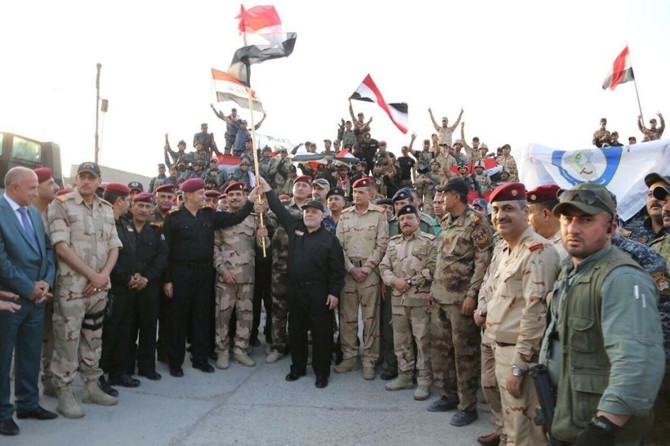
BAGHDAD: Shiite political and paramilitary groups have called for the withdrawal of the remaining US troops in Iraq as they seek to make electoral gains on the man who helped empower them, Prime Minister Haider Abadi.
The demand by the opposition Al-Fattah alliance is just the latest sign that the Iranian-backed forces who played a key role in the defining achievement of his premiership — the defeat of Daesh in much of the country — are trying to outmaneuver the Iraqi leader before a nationwide vote that will decide his fate this spring.
While the two sides continue to cooperate militarily and there is no suggestion of their political rivalry degenerating into violence, their contest could have far-reaching consequences for Iraq.
Parliamentary elections for the 329-member Council of Representatives are scheduled to be held on May 12. The MPs will then choose Iraq’s prime minister and president, meaning Abadi is fighting for his political career even as he rides a wave of popular support thanks to his victories on the battlefield.
Last week the Al-Fattah alliance submitted a draft resolution to the national assembly calling for the final few thousand American soldiers in Iraq to be withdrawn “as their mission has been achieved.” Although the resolution cannot become legislation under Iraqi law, it is highly symbolic of the precarious position in which Abadi finds himself.
Having built his reputation on the defeat of Daesh, the prime minister is being pressured into making political concessions by the very militias he used to crush the extremists and strengthen his hold on the country.
The resolution calling for the Americans to withdraw is “a typical way to embarrass him,” an MP and Al-Fattah alliance member told Arab News on condition of anonymity. “He is the Americans’ man, so let them protect him.”
A former electrical engineering student who spent several years in exile in the UK during the regime of Saddam Hussein, Abadi is himself a Shiite Muslim. He returned to Iraq after the 2003 US-led invasion and was elected to Parliament less than three years later.
He was appointed prime minister in September 2014 and has had to face down a Kurdish referendum for independence, as well as the Daesh insurgency that swept through Iraq.
The challenge he now faces, however, comes from former allies backed by Iran and their pressure may already be paying off.
On Thursday, the prime minister issued a decree that will allow an assortment of Shiite militias from the Al-Fattah alliance to be formally absorbed into Iraq’s security forces. The move will go some way to appeasing his political opponents, but it is unlikely to silence them entirely with the election just two months away.
The Al-Fattah alliance is made up of some of Iraq’s most powerful paramilitary groups including the Badr Organization and Asai’b Ahl Al-Haq, two groups that played pivotal roles in the bloodshed and sectarian violence that dominated the early years of the US-led occupation.
The Badr Organization has its roots in the Supreme Council for Islamic Revolution in Iraq, which fought on the side of Tehran in the 1980-1988 Iran-Iraq war. Many of its members joined the Iraqi security forces after the 2003 American invasion.
The Asai’b Ahl Al-Haq is an offshoot of the Iranian-backed Mahdi Army, which fought pitched battles with US troops in the cities of Baghdad and Najaf in 2004.
Last December the US said it had 5,200 troops in Iraq and Abadi has insisted these remaining forces only provide security and logistical support, and are not involved in combat.
Sa’ad Al-Hadaithi, a spokesman for the Iraqi government, told Arab News the country still needed American military help.
“Until the battle with Daesh is resolved on the Syrian side (of the border) and pockets of Daesh militants are eliminated in those areas, we still need the support of the coalition forces,” he said.
The US insists its continued presence in Iraq will be “conditions-based.”
In recent years, it has launched air strikes in aid of Shiite militias fighting Daesh, but the upcoming elections have emboldened the paramilitary groups and their allies in Parliament, giving them the confidence to turn the tables on both Abadi and Washington.
“We are not the only ones who demand the departure of these forces; this decision is consistent with the will of the Iraqi people,” said Mahmoud Al-Rubaiai, a leading member of Al-Fattah.
He added that if the US troops did not leave, “then we will consider them as occupation forces and deal with them on that basis.”

Shiite alliance turns on Iraqi PM as election looms
Virtual museum preserves Sudan’s plundered heritage
CAIRO: Destroyed and looted in the early months of Sudan’s war, the national museum in Khartoum is now welcoming visitors virtually after months of painstaking effort to digitally recreate its collection.
At the museum itself, almost nothing remains of the 100,000 artefacts it had stored since its construction in the 1950s. Only the pieces too heavy for looters to haul off, like the massive granite statue of the Kush Pharaoh Taharqa and frescoes relocated from temples during the building of the Aswan Dam, are still present on site.
“The virtual museum is the only viable option to ensure continuity,” government antiquities official Ikhlass Abdel Latif said during a recent presentation of the project, carried out by the French Archaeological Unit for Sudanese Antiquities (SFDAS) with support from the Louvre and Britain’s Durham University.
When the museum was plundered following the outbreak of the war between the regular army and the paramilitary Rapid Support Forces (RSF) in April 2023, satellite images showed trucks loaded with relics heading toward Darfur, the western region now totally controlled by the RSF.
Since then, searches for the missing artefacts aided by Interpol have only yielded meagre results.
“The Khartoum museum was the cornerstone of Sudanese cultural preservation — the damage is astronomical,” said SFDAS researcher Faiza Drici, but “the virtual version lets us recreate the lost collections and keep a clear record.”
Drici worked for more than a year to reconstruct the lost holdings in a database, working from fragments of official lists, studies published by researchers and photos taken during excavation missions.
Then graphic designer Marcel Perrin created a computer model that mimicked the museum’s atmosphere — its architecture, its lighting and the arrangement of its displays.
Online since January 1, the virtual museum now gives visitors a facsimile of the experience of walking through the institution’s galleries — reconstructed from photographs and the original plans — and viewing more than 1,000 pieces inherited from the ancient Kingdom of Kush.
It will take until the end of 2026, however, for the project to upload its recreation of the museum’s famed “Gold Room,” which had housed solid-gold royal jewelry, figurines and ceremonial objects stolen by looters.
In addition to the virtual museum’s documentary value, the catalogue reconstructed by SFDAS is expected to bolster Interpol’s efforts to thwart the trafficking of Sudan’s stolen heritage.
At the museum itself, almost nothing remains of the 100,000 artefacts it had stored since its construction in the 1950s. Only the pieces too heavy for looters to haul off, like the massive granite statue of the Kush Pharaoh Taharqa and frescoes relocated from temples during the building of the Aswan Dam, are still present on site.
“The virtual museum is the only viable option to ensure continuity,” government antiquities official Ikhlass Abdel Latif said during a recent presentation of the project, carried out by the French Archaeological Unit for Sudanese Antiquities (SFDAS) with support from the Louvre and Britain’s Durham University.
When the museum was plundered following the outbreak of the war between the regular army and the paramilitary Rapid Support Forces (RSF) in April 2023, satellite images showed trucks loaded with relics heading toward Darfur, the western region now totally controlled by the RSF.
Since then, searches for the missing artefacts aided by Interpol have only yielded meagre results.
“The Khartoum museum was the cornerstone of Sudanese cultural preservation — the damage is astronomical,” said SFDAS researcher Faiza Drici, but “the virtual version lets us recreate the lost collections and keep a clear record.”
Drici worked for more than a year to reconstruct the lost holdings in a database, working from fragments of official lists, studies published by researchers and photos taken during excavation missions.
Then graphic designer Marcel Perrin created a computer model that mimicked the museum’s atmosphere — its architecture, its lighting and the arrangement of its displays.
Online since January 1, the virtual museum now gives visitors a facsimile of the experience of walking through the institution’s galleries — reconstructed from photographs and the original plans — and viewing more than 1,000 pieces inherited from the ancient Kingdom of Kush.
It will take until the end of 2026, however, for the project to upload its recreation of the museum’s famed “Gold Room,” which had housed solid-gold royal jewelry, figurines and ceremonial objects stolen by looters.
In addition to the virtual museum’s documentary value, the catalogue reconstructed by SFDAS is expected to bolster Interpol’s efforts to thwart the trafficking of Sudan’s stolen heritage.
© 2026 SAUDI RESEARCH & PUBLISHING COMPANY, All Rights Reserved And subject to Terms of Use Agreement.