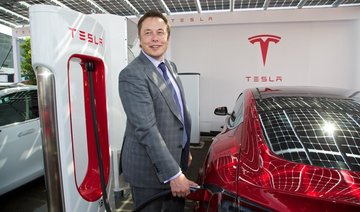
WASHINGTON/SHANGHAI: Tesla Chief Executive Elon Musk took to Twitter on Thursday to call on US President Donald Trump to challenge China’s auto trade rules, which limit foreign ownership of Chinese ventures and impose steep tariffs on imported cars.
In a series of tweets aimed at the president, Musk said he was “against import duties in general, but the current rules make things very difficult. It’s like competing in an Olympic race wearing lead shoes.”
Tesla has been pushing hard to build cars in China, the world’s largest auto market, but has hit roadblocks in negotiations with local authorities, in part because Musk is keen to keep full control of any local venture.
“No US auto company is allowed to own even 50 percent of their own factory in China, but there are five 100 percent China-owned EV (electric vehicle) auto companies in the US,” Musk wrote in another tweet.
Tesla “raised this with the prior administration and nothing happened. Just want a fair outcome, ideally where tariffs/rules are equally moderate. Nothing more. Hope this does not seem unreasonable,” he said.
Trump quoted one of Musk’s tweets in his announcement on new tariffs and said American automakers have not been treated fairly by trade rules around the world. Trump announced steep tariffs on steel and aluminum imports on Thursday.
Politicians “have known it for years and never did anything about it. It’s got to change,” Trump said, saying he plans to impose a “reciprocal tax” on other countries. “We’re changing things,” Trump added. “We just want fairness.”
We raised this with the prior administration and nothing happened. Just want a fair outcome, ideally where tariffs/rules are equally moderate. Nothing more. Hope this does not seem unreasonable.
— Elon Musk (@elonmusk) March 8, 2018
Tesla has sought to build a factory in the Chinese financial capital of Shanghai, and last November Musk said he hoped the plant would be operating within three years. However, Tesla and Chinese authorities have yet to announce an agreement.
The Shanghai Municipal Commission of Commerce did not immediately respond to calls and faxed requests for comment. Tesla officials in China declined to comment.
China has said it will look to lower import taxes for cars and carry out a pilot scheme to loosen foreign ownership rules for new energy vehicles, a term China uses to refer to fully-electric and plug-in hybrid cars.
Late Thursday, Musk struck a more hopeful tone. “To be clear, I think a fair outcome for all is quite likely. China has already shown a willingness to open their markets and I believe they will do the right thing,” he said on Twitter.
China, which is making a major push towards electric cars, requires foreign automakers to build factories in 50-50 joint ventures with domestic Chinese automakers and not allowed them to establish wholly owned factories.
Trump said in an interview in January that “we have helped to build China because they have taken out so much money in terms of trade deficits with this country.”
He added that “when China or another country charges us 50 percent tariffs – more than that in some cases – and we charge them nothing, that’s not fair. That’s not fair.”
China levies a 25 percent duty on sales of imported vehicles. Those are problems for Tesla, which wants to expand its presence in China’s growing electric vehicle market without compromising its independence or intellectual property.
Musk noted that a US car “going to China pays 25 percent import duty, but a Chinese car coming to the US only pays 2.5 percent, a tenfold difference.”
He asked Trump: “Do you think the US & China should have equal & fair rules for cars? Meaning, same import duties, ownership constraints & other factors.”
Trump said the US plans to charge countries a “mirror tax” for what American products face.
Musk has met with Trump on several occasions since his election in November 2016. In June 2017, Musk withdrew from a pair of White House advisory councils after Trump said he would withdraw from the Paris climate accord.