LONDON: Whoever attacked a former Russian spy with a rare nerve agent is guilty of a “brazen and reckless act,” and Britain’s government will act on it without hesitation when it becomes clear who is responsible, the minister in charge of domestic security said Thursday.
British Home Secretary Amber Rudd told the House of Commons that enormous resources are being used to determine who is responsible for poisoning Sergei Skripal, 66, and his daughter, Yulia, 33. The pair were found unconscious on a bench in the city of Salisbury on Sunday, triggering a police investigation that is being led by counterterrorism detectives.
“The use of a nerve agent on British soil is a brazen and reckless act,” she said. “This was attempted murder in the most cruel and public way. People are right to want to know who to hold to account. But if we are to be rigorous in this investigation we must avoid speculation and allow the police to carry on their investigation.”
While police have refused to speculate on who is behind the attack, many have focused on Russia because of the case’s similarity to the 2006 killing of another former Russian spy who was poisoned in London with radioactive polonium-210. A public inquiry found that Russia was responsible for the murder of Alexander Litvinenko, and that President Vladimir Putin probably approved it.
Skripal and his daughter are in critical but stable condition at a hospital in Salisbury. A police officer who came to their aid is in a serious but stable condition, though he is conscious and talking, Rudd said.
The Russian government has denied any involvement in the Litvinenko killing or the attempted murder of Skripal, a former Russian agent who had served jail time in his homeland for spying for Britain before being freed in a spy swap.
Rudd said the “government will act without hesitation as the facts become clearer.”
In an interview with the BBC, Rudd refused to speculate about what nerve agent may have been used, but she confirmed that it was a “very rare” toxic substance.
The rarity of the material buttresses suggestions that a state actor was involved.
Chemical weapons expert Richard Guthrie of the research project CBW Events, which records the use of chemical and biological weapons, said the highly public attack appears to be “an expression of power” intended to send a message.
“There’s echoes of Litvinenko — you are doing it in a way that makes it obvious you’re doing it,” he said.
Russia is “obviously a clear candidate,” but it is too soon to say who was behind the attack, Guthrie added.
“It’s also possible there could be some troublemaker out there who wants to make it look like it was Russia,” he said.
Nerve agents are chemicals that disrupt the messages sent by the nerves to the body’s organs. They can be administered in gas or liquid form, causing symptoms including vomiting, breathlessness, paralysis and often death. The banned VX nerve agent was used to kill the estranged half-brother of North Korea’s leader last year in Malaysia.
Sally Davies, the chief medical officer for England, said there was a low risk to the public, but experts said nerve agents are highly dangerous and need to be processed with specialized care.
“Nerve agents are not materials that can be made at home,” said Andrea Sella, a professor of inorganic chemistry at University College, London. “Their level of toxicity is such that they are only to be manufactured in specialized facilities.”
Authorities will be looking to find impurities and residues that might provide clues as to the precise chemical process used to manufacture the material, Sella said.
“There is no question that the authorities will be looking for the container used to deliver the material, as the chemical contents would be a goldmine,” Sella said. “With this information it might well be possible to trace the origin of the substance.”
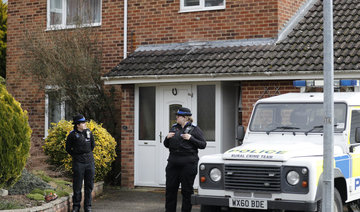
Police and forensics officers are focusing on three sites in Salisbury, a medieval city known for its towering cathedral, located 90 miles (145 kilometers) southwest of London. Rudd said the sites are Skripal’s home, a pub and a restaurant.
Skripal, a former colonel in Russia’s GRU military intelligence service, was convicted in 2006 of spying for Britain and imprisoned. He was freed in 2010 as part of a widely publicized spy swap in which the US agreed to hand over 10 members of a Russian sleeper cell found operating in America in return for four Russians convicted of spying for the West.
Those who knew him in Salisbury were shocked, describing him as friendly and outgoing — hardly a man hiding out.
The owner of a local convenience shop frequented by Skripal described him as one of her favorite customers. Ebru Ozturk said she made sure to stock the food he liked, particularly smoked bacon and Polish salami.
Ozturk, 41, painted an image of an educated man enjoying his retirement — fond of playing the lottery and chatting with the locals.
“Usually he plays lottery and scratch cards,” she said. “Plus a few weeks he was lucky as well and laughed about it.”


![]()
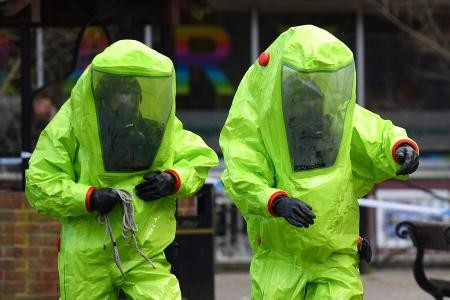
UK: Nerve agent attack on ex-spy was ‘brazen and reckless’
UK: Nerve agent attack on ex-spy was ‘brazen and reckless’

Latest updates


© 2026 SAUDI RESEARCH & PUBLISHING COMPANY, All Rights Reserved And subject to Terms of Use Agreement.