


UK police: Russian ex-spy was attacked with nerve gas, Moscow suspected

Photo showing Britain’s Home Secretary Amber Rudd arrives in Downing street Mar 6, 2018, for the weekly meeting of Cabinet. (AFP)
Updated 07 March 2018
Follow

UK police: Russian ex-spy was attacked with nerve gas, Moscow suspected

LONDON: Britain on Wednesday said it was sure that the Russian ex-spy was attacked with nerve gas, as Moscow accused politicians and journalists of whipping up anti-Russian sentiment. Earlier, 
Interior Minister Amber Rudd said police “know more about the substance” after chairing an emergency government meeting to discuss the case of Sergei Skripal, but did not release any details of what progress had been made.
She also called for “cool heads” over the poisoning, which is already being linked with Russia by British politicians and media.
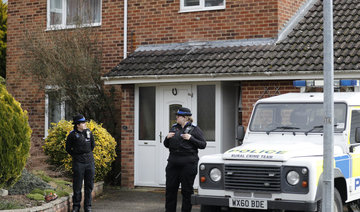
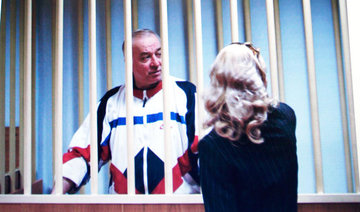
The 66-year-old Russian, who moved to Britain in a 2010 spy swap, is in a critical condition in hospital along with his daughter Yulia after they collapsed on a bench outside a shopping center in the southwestern English city of Salisbury on Sunday.
“We need to keep a cool head,” said Rudd, adding that investigators would respond to “evidence, not to rumor.”
Police say they are keeping an open mind about what happened, but Foreign Secretary Boris Johnson on Tuesday pointed the finger at Russia.
He noted the “echoes” with the 2006 poisoning in London of former Russian spy and Kremlin critic Alexander Litvinenko, which Britain has blamed on Moscow.
The Kremlin hit back on Wednesday, with foreign ministry spokeswoman Maria Zakharova telling reporters the story “was straight away used to boost an anti-Russian campaign in the media.”
Zakharova earlier said Johnson’s comments were “wild.”
National counter-terrorism police have taken control of the case, citing the “unusual circumstances,” and opened a new crime scene on Wednesday in the nearby town of Amesbury.
“The focus at this time is to establish what has caused these people to become critically ill,” said the head of the unit, assistant commissioner Mark Rowley.

Skripal and his 33-year-old daughter had lunch at a nearby restaurant before walking to the shopping center, where witnesses said they appeared “out of it.”
Experts said the circumstances appeared to rule out radiation poisoning, as in Litvinenko’s case.
“Radiation poisoning tends to take tens of hours to several days to show symptoms after exposure,” said Professor Malcolm Sperrin, a medical physics expert with the state-run National Health Service.
“This may have been chemical, but we can’t be sure.”
Some emergency services personnel who treated the pair required medical treatment, and The Sun tabloid reported that two police officers had itchy eyes, wheezing and rashes.
The BBC reported that without knowing the cause, the hospital treating Skripal and his daughter could only treat their symptoms, citing one source as saying that he “is not in a good way at all.”

Prime Minister Theresa May was updated on the case at a meeting of her national security council on Tuesday, but has declined to publicly comment on the ongoing investigation.
However, she confirmed the government might consider an official-level boycott of the 2018 football World Cup in Russia if it were found to have been involved.
“Depending on what comes out in relation to the investigation... it might be appropriate for the government to look at whether ministers and other dignitaries should attend the World Cup in Russia,” she said Wednesday.
The possible boycott — which would not include players — was first raised by Johnson on Tuesday, when he told MPs that he was not pointing fingers for Skripal’s collapse but made several references to Russia.
He warned Britain would respond “appropriately and robustly” if a government was found responsible.
Skripal was a former colonel in Russian military intelligence who was jailed in his country for betraying agents to Britain’s MI6 secret service.
He was pardoned before being flown to Britain as part of a high-profile spy swap involving Russia and the United States in 2010, and has kept a low profile since.
The Times newspaper reported that police would look into the 2012 death of Skripal’s wife from cancer, and that of his 44-year-old son last year in St. Petersburg, reportedly from liver problems.

Mystery of CIA’s lost nuclear device haunts Himalayan villagers 60 years on

Updated 56 min 44 sec ago
Follow

Mystery of CIA’s lost nuclear device haunts Himalayan villagers 60 years on

  • Plutonium-fueled spy system was meant to monitor China’s nuclear activity after 1964 atomic tests
  • Porter who took part in Nanda Devi mission warned family of ‘danger buried in snow’

NEW DELHI: Porters who helped American intelligence officers carry a nuclear spy system up the precarious slopes of Nanda Devi, India’s second-highest peak, returned home with stories that sent shockwaves through nearby villages, leaving many in fear that still holds six decades later.

A CIA team, working with India’s Intelligence Bureau, planned to install the device in the remote part of the Himalayas to monitor China, but a blizzard forced them to abandon the system before reaching the summit.

When they returned, the device was gone.

The spy system contained a large quantity of highly radioactive plutonium-238 — roughly a third of the amount used in the atomic bomb dropped by the US on the Japanese city of Nagasaki in the closing stages of the Second World War.

“The workers and porters who went with the CIA team in 1965 would tell the story of the nuclear device, and the villagers have been living in fear ever since,” said Narendra Rana from the Lata village near Nanda Devi’s peak.

His father, Dhan Singh Rana, was one of the porters who carried the device during the CIA’s mission in 1965.

“He told me there was a danger buried in the snow,” Rana said. “The villagers fear that as long as the device is buried in the snow, they are safe, but if it bursts, it will contaminate the air and water, and no one will be safe after that.”

During the Sino-Indian tensions in the 1960s, India cooperated with the US in surveillance after China conducted its first nuclear tests in 1964. The Nanda Devi mission was part of this cooperation and was classified for years. It only came under public scrutiny in 1978, when the story was broken by Outsider magazine.

The article caused an uproar in India, with lawmakers demanding the location of the nuclear device be revealed and calling for political accountability. The same year, then Prime Minister Morarji Desai set up a committee to assess whether nuclear material in the area near Nanda Devi could pollute the Ganges River, which originates there.

The Ganges is one of the world’s most crucial freshwater sources, with about 655 million people in India, Nepal, and Bangladesh depending on it for their essential needs.

The committee, chaired by prominent scientists, submitted its report a few months later, dismissing any cause for concerns, and establishing that even in the worst-case scenario of the device’s rupture, the river’s water would not be contaminated.

But for the villagers, the fear that the shell containing radioactive plutonium could break apart never goes away, and peace may only come once it is found.

Many believe the device, trapped within the glacier’s shifting ice, may have moved downhill over time.

Rana’s father told him that the device felt hot when it was carried, and he believed it might have melted its way into the glacier, remaining buried deep inside.

An imposing mass of rock and ice, Nanda Devi at 7,816 m is the second-highest mountain in India after Kangchenjunga. 

When a glacier near the mountain burst in 2021, claiming over 200 lives, scientists explained that the disaster was due to global warming, but in nearby villages the incident was initially blamed on a nuclear explosion.

“They feared the device had burst. Those rescuing people were afraid they might die from radiation,” Rana said. “If any noise is heard, if any smoke appears in the sky, we start fearing a leak from the nuclear device.”

The latent fear surfaces whenever natural disasters strike or media coverage puts the missing device back in the spotlight. Most recently, a New York Times article on the CIA mission’s 60th anniversary reignited the unease.

“The apprehensions are genuine. After 1965, Americans came twice to search for the device. The villagers accompanied them, but it could not be found, which remains a concern for the local community,” said Atul Soti, an environmentalist in Joshimath, Uttarakhand, about 50 km from Nanda Devi.

“People are worried. They have repeatedly sought answers from the government, but no clear response has been provided so far. Periodically, the villagers voice their concerns, and they need a definitive government statement on this issue.”

Despite repeated queries whenever media attention arises, Indian officials have not released detailed updates since the Desai-appointed committee submitted its findings.

“The government should issue a white paper to address people’s concerns. The white paper will make it clear about the status of the device, and whether leakage from the device could pollute the Ganges River,” Soti told Arab News.

“The government should be clear. If the government is not reacting, then it further reinforces the fear.”