

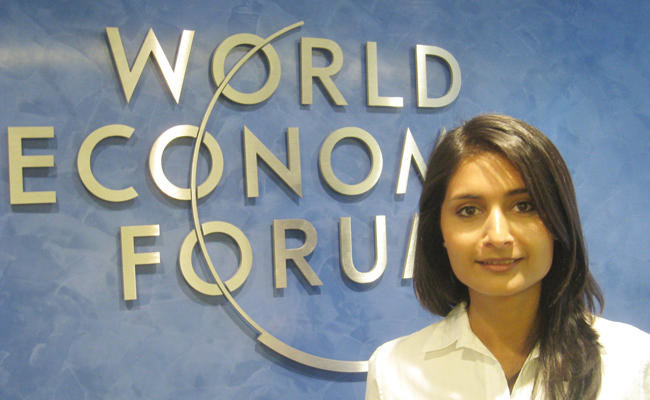
Working women across the Muslim world now at 155 million, says economist

Saadia Zahidi
Updated 08 March 2018
Follow

Working women across the Muslim world now at 155 million, says economist

DUBAI: An incredible increase in female employment in the Muslim world during the past 15 years means that there are now more women working in the region than in the US or EU.

“Just after the turn of the millennium, across the largest emerging markets of the Muslim world 100 million women were working,” said economist Saadia Zahidi, head of education, gender and work, and a member of the executive committee at the World Economic Forum. “Today, that number is 155 million, more than a 50 percent increase in just a decade and a half.”

Speaking exclusively to Arab News ahead of International Women’s Day, Zahidi told how her book, “Fifty Million Rising,” published in January 2018, sheds light on this change in employment patterns through the stories of some of the Muslim women playing crucial roles in their economies.

However, the Western world might continue to view and stereotype Muslim women. She points out that their combined income now ranks them as a major economic force.

“My book is about this remarkable rising of an additional 50 million working women across the Muslim world, focused in particular on 30 economies including many in the Arab world as well as Pakistan, Iran, Turkey, Kazakhstan, Indonesia and Malaysia,” said Zahidi.

“The combined income of the 155 million working women across the Muslim world is nearly $1 trillion, making them the 16th largest economy in the world. As consumers, employees, employers, entrepreneurs and taxpayers, they are a newfound economic power and this in turn is changing both the economy and society in their countries.”

The quality and availability of education for women in Saudi Arabia is much better than many other countries, Zahidi pointed out.

“Half of all university-age women in Saudi Arabia attend university,” she said. “This proportion is more than in Brazil, India and China and is a unique education success story. The potential of this talent
is unparalleled and, if unleashed, it can contribute to the goals of Vision 2030 and the diversification of the economy.

“The changes in regulations around driving and being able to register a business are a good start. More must be done to ensure that women can fully integrate their skills into the economy through employment and entrepreneurship.”

A lack of role models remains a hurdle for many young Arab women but change is happening regardless.

“For many young women who are joining the workforce today there are no working women in their mothers’ and grandmothers’ generations, said Zahidi. “A lack of positive role models is often a drawback.

“However, the positive is that young women in the Muslim world today believe nothing can hold them back. They are trailblazers themselves and therefore extremely skillful negotiators in carving new roles for themselves, setting a new standard in the society around them and inspiring a new generation.”
Two high-speed trains derail in Spain, police sources say 21 people killed

Updated 19 January 2026
Follow

Two high-speed trains derail in Spain, police sources say 21 people killed

  • The accident happened near Adamuz, in Cordoba province. So far, 21 people ​have been confirmed dead by police

MADRID: A high-speed train derailed and smashed into another oncoming train in southern Spain on Sunday, pushing the second train off the tracks in a collision that police sources confirmed to Reuters had killed at least 21 people.
The accident happened near Adamuz, in Cordoba province. So far, 21 people ​have been confirmed dead by police, with state broadcaster Television Espanola adding that 100 people had been injured, 25 seriously. The driver of one of the trains, which was traveling from Madrid to Huelva, was among those who died, the TV station added.
“The Iryo 6189 Malaga — (to Madrid) train has derailed from the track at Adamuz, crashing onto the adjacent track. The (Madrid) to Huelva train which was traveling on the adjacent track has also derailed,” said Adif, which runs the rail network, in a social media post.
Adif said the accident happened at 6:40 p.m. (1740 GMT), about 10 minutes after the Iryo train left Cordoba heading toward Madrid.
Iryo is a private rail operator, majority-owned by Italian state-controlled railway group Ferrovie dello Stato. The train involved was a Freccia 1000 train which was traveling between ‌Malaga and Madrid, ‌a spokesperson for Ferrovie dello Stato said.
The company said in a statement that it ‌deeply ⁠regretted what ​had happened ‌and had activated all emergency protocols to work closely with the relevant authorities to manage the situation.
The second train was operated by Renfe, which also did not respond to a request for comment.
Adif has suspended all rail services between Madrid and Andalusia.

HORRIFIC SCENE
The Iryo train had more than 300 passengers on board, while the Renfe train had around 100.
Paco Carmona, Cordoba fire chief, told TVE the first train heading to Madrid from Malaga had been evacuated.
The other train’s carriages were badly damaged, he said, with twisted metal and seats. “There are still people trapped. We don’t know how many people have died and the operation is concentrating on getting people out of areas which are very narrow,” he ⁠said. “We have to remove the bodies to reach anyone who is still alive. It is proving to be a complicated task.”
Transport Minister Oscar Puente said he was following events ‌from rail operator Adif’s headquarters in Madrid.
“The latest information is very serious,” ‍he posted on X. “The impact was terrible, causing the first two ‍carriages of the Renfe train to be thrown off the track. The number of victims cannot be confirmed at this time. ‍The most important thing now is to help the victims.”
The mayor of Adamuz, Rafael Moreno, told El Pais newspaper that he had been among the first to arrive at the scene of the accident alongside the local police and saw what he believed to be a badly lacerated body several meters from the accident site.
“The scene is horrific,” he said. “I don’t think they were on the same track, but it’s not clear. Now ​the mayors and residents of the area are focused on helping the passengers.”

CALLS FOR MEDICS
Images on local television showed a reception center set up for passengers in the town of Adamuz, population 5,000, with locals coming ⁠and going with food and blankets amid nighttime temperatures of around 42 degrees Fahrenheit (6 degrees Celsius).
A woman named Carmen posted on X that she had been on board the Iryo train to Madrid. “Ten minutes after departing (from Cordoba) the train started to shake a lot, and it derailed from coach 6 behind us. The lights went out.”
Footage posted by another Iryo train passenger, also on X, showed an Iryo staffer in a fluorescent jacket instructing passengers to remain in their seats in the darkened carriages, and those with first aid training to keep watch over fellow passengers. He also urged people to maintain mobile phone batteries to be able to use their torches when they disembarked.
Salvador Jimenez, a journalist for RTVE who was on board the Iryo train, shared images showing the nose of the rear carriage of the train lying on its side, with evacuated passengers sitting on the side of the carriage facing upwards.
Jimenez told TVE by phone from beside the stricken trains that passengers had used emergency hammers to smash the windows and climb out, and they had seen two people taken ‌out of the overturned carriages on stretchers.
“There’s a certain uncertainty about when we’ll get to Madrid, where we’ll spend the night, we’ve had no message from the train company yet,” he said. “It’s very cold but here we are.”