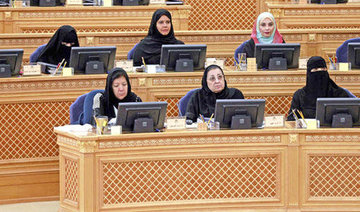
Time for Saudi women to be more vocal about their rights

Dima Talal Al-Sharif, a Saudi lawyer at the Law Firm of Majed Garoub.
Updated 08 March 2018
Follow

Time for Saudi women to be more vocal about their rights

JEDDAH: Often classified as oppressed, persecuted and crushed by the ultra-conservative, male-dominant society, Saudi women must take a stand against the misconceptions and false stereotypes many have of them.
Times have changed in the Kingdom, and Saudi women are gaining more and more rights — something much of the world is still ignorant about.
Many people around the world have been fed wrong ideas about Saudi Arabia’s 32 million population, of which nearly half are women, according to a Step Feed report citing the Saudi General Authority for Statistics.
Women in the Kingdom can and do open their own bank accounts without the need for a male guardian’s permission, contrary to several false reports by renowned media outlets.
Women do have the authority over their own bodies and health as elective surgeries or medical treatments can be freely sought without permission from a male guardian.
“The Law of Practicing Healthcare Professions in Saudi Arabia states in article 19 that the competent patient has the right to decide on the surgery, it means that it applies for both genders,” Dima Talal Al-Sharif, a lawyer at the Law Firm of Majed Garoub in Jeddah, told Arab News.
Since the historical royal decree on September 26 last year allowing women to drive, obtaining a driver’s license does not require a guardian’s consent. “Saudi women are allowed to get a driver's license without permission from a legal guardian,” said Al-Sharif.
Since 2006, Saudi women have been able to apply for their own personal identification cards too, she added.
“As per the King’s instructions, Saudi women will be allowed to issue and renew their own passports without the guardian's permission very soon, in addition to studying abroad and traveling without their guardian's permission,” according to Al-Sharif.
“Some Saudi families allow their daughters to travel abroad without a male companion, be it for tourism or treatment,” said Riham Al-Saadi, 27, a Saudi national who has traveled to several countries without her male guardians. Al-Sharif agreed, saying that some Saudi families allow their daughters to travel alone through the electronic travel permission.
Saudi female lawyers can also plead in Saudi courtrooms, a change that came about after 2013 when the first female trainee advocate was registered, achieving a significant victory for women who were subsequently allowed to practice as lawyers.
Jeddah-based attorney Bayan Zahran became the first Saudi woman to open a law firm in January 2014.
Al-Sharif also pointed out that women have the right to issue a power of attorney by themselves.
Women are also allowed to start their own businesses without the need for a male guardian’s permission, be it a husband, father, brother or even son, explained the lawyer citing the Ministry of Commerce and Investment.
As for renting apartments and cars, Al-Sharif said, “King Salman ordered all women’s procedures to be facilitated since having their own national ID. So she has the right to rent an apartment or even a car. However, most rental offices ignore this and never apply it and require a male guardian’s [permission].”
Applying for a job is another basic right that Saudi women enjoy without the interference of a male guardian.
Claiming that women cannot mix with the opposite gender is not entirely true. While it applies in some workplaces, men and women do interact in public place like malls, restaurants and universities, where female students in Saudi universities have male instructors in classes.
Saudi courts sometimes also grant mothers custody of their children in cases where the father is found ineligible, Al-Sharif added.
Wearing a full-length black abaya is not mandatory in the country either. Women still can wear colorful robes without headscarves in some big cities like Jeddah and Riyadh. Medicine students and nurses publicly move around the hospital grounds wearing a white lab coat.
Al-Saadi said one of the biggest misconceptions she has heard about Saudi women is that they are not allowed to leave the house and they only “cook and obey men”.
“This is very wrong. Thankfully, we are living our lives to the fullest, and all these wrong ideas about us do not exist on the ground.”
A documentary about women in Saudi Arabia would be a good way to educate people, she suggested. “A documentary that shows our lives, how we are happily living. I think this is the fastest way to correct the misconceptions about us.”
Al-Sharif, the lawyer, believes that some of the misconceptions come from women's own lack of awareness of their rights.
In July 2016, an app called “Know Your Rights” was launched by Saudi lawyer Nasreen Alissa, to help spread awareness among her peers.The media plays a major role in marketing inaccurate information and claims too, said Al-Sharif.
“The solution to raise women’s awareness of their rights can be the media itself, through the proper coverage of women's empowerment and the correction of the inaccurate information.”
Her advice to Saudi women is to be more vocal about their rights.
“As a Saudi woman, it’s your turn now to look for rights and to make sure that such rights are known and applied.”


The secret keepers of desert balance in Saudi Arabia

Updated 27 December 2025
Follow

The secret keepers of desert balance in Saudi Arabia

  • How the Kingdom’s wildcats control pests, protect public health, and sustain the ecosystem

RIYADH: During the summer of 2024, two desert lynx kittens were born in Taif as part of Saudi Arabia’s efforts to protect and increase the population of caracals in the country.

Although caracals are critically endangered, wildcats in general play a significant ecological role in the Kingdom. They act as natural pest control, and Saudi Arabia is committed to conserving these species while increasing their populations to support a thriving ecosystem.

Despite the Kingdom’s harsh, arid climate, conditions are suitable for wildcats not only to survive but also to flourish. Among the terrestrial species inhabiting Saudi Arabia are sand cats, Arabian wildcats, and the desert lynx.

Felis margarita, or sand cats, are small — around 40-60 cm — with pale sandy fur that allows them to blend into the desert. They have a broad head, large ears, and long hair on the bottom of their feet to walk on hot sand.

Sand cats have long hair on the bottom of their feet, allowing them to walk on hot sand and prevent them from sinking into the sand. (SPA/Visitsaudi)

“It is small in size and does not mate with other cats. It is the only cat species in the world with hair on the soles of its feet instead of skin to prevent it from sinking into the sand,” said Obaid Alouni, a Saudi environmentalist.

Alouni explained that one defensive technique sand cats use is to lie flat on the ground to avoid detection.
“It lies flat on the ground when it senses danger to avoid being noticed by other animals.”

These cats primarily feed on rodents and small reptiles, occasionally large insects, obtaining their water from their prey. Sand cats are native to West Asia and help regulate rodent and insect populations, preventing outbreaks and reducing disease spread.

Opinion

This section contains relevant reference points, placed in (Opinion field)

Interestingly, raising sand cats as domestic pets is becoming more popular, Alouni said. But he emphasized that adoption is easier when they are kittens, as they remain wild animals. Although widely distributed across the Kingdom, exact population numbers are difficult to determine due to their elusive nature. They are currently listed as “least concern” by the International Union for Conservation of Nature.

Similar to sand cats, Arabian wildcats (Felis lybica) are found across the Arabian Peninsula and play a vital role in environmental health.

“They are wild cats that live independently without human intervention,” Alouni told Arab News.

An Arabian wildcat at Olomouc Zoo in the Czech Republic. (Wikimedia Commons: Michal Maňas)

Arabian wildcats resemble domestic cats but have thicker, sandy to grey-brown coats with faint stripes or spots and ringed tails with blunt tips. Like sand cats, they feed on rodents, birds, reptiles, and insects and are listed as “least concern” by the IUCN.

However, Alouni warned that pure populations of Arabian wildcats in Saudi Arabia could be threatened by hybridization with domestic cats.

“Currently, wild cats face the problem of interbreeding with domestic cats. This weakens their immune systems and makes them more susceptible to diseases from other cats,” he said.

“This contributes to the extinction of the purebred lineage and, consequently, the disappearance of their wild instincts,” he added.

DID YOU KNOW?

• Sand cats are the only cat species with hair on the soles of their feet, allowing them to walk on hot sand without sinking.

• Caracals, locally known as Al-Washaq, are native and endangered, capable of jumping 3 to 4 meters in a single leap.

• Pure populations of the Arabian wildcat are at risk due to hybridization with domestic cats.

While both species are desert dwellers, sand cats are harder to spot as they avoid heavily trafficked areas. They are mainly found in the Ad Dahna desert and the Empty Quarter, where sand dunes dominate the landscape. Arabian wildcats, however, inhabit rocky or mountainous areas such as the Tuwaiq Mountains, valleys, and farms with abundant small prey.

“Wild cats come around towns and villages, and unfortunately, begin mating with domesticated cats that people release outside,” Alouni explained. He stressed the importance of keeping domestic cats away from wildcat habitats, including deserts and camping sites.

The third wildcat species native to Saudi Arabia, the caracal or desert lynx, is critically endangered. “The lynx is classified in size between large and small, and is distinguished by its jump, which can reach 3 meters or even 4 meters in the sky,” Alouni described.

This combination of photos released by the Saudi National Center for Wildlife (NCW) last year shows a female Caracal and its cub at the Prince Saud Al-Faisal Wildlife Research Center in Taif. (SPA file)

Locally known as Al-Washaq, desert lynx have reddish-tan coats, long legs, and black-tufted ears. They feed on birds, rodents, and sometimes small antelopes. Thankfully, these cats are protected under Saudi law due to their critically endangered status.

Hunting any sand cats, Arabian wildcats, or desert lynx can result in fines of approximately $20,000, according to the Saudi Ministry of Environment, Water, and Agriculture.
“There is a very severe financial penalty in Saudi Arabia for anyone who hunts it,” Alouni added.

The Kingdom has strict regulations to protect endangered animals, criminalizing not only hunting or killing but also trade. Violators could face penalties of up to $8 million, up to 10 years in prison, or both.

Overall, sand cats, Al-Washaq, and Arabian wildcats are essential to maintaining a healthy environment in Saudi Arabia. By controlling rodent populations, they help prevent outbreaks that could threaten agriculture and public health.