LONDON: Female empowerment and women’s status in society are increasingly hot topics on the streets and in headlines alike — issues the Middle East’s rising ranks of contemporary artists have long been wrestling with behind cloistered gallery walls. Digging deeper, and more articulately, than many of her contemporaries, Farah Salem’s multidisciplinary work examines not just the pervading cultural pressures, but also the self-imposed mental barriers that often paralyze women from realizing their potential.
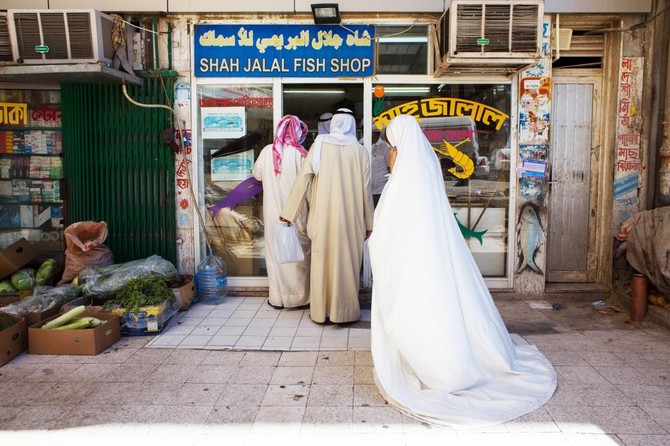
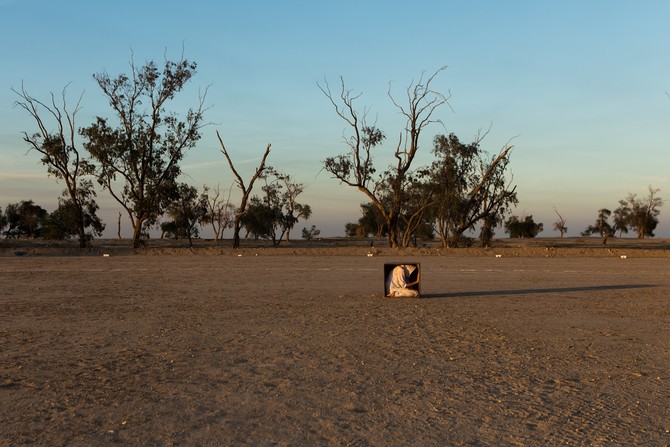
Last year, the young Kuwaiti talent beat close to 1,000 competitors from 84 countries to be named Laureate winner of the International Women Photographers Award 2017 for her work “Cornered” — a series of 10 photographs, each depicting a woman awkwardly bent inside a cardboard box in a striking variety of locations.
“It’s about how we choose to live, uncomfortably folded up in our box, because we’re too scared to leave our comfort zone,” says Salem. “But, outside, there is actually this wonderful nowhere, and it’s so easy to stand up and explore these beautiful spaces and landscapes.”
Salem is quick to point out that, while the subject is a headscarf-clad woman, the work can relate to anyone suffocated by their own self-imposed ideologies about gender, race or class.
Yet the traditional female clothing of the Arab world remains a recurring theme in the artist’s work. In “Disclosed,” another performance photography piece she dubs “gender soft-texture architecture,” Salem captures her subject garbed in ornate, self-designed abayas, confidently striding across an array of colorful landscapes. Last year’s sculptural “Crown of Your Head” depicts a model wearing a fiber pulp headpiece inspired by the headscarf.
Meanwhile, in “The Dove,” Salem turns convention on its head, presenting images of a woman in a white abaya — a symbol of purity and sanctuary — freed from the societal shackles of convention and expectation; or, as Salem puts it, “freeing the dove.”
Fittingly, the boxed subject of “Cornered” is Salem herself. The work takes cues from the artist’s personal experience of breaking down her own mental barriers when realizing her biggest project to date, “In-Between the Skyline of Kuwait City.” The result of more than five years’ labor, this photography series offers an unflinching portrait of her home city, deeply probing into the less glamorous multicultural communities few visitors, or even prosperous residents, ever see.
“I was an 18-year-old undergrad student and I had all these dreams about traveling alone, exploring different cultures and countries, finding a space where I could express myself freely, which I didn’t find in society — but all I had was my car and my camera,” remembers Salem, now aged 26.
“So I started to pretend I was a stranger in my own city, going on adventures, walking alone on the backstreets, getting lost, having these moments — these stolen frames. It was an interesting experience being a local woman on my own in those places. Back then it was kind of strange, it was breaking boundaries.”
In 2016, the mammoth personal project was realized as both a published photo book, supported by Kuwait’s National Council for Culture, Art and Letters, and a touring solo exhibition, accompanied with a sound installation of ambient noises catching the city’s vibrant backstreet thrum. The project’s steady evolution mirrored the artistic and personal development of its author.
“As a creative person, my thoughts are always flowing around everywhere, and the dynamic meditation of being able to follow them while walking, and having that camera. The experience of capturing an image was like also capturing my thoughts at that place, at that time, being a woman in that city,” she says.
“I felt like I was more at home than ever — I never felt at home walking around malls. It felt safer to me to be on the streets. I met so many wise old people who have lived there for years and know so much history about the city.”
Salem is speaking from her current home in the United States, where she is midway through a Masters in Art Therapy and Counselling at the School of the Art Institute of Chicago. Inspired by a desire to direct her creative impulses into an altruistic calling, Salem’s studies are channelled through a social justice model examining systems of opposition, viewed through the flashpoints of race and gender: Two topics often reflected in her work.
The fixation on gender identity and empowerment was solidified for Salem at any early age, the natural consequence of growing up with two brothers and noticing the differing freedoms, expectations and opportunities. “I’ve always been a little bit of a feminist warrior, because I didn’t think it was fair. Just because I was a woman and my society didn’t approve of these things, things that to me that were a basic human right,” says Salem
When I ask at what age she first encountered these glass ceilings, Salem laughs. “Since I was born — it was always there,” she adds. “At first, they joke about it, it’s cute you’re a female. At some point, the more you grow up, the more realistic it becomes.”
Art gave Salem her platform to address the injustices she felt on a public canvas. After taking painting classes and experimenting with photography in her early teens, her voice developed with her first major performance piece, which wore its intent in the title “Society Projections.”
Staged as a 40-day residency at Kuwait’s Contemporary Art Platform in 2014, the work begins with a newlywed woman named Lulwa — played by Salem and dressed all in white — inviting the assembled audience into her “home,” a blank gallery space decorated with outre “white on white” art. Slowly mounting pressures — a kitchen, chores, a family — are projected onto the wall behind. The piece closes with the adage “a woman’s place is her home” beamed directly on to Salem’s form, before the artist hurriedly gets up and walks away.
“The white is a metaphor of being this pure, well-put-together female that society expects from women, but also a metaphor for blending. The woman becomes a screen for whatever society wants to project onto her,” says Salem. “Having a choice, decision-making, for me that’s what signifies freedom. Often women don’t have any other choice than to follow what is expected.
“My statement in the piece is very clear — I left the room.”


![]()
![]()
![]()
Thinking outside the box with award-winning photographer Farah Salem

Thinking outside the box with award-winning photographer Farah Salem

Latest updates


© 2026 SAUDI RESEARCH & PUBLISHING COMPANY, All Rights Reserved And subject to Terms of Use Agreement.