Saudis develop heart disease 10 years younger than global average

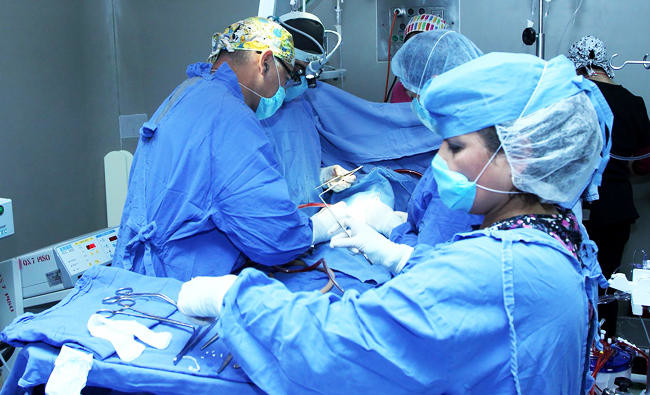
Handout photo released by the Mexican Social Security Institute (IMSS in Spanish) press office showing doctor David Arellano (L) conducting a surgery at the La Raza hospital in Mexico City, on September 14, 2017. (AFP)
Updated 06 March 2018
Follow

Saudis develop heart disease 10 years younger than global average

RIYADH: The average age for developing heart disease in the Kingdom is 56, 10 years younger than the global average, the president of the Saudi Heart Association (SHA) said in an address to its 29th annual conference.
“The number of men and women suffering from heart disease is equal… though men used to have the largest share of the disease,” the Saudi Press Agency (SPA) quoted Dr. Hussam Al-Faleh as saying. He stressed the importance of exercising and healthy eating.
During the conference, a new treatment approved by the American Medical Association and the Saudi Food and Drug Authority was introduced.
“This treatment will effectively reduce cholesterol by 60 percent,” Al-Faleh said. He cited Khalaf Al-Balawi, a 79-year-old Saudi who ran a 21-km half marathon, as an example of the importance of exercise. Al-Balawi thanked the SHA for inviting him to the conference and honoring him.
Dr. Mohammed Balghith said 60 percent of patients with heart disease suffer type 2 diabetes due to lack of activity, excessive fat intake and smoking.
The chairman of the Department of Cardiology at the Houston Methodist DeBakey Heart and Vascular Center, Dr. William Zogby, said Saudi cardiologists are among the best because they graduate from the world’s top universities and train at leading hospitals.
“The most common challenge faced by Saudi cardiologists is that their patients are not interested in exercising,” he added, stressing the importance of keeping in check one’s blood pressure, blood sugar and cholesterol.
At the end of the conference, the SHA announced the winners of scientific research awards worth more than SR250,000 ($66,665).
Dr. Walid Al-Jawhar, Dr. Owaid Al-Shammari and Dr. Fatima Massoudi received the Prof. Mohammad Al-Faqih Annual Award.
Dr. Fatima Sharafuddin received the Dr. Zuhair Al-Hallis Annual Prize, and Dr. Mohammed Mahamoud Nassif received the Dr. Wael Al-Mohaimeed Prize.


Musaned confirms mandatory salary transfers for domestic workers via official channels

Updated 12 sec ago
Follow

Musaned confirms mandatory salary transfers for domestic workers via official channels

  • Move aims to protect wage-related rights, enhance transparency

RIYADH: All employers in Saudi Arabia have been informed they must transfer domestic workers’ salaries through official channels, starting from Jan. 1, 2026.

The move, confirmed through Musaned platform’s X account, aims to protect wage-related rights, enhance transparency and simplify employer-worker relationships.

The electronic payment service provided through Musaned will use approved digital wallets and participating banks to ensure reliability, security and consistency in wage transfers.

Ministry spokesperson Mohammed Al-Rizgi told Arab News that the move “comes as part of the ministry’s efforts to develop the domestic labor sector and strengthen the rights of both employers and domestic workers.”

Lawyer Majed Garoub told Arab News that the new regulation would help tackle persistent issues in employer-worker relationships, especially disputes over unpaid wages.

He said: “This regulation will significantly help resolve many problems that arise when domestic workers leave the country without proper verification of receiving their full rights.”

Garoub explained that informal salary payments were common in the past, often made without proper documentation or signatures.

This, he added, made it challenging for Saudi employers to prove they had paid all wages if workers later filed claims after returning to their home countries.

The new regulation, which has been rolled out in stages, began with domestic workers newly arriving in the Kingdom on July 1, 2024.

It was then extended to employers with four or more domestic workers in January 2025, followed by those employing three or more by July 2025.

The latest stage, which took effect on Oct. 1, applies to employers with two or more domestic workers. This phased approach has ensured a smooth adoption of the system for all employers.

Garoub said the regulation would bring broader legal and security benefits. He explained that informal salary payments had, at times, enabled illegal practices.

He added: “Workers might have falsely claimed unpaid wages or engaged in activities outside their employment.”

Such funds, he added, could even have contributed to crimes like money laundering or the financing of terrorism.

He said: “By mandating official payment channels, this regulation protects the Saudi economy, national security, and international financial systems.”

The Musaned platform offers significant advantages for both employers and workers. Employers gain a reliable salary verification mechanism that simplifies end-of-contract and travel-related procedures, while workers benefit from consistent, secure and timely payments.

The system also allows domestic workers to transfer their earnings to family members abroad through trusted channels.

For those who prefer cash withdrawals, a Mada card will be issued for secure and convenient access to salaries.

According to Musaned, salary transfers for workers covered under the Wage Protection System must be made through authorized channels.

This regulatory change marks a significant step forward in protecting the rights of domestic workers, ensuring transparency in employer-employee relationships, and bolstering the Kingdom’s economic and security interests.