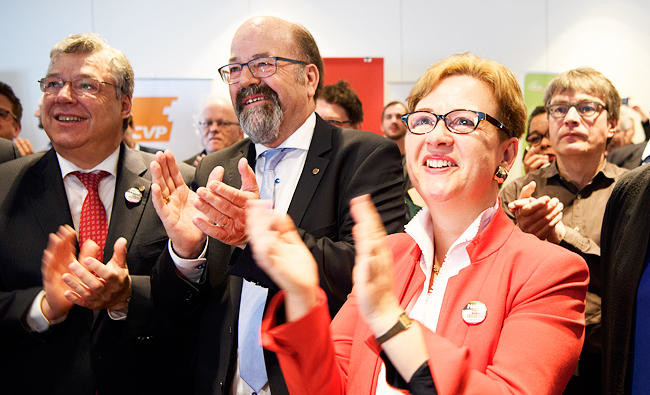
ZURICH: Swiss citizens clearly rejected an attempt to abolish fees for state radio and TV in a referendum vote on Sunday seen as protecting public service broadcasting in the country.
Had the proposal passed, Switzerland would have been the first European country to abolish mandatory license fees for its public service broadcaster.
Nearly 72 percent voted against the proposal to scrap the so-called Billag fees in a referendum under Switzerland’s system of direct democracy.
Every household pays a 451 Swiss franc ($480.8) annual charge to fund Swiss public broadcasters. Their budgets faced being cut by three quarters if the vote had been successful.
Communications minister Doris Leuthard said she was pleased Swiss voters had shown they were prepared to pay a fee for public services and did not want purely commercial broadcasting.
The Swiss government had opposed the proposal, saying it threatened media diversity and would damage political debate in the country of 8.4 million people divided into four different language groups.
“Radio and television in Switzerland should also in the future contribute to education, cultural development, forming opinions as well as entertainment,” she told a news conference. “I am pleased that media diversity has been maintained.”
Broadcasters should continue to serve all Swiss, Leuthard added.
Opponents had said abolishing the fee would lead to reduced independence for broadcasters and undermine services for Switzerland’s four different linguistic regions.
Campaigners against the fee had argued that state broadcaster SRG was too large and must save money. They also said that charging fees had become outmoded, especially in an era of streaming services such as Netflix.
“At present we have a near monopoly with a state-controlled broadcasting company. But by cutting down the subsidy it receives, a freer market for the media will exist in Switzerland,” said Florian Maier, secretary general of the No Billag campaign.
In a second vote on Sunday, 84.1 percent of voters approved extending the government’s right to levy income and sales taxes to 2035.
Unlike other countries, Switzerland gives the central government the right to raise taxes only for a limited time, with the current arrangement due to finish at the end of 2020.
($1 = 0.9380 Swiss francs)

Switzerland vote to retain license fee for state broadcaster
Semafor targets Gulf expansion after first profitable year
- Digital news brand generates $2m in earnings on $40m of revenue in 2025, and raises $30m in new financing
- Platform aims to be the ‘business and financial news brand of record for the Gulf,’ CEO says, and to ‘blanket the world’ within 2 years
DUBAI: Digital news platform Semafor generated $2 million in earnings in 2025 before interest, taxes, depreciation and amortization, on revenue of $40 million, marking its first year of profitability.
It also closed $30 million in new financing, which it plans to use to grow its editorial operations and live events business.
These achievements are particularly notable at a time when the global news industry is facing declining revenues and the erosion of audience trust, the company said.
Justin B. Smith, the company’s co-founder and CEO, told Arab News that Semafor’s model and approach is distinguished by several factors, which can be encapsulated by its vision of building a news product to “serve consumers that are increasingly not trusting news, but also designed with a business model that could deliver sustainable economic advantage.”
Following its first profitable year and armed with new funding, Semafor, founded in 2022, now plans an accelerated phase of global expansion with a focus on scaling editorial output and global convenings.
The company said it will broaden its publication schedule in the year ahead. Semafor Gulf and Semafor Business will become daily publications as the platform increases the frequency of its “first-read” services, which are daily briefings designed to showcase “front page” news and intended to serve as the “first read” for audiences, Smith said.
The Gulf edition of Semafor launched in September 2024, with former Dow Jones reporter Mohammed Sergie as editor. In 2025 Matthew Martin was appointed its Saudi Arabia bureau chief.
Semafor’s brand slogan is “intelligence for the new world economy” and “the Gulf is the epicenter of the new world economy,” Smith said. Currently, its Gulf operation employs eight journalists, based in the UAE and Saudi Arabia, and as it moves to a daily publishing schedule it plans to significantly bolster its editorial team, both in existing markets and new ones, such as Qatar.
Semafor is “obsessed with the business, financial and economic story” in the region and aims to become “the business and financial news brand of record for the Gulf,” Smith said.
In the US, Semafor DC, currently published daily, will move to a twice-a-day format in March. In addition, the company’s flagship annual Semafor World Economy platform in Washington will expand this year from a three-day event to five days, with extended programming. The event, in April, is expected to attract more than 400 global CEOs, more than double the number that took part in 2025.
In addition to the US and the Gulf, Semafor currently operates in Africa. It held its first event in the Gulf region last month, during Abu Dhabi Finance Week, and said it is now looking to grow its events footprint across the Gulf, and into Asia. It will launch a China edition next month, its first foray into Asia, and plans to launch in Europe in 2027, followed eventually by Latin America.
Within the next two years, Semafor aims to have “blanketed the whole world” and become a mature, global intelligence and news brand competing with the “greatest legacy business and financial news brands in the world,” Smith said.
“Our goal is to become the leading global intelligence and news company for the world, founded on independent, high-quality content and convenings,” he added.