DURBAN: When it comes to Test cricket in the modern era, it does not get much better than South Africa against Australia.
In the quarter of a century since the Proteas were readmitted to the international fold, the two teams have clashed in some epic games, in a rivalry that has been both engrossing and bizarre. But judging by attendance figures for the first Test in Durban, you would not know it.
Kingsmead holds 18,000 spectators, and was heaving just over a month ago when Virat Kohli’s Indian side won the first of six ODIs against the hosts. But, for the first day of this eagerly anticipated series – among Test-lovers around the world, at any rate – only 3,957 made it through the turnstiles. It was little better on Friday, when Australia wrested back control of the game in front of just 4,865. Student tickets were priced at 60 South African rand ($5), and with the cheapest adult ticket costing just 100 rand, the price of admission clearly was not the issue.
Things did not improve much on the Saturday either, with Kings Park, across town, hosting a Super Rugby game featuring the hometown Sharks. TV crews are usually instructed to keep the cameras away from the empty seats. But at Kingsmead, it was impossible to avoid the vast swaths of abandoned seating.
Before we start writing any obituaries for Test cricket, it is worth remembering that the five recent Tests in an utterly one-sided Ashes series in Australia attracted close to a million fans, with nearly 200,000 making it to the pink-ball Test in Adelaide. Tests in England, at least against Australia and India, are regularly played in front of full houses, despite often extortionate ticket prices. And when India introduced a clutch of new Test venues in the 2016-17 home season, Indore led the way with packed stands.
Any soapbox hectoring of cricket fans should also take into account the strained economic situation across the world. Unless matches are played in the holiday season, as they always tend to be in Australia, most folk just cannot manage to take that much time off work. The worry, though, is that the authorities are not doing nearly enough to put spectators first when it comes to the five-day format.
Recently, a passionate cricket fan now based in California spoke to this columnist about the absurdity of light meters — when many grounds have floodlights — and players going off for the lightest drizzle. He contrasted that with NFL teams battling it out in Green Bay’s frozen tundra in December and January. It was not the best comparison, but you could understand his angst.
Former England captain Michael Vaughan wrote in his latest Telegraph column about having four-day Tests and off-field entertainment similar to T20 matches. He even mentioned awarding fans money for taking catches in the stands as well as having a ballot process at poorly attended matches where people could register for free tickets for the third and fourth days, enabling cricket boards to get hold of valuable consumer data. He demanded entry to four-day domestic games be offered to fans for free by getting it underwritten by a sponsor. “Breathe life into it because it is worth saving,” he said.
Those are all suggestions worth trying, but first we have to ask how committed administrators outside England and Australia are about the oldest form of the game. During the Indian Premier League (IPL) season, advertising billboards across the cities hosting the eight franchises feature marquee players. Even a cricket novice would know that something was going on if he or she landed up in such a city.
I have seen the same level of publicity and promotion even when the IPL was moved to South Africa for the 2009 season. At Centurion, with its family-friendly grass banks, it was possible for a family of four to watch a double-header for around 400 Rand. And when they turned up for the game, there would be volunteers giving away franchise merchandise to those that wanted it.
Such initiatives cost money, but the IPL and Lalit Modi, who ran it at the time, understood that they were necessary to bring in the fans thousands of miles from home. In sharp contrast, you could spend days in Indian cities like Nagpur and Chandigarh without having a clue that there was a Test match on. Forget billboards, there would not even be flyers advertising the game.
The sad thing about falling attendances is that Test cricket is a far better spectacle now than it was in the past. Durban, where Australia are poised to win resoundingly, has seen exceptional batting from the Marsh brothers, Steven Smith, AB de Villiers and Aiden Markram. There has been quality pace bowling from both sides, and Nathan Lyon and Keshav Maharaj have delivered probing spells of spin.
This should be a golden age for Test cricket. But for that to be the case, those entrusted with bringing in the crowds need to care.


![]()
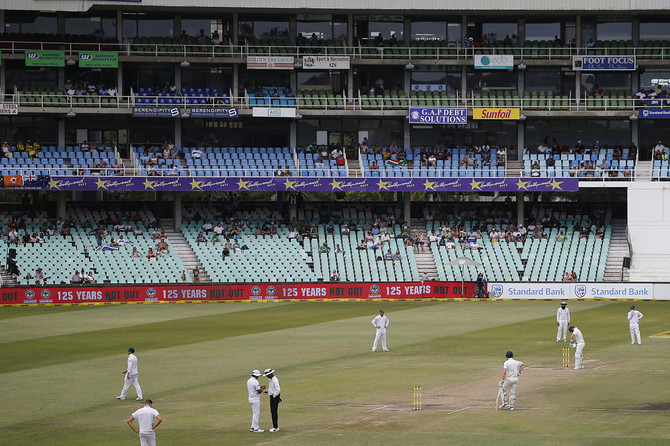
Low crowds at South Africa v. Australia Test raises yet more concerns for the game
Low crowds at South Africa v. Australia Test raises yet more concerns for the game
Latest updates





© 2026 SAUDI RESEARCH & PUBLISHING COMPANY, All Rights Reserved And subject to Terms of Use Agreement.