WASHINGTON DC: US President Donald Trump yesterday welcomed the prospect of a trade war with other countries, remaining defiant in the face of the global uproar sparked by his sudden announcement of steel and aluminum tariffs.
With global stock markets tumbling and allies indignant, the president responded to the negative reaction by raising the stakes and vowing even more sweeping trade steps.
In a blistering series of morning tweets, he said he would impose “reciprocal taxes” on all imports from trading partners that have duties on American exports.
Such a move would expand the administration’s confrontational “America First” trade policy far beyond the hefty steel and aluminum tariffs he announced on Thursday — which come despite strenuous objections from stunned advisers and powerful industry groups.
The wide-ranging actions, if imposed, would eviscerate the rules-based global trading system and drastically raise the chances of a trade war.
But in an early morning tweet Trump seemed to welcome the prospect, saying trade wars were “good and easy to win.”
“Example, when we are down $100 billion with a certain country and they get cute, don’t trade anymore-we win big. It’s easy!”
Allowing imports into the US market duty free when similar exports face tariffs is “not fair or smart,” Trump said on Twitter.
“We will soon be starting RECIPROCAL TAXES so that we will charge the same thing as they charge us. $800 Billion Trade Deficit-have no choice!“
He also defended his decision on Thursday to impose 25 percent tariffs on steel imports and 10 percent on aluminum.
“IF YOU DON’T HAVE STEEL, YOU DON’T HAVE A COUNTRY!” Trump said in another tweet on Friday.
Wall Street losses continued to mount on Friday’s opening, with all major global indices also in the red.
Senior officials were caught flat-footed by Trump’s announcement on Thursday, which comes at a period of low morale and turmoil for the embattled White House, which has suffered stinging reversals and high profile departures in recent days.
And economists say tariffs such as those Trump proposes will hurt the US companies and workers he has said he wants to protect. As the world’s largest steel importer, the move risks jacking up costs for crucial inputs for infrastructure and industries that are major employers.
An editorial in the conservative Wall Street Journal typified the dismay of industry advocates, calling the tariffs the “biggest policy blunder” of Trump’s young presidency and “self-inflicted folly.”
Trump’s most persistent trade adversary, China, on Friday called on the US to exercise “restraint,” warning that the US offensive could prompt reprisals and have “a serious impact” on the global trade order.
The European Commission vowed to “react firmly” while Canada and Germany each called the tariffs “unacceptable,” with Germany urging Trump to reconsider.
David Kotok, chief investor at the asset manager Cumberland Advisers, said Trump’s action endangered any economic benefits from December’s sweeping tax cuts and the current cycle of rising benchmark interest rates at the Federal Reserve.
“He is losing his staff. He is isolated and beleaguered,” Kotok said in a client briefing note.
“And in the midst of crisis he tosses an ill-thought-out bomb called protectionism that punches out the best of our allies and friends while it strengthens our nation’s adversaries.”
Trump’s decision — which leans on a rarely-used trade provision allowing protections for national security — could hit other countries far more than China, which is the world’s largest steel producer but accounts for less than 1 percent of US imports.
Major players in the US metals industry and their workers, who have long complained of dumping, overcapacity and subsidies by competing producers, would be the obvious beneficiaries.
But analysts say a far larger share of US industry and economic activity would be exposed to higher prices, weighing on growth and employment.
Recent official figures show about 140,000 Americans work in US steel mills, generating about $36 billion in economic activity, or about 0.2 percent of GDP.
But steel-consuming industries employ 6.5 million Americans and add about $1 trillion to GDP.
In 2002, then-President George W. Bush imposed steel tariffs that caused an estimated 200,000 in job losses and cost nearly $4 billion in lost wages. The administration backtracked a year later after it lost a dispute before the World Trade Organization.
According to NERA Economic Consulting, a 7 percent duty on aluminum alone would cost the manufacturing sector 3,040 jobs and $1.4 billion a year, while the economy overall would lose $5 billion and 22,600 jobs.
And analysts said the main fear is what happens as the situation escalates once other countries begin to react.
“We think overall, the danger is contagion — the reaction — rather than the actual tariffs themselves,” Fat Prophets resources analyst David Lennox told AFP.


![]()
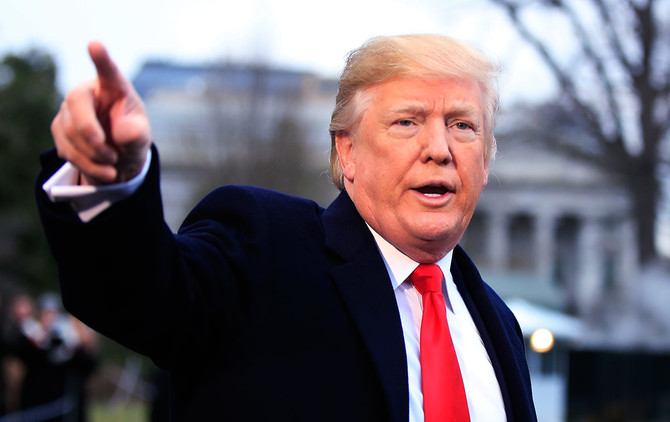
Defiant Trump welcomes ‘easy to win’ trade war
Defiant Trump welcomes ‘easy to win’ trade war
Latest updates


© 2026 SAUDI RESEARCH & PUBLISHING COMPANY, All Rights Reserved And subject to Terms of Use Agreement.