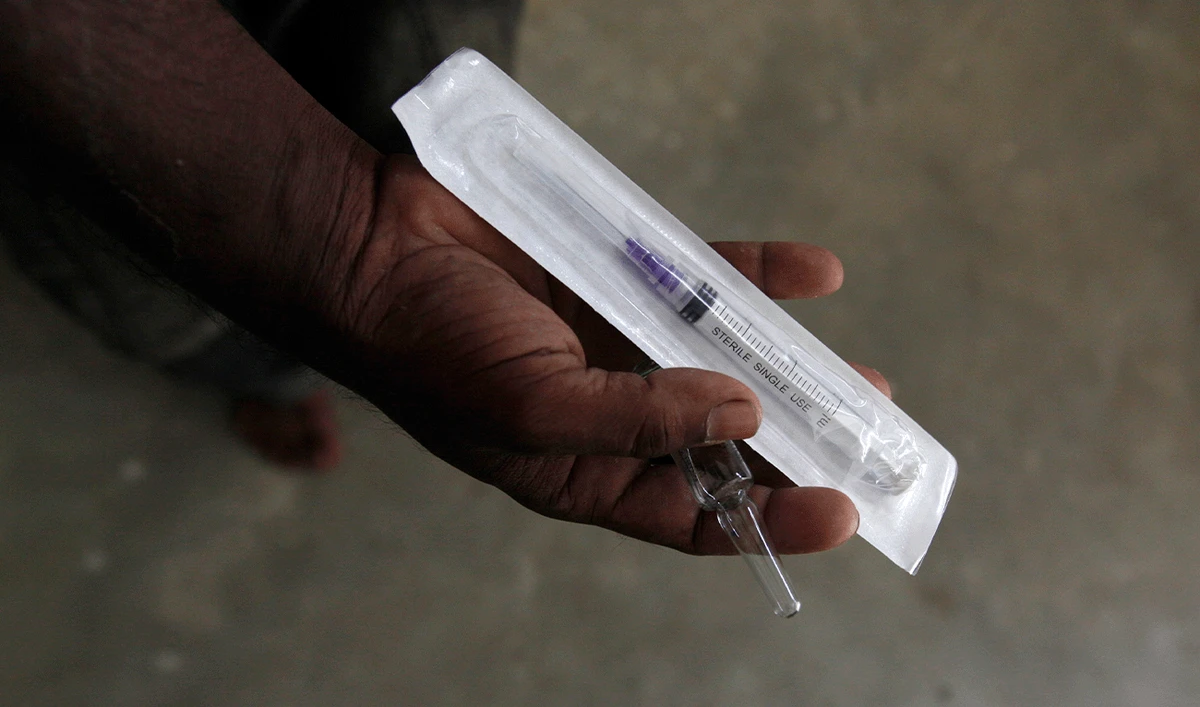
- Pakistan has around 10 million people living with hepatitis C, while reused syringes have also contributed to HIV outbreaks
- The Drug Regulatory Authority of Pakistan urges provincial health departments to ensure compliance to safeguard public health
ISLAMABAD: Pakistan’s drug regulator has announced a phased ban on the manufacture, import, sale and public retail of certain conventional disposable syringes from Jan. 1, replacing them with safety-engineered reuse-prevention (RUP) syringes as part of efforts to curb the spread of HIV, hepatitis and other blood-borne infections.
Pakistan has an estimated 10 million people living with hepatitis C, the highest number of any country, according to the World Health Organization. Around 110,000 people are newly infected each year, with unsafe medical injections accounting for about 62 percent of new infections.
Reused syringes have also contributed to HIV outbreaks, including one in Sindh’s Ratodero in 2019 that infected hundreds of children. A BBC investigation also found at least 331 children tested positive in Punjab’s Taunsa district between late 2024 and October 2025, with the province recording the most new HIV cases in 2025, at 7,920 of a national total of 14,182.
The Drug Regulatory Authority of Pakistan (DRAP) said its board expressed grave concern over the epidemiological findings of a taskforce connecting iatrogenic transmission directly to unsafe injection practices and the reported reuse of conventional syringes in some health care facilities.
“There shall be a complete ban on the manufacture, import and sale of conventional 1cc (non-insulin) disposable syringes and transition to safety-engineered reuse-prevention (RUP) syringes equipped with validated auto-destructible, retractable, or auto-lock technologies. To ensure a smooth transition and prevent supply chain deficits, the Board fixed December 31, 2026, as the definitive cut-off date after which all manufacture, import and sale of the aforementioned conventional syringes shall stand legally prohibited,” DRAP said in a notification dated July 1 that emerged on Sunday.
“There shall be a complete ban on the retail/market sale of conventional 10cc disposable syringes effective from 1 January 2027. Thereafter only safety-engineered reuse-prevention (RUP) syringes equipped with validated auto-destructible, retractable, or auto-lock technologies shall be available for market/retail sale. The Board decided to restrict the supply of conventional 10cc syringes exclusively to public and private secondary and tertiary health care hospitals/institutions for specialized clinical procedures.”
Pakistan Prime Minister Shehbaz Sharif this week issued directives in which he asked authorities to impose a nationwide ban on the manufacture of substandard syringes and ordered action against those involved in their use as Pakistan steps up efforts to curb the spread of HIV/AIDS and hepatitis C.
DRAP made it mandatory for manufacturers and importers to ensure that the name of the procuring institution is indelibly and clearly printed on the individual 10cc syringe’s primary packaging.
“Procuring institutions shall be responsible for establishing internal inventory safeguards to completely eliminate pilferage outside their facilities,” it said.
“To maintain the track record of 10cc conventional syringes supplied to secondary and tertiary health care hospitals/institutions, relevant manufacturers, importers and procuring institutions shall report/upload relevant end-to-end manufacturing/import, procurement, supply and utilization data of conventional 10cc syringes with effect from 01-01-2027 in a digital portal to be developed and shared by DRAP before the aforementioned deadline.”
DRAP stressed the role of provincial health departments as essential strategic partners in safeguarding public health.
“Their proactive leadership and enforcement mechanisms are critical in ensuring a smooth and effective transition away from unsafe injection practices,” the authority said. “You are, therefore, requested to implement the aforesaid directives/decisions of the Board and ensure compliance.”