SEOUL/SYDNEY: US President Donald Trump’s planned tariffs on steel and aluminum will distort global trade and cost jobs, Australia’s trade minister said on Friday, highlighting the risk of retaliatory measures as Asian exporters sought more detail on the plans.
Fears of an escalating trade war hit the share prices of Asian steelmakers and manufacturers supplying US markets particularly hard on Friday following a rough night on Wall Street.
Trump said the duties of 25 percent on steel and 10 percent on aluminum would be formally announced next week, although White House officials later said some details still needed to be ironed out.
“The imposition of a tariff like this will do nothing other than distort trade and ultimately, we believe, will lead to a loss of jobs,” Australian trade minister Steven Ciobo told reporters in Sydney.
“My concern remains that on the back of actions like this we could see retaliatory measures that are put in place by other major economies. That is in no-one’s interest.”
Australia, which has championed the free-trade Trans Pacific Partnership that Trump pulled the US out of, has sought an exemption for its steel and aluminum to the US, Ciobo added.
Steel has become key focus for Trump, who pledged to restore the US industry and punish what he sees as unfair trade practices, particularly by China.
Although China only accounts for 2 percent of US steel imports, its massive industry expansion has helped produce a global glut of steel that has driven down prices.
“The impact on China is not big,” said Li Xinchuang, vice secretary-general of the China Iron and Steel Association. “Nothing can be done about Trump. We are already numb to him.”
South Korea, the third-largest steel exporter to the US after Canada and Brazil, said it will keep talking to US officials until Washington’s plans for tariffs are finalized.
“For us, the worst-case scenario was a 54 percent tariff,” said a South Korean trade ministry official who declined to be named as he was not authorized to speak to media. “Still if the option for a global tariff of at least 24 percent is taken, that will still affect our steel exports to the US.”
South Korean trade minister Kim Hyun-chong has been in the US since February 25, the trade ministry said. Kim has met US Commerce Secretary Wilbur Ross and other officials to raise concerns over the so-called Section 232 probe and consider a plan that would minimize the damage to South Korean companies.
Asian steelmakers fear US tariffs could result in their domestic markets becoming flooded with steel products that have nowhere else to go.
“We are concerned about how other exporters react, what will happen with steel that cannot be sold to the US,” Vikrom Wacharakrup, Chairman of Iron and Steel Industry Group, Federation of Thai Industries, said. Thailand exports steel mainly to Asia but also the US.
The Trump administration also cited national security interests for its action, saying the US needs domestic supplies for its tanks and warships.
Contrary to the action announced by Trump on Thursday, the Department of Defense had recommended targeted steel tariffs and a delay in aluminum duties.
“We continue to seek clarification,” said Japanese Trade and Industry Minister Hiroshige Seko. “I don’t think exports of steel and aluminum from Japan, which is a US ally, damages US national security in any way, and we would like to explain that to the US.”
India also raised concerns about the use of the national security interests provisions.
“We have only 2 percent of our exports to US so no immediate dent, but validity of Section 232 is stretched to be used as tariff barrier,” India’s Steel Secretary Aruna Sharma said.
Trump believes the tariffs will safeguard American jobs but many economists say the impact of price increases for consumers of steel and aluminum, such as the auto and oil industries, will be to destroy more jobs than they create.
Japan’s Toyota Motor Corp. said the tariffs would substantially raise costs and therefore prices of cars and trucks sold in America.
News of the tariffs hit sentiment on Wall Street due to the potential impact of higher costs on consumers and the potential for damaging tit-for-tat retaliation by affected countries.
Asian steelmakers suffered with shares in South Korea’s POSCO and Japan’s Nippon Steel & Sumitomo Metal Corp. down more than 3 percent.


![]()
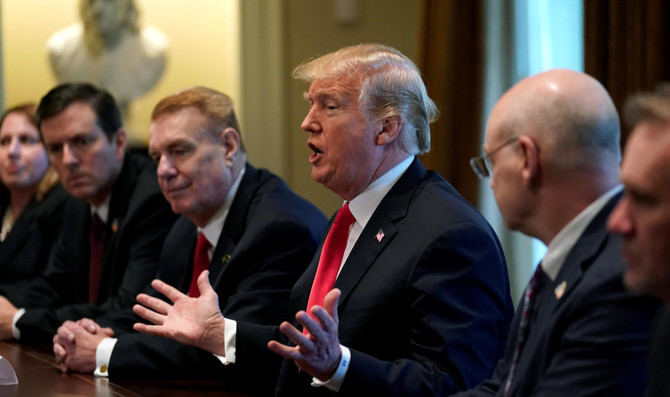
Asia fears trade war after US President Trump to impose hefty steel, aluminum tariffs
Asia fears trade war after US President Trump to impose hefty steel, aluminum tariffs

Latest updates





© 2026 SAUDI RESEARCH & PUBLISHING COMPANY, All Rights Reserved And subject to Terms of Use Agreement.