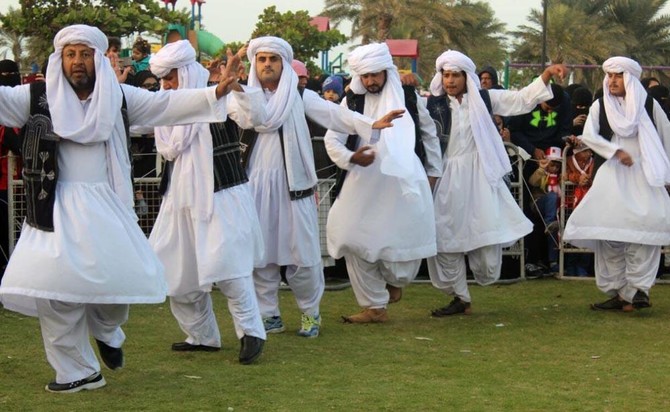
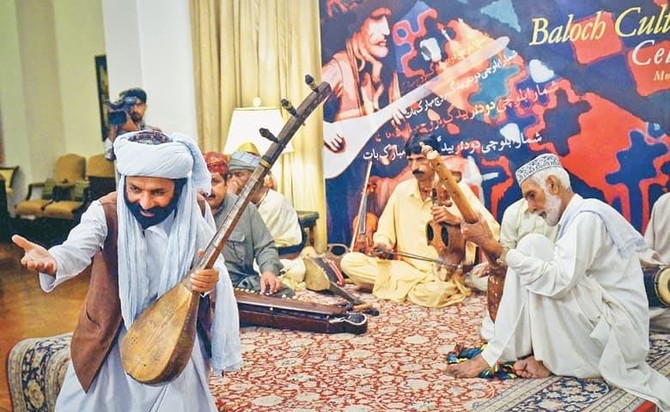
QUETTA: Baloch Culture Day which was celebrated on Friday created a great deal of excitement all over Pakistan’s southwestern province of Balochistan and also in parts of Karachi. Balochi people dressed in ethnic clothing organized colorful events in many different towns and cities.
Baloch Culture Day is celebrated every year on March 2 to highlight the rich history and traditions of the Baloch community that traces its origins to the area of Aleppo in Syria.
Most Baloch men cover their heads with long, white turbans and wear short jackets over their baggy clothes. Baloch women like to wear more colorful dresses that are mostly made by hand and feature attractive designs.
Balochistan is the largest province in Pakistan in terms of its landmass though it is sparsely populated.
Until recently, governments had not paid much attention to its development and this led to serious political grievances among its people. The province has now, however, acquired tremendous strategic importance because of the Gwadar deep-water port that is quite integral to the China-Pakistan Economic Corridor (CPEC).
Friday’s celebrations were also enjoyed by senior security forces officials. Addressing a gathering that was arranged to commemorate the day, Frontier Corps (FC) West Sector Commander Brig. Rahat Sadiq praised the Baloch people for their strength.
As in previous years, the people celebrating the day listened to Baloch folk music and enjoyed their traditional cuisine as the spent a day full of pride and joy.


Pakistan’s Baloch community celebrates Culture Day with fervor
Pakistan’s Baloch community celebrates Culture Day with fervor

‘One in a Million’: Syrian refugee tale wows Sundance
PARK CITY: As a million Syrians fled their country's devastating civil war in 2015, directors Itab Azzam and Jack MacInnes headed to Turkey where they would meet a young girl who encapsulated the contradictions of this enormous migration.
In Ismir, they met Isra'a, a then-11-year-old girl whose family had left Aleppo as bombs rained down on the city, and who would become the subject of their documentary "One In A Million," which premiered at the Sundance Film Festival on Friday.
For the next ten years, they followed her and her family's travels through Europe, towards Germany and a new life, where the opportunities and the challenges would almost tear her family apart.

There was "something about Isra'a that sort of felt to us like it encapsulated everything about what was happening there," MacInnes told an audience at the Sundance Film Festival in Park City, Utah on Friday.
"The obvious vulnerability of her situation, especially as being a child going through this, but that at the same time, she was an agent.
"She wasn't sitting back, waiting for other people to save her. She was trying to fight, make her own way there."
The documentary mixes fly-on-the-wall footage with sit-down interviews that reveal Isra'a's changing relationship with Germany, with her religion, and with her father.
It is this evolution between father and daughter that provides the emotional backbone to the film, and through which tensions play out over their new-found freedoms in Europe -- something her father struggles to adjust to.
Isra'a, who by the end of the film is a married mother living in Germany, said watching her life on film in the Park City theatre was "beautiful."
And having documentarists follow her every step of the way as she grew had its upsides.
"I felt like this was something very special," she told the audience after the screening. "My friends thought I was famous; it made making friends easier and faster."


