

Jordan renews ties with India on defense, health, mining

1 / 3
Indian Prime Minister Narendra Modi (R) and Jordanian King Abdullah II (L) shake hands during a meeting in New Delhi on March 1, 2018. (AFP / PRAKASH SINGH)
2 / 3
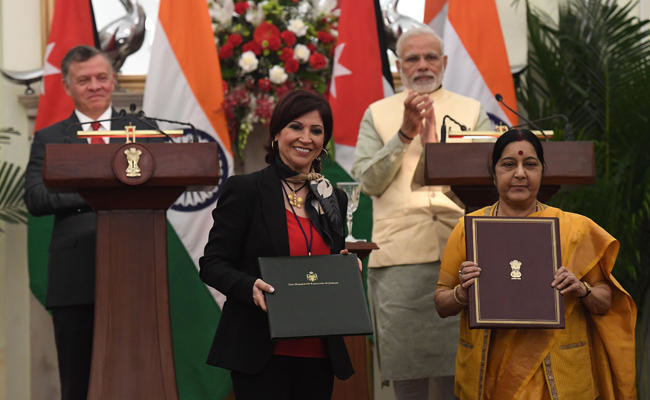
Indian Prime Minister Narendra Modi (R back) and Jordanian King Abdullah II (L back) watch as Indian Foreign Minister Sushma Swaraj (R) poses Jordan's Minister of Information Majd Shweikeh as they exchange bilateral agreement signing documents during a meeting in New Delhi on Thursday, March 1, 2018. (AFP / PRAKASH SINGH)
3 / 3
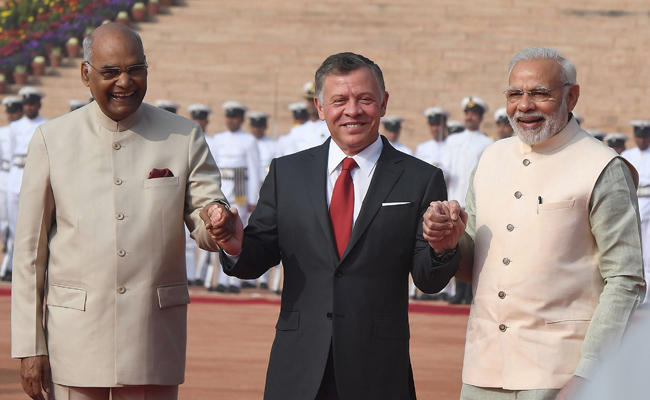
Jordan's King Abdullah II poses wth India's President Ram Nath Kovind (L) and Prime Minister Narendra Modi (R) during a ceremonial reception at the Presidential palace in New Delhi on March 1, 2018. (AFP)
Updated 01 March 2018
Follow

Jordan renews ties with India on defense, health, mining

NEW DELHI: India and Jordan have agreed to strengthen cooperation across a wide range of areas, including defense and health, capping a three-day visit by the king of Jordan that highlighted India’s increasing focus on the Middle East.

King Abdullah’s first visit to India in more than a decade came hard on the heels of Indian Prime Minister Narendra Modi’s stopover in Amman on his way to Palestine.

Modi broke with protocol to welcome King Abdullah on his arrival in New Delhi on Feb. 27, greeting him with a characteristic hug.

India relies on the Gulf and Middle East for oil and remittances from more than 8 million Indian citizens who live there. Yet New Delhi has for several years lacked a serious policy on the region, experts say. That is starting to change under the Modi government.

“There is a greater realization on the part of the Indian government in the past three years that we need to give due attention to links with western Asia, and there needs to be a greater focus on energy security,” said Dr. Meena Singh Roy, head of the West Asia Center at the Institute for Defense Studies and Analyses in New Delhi.

“This trip and the prime minister’s recent trip through Amman are about recognizing the importance of Jordan in the region and about India wanting to play a greater role,” she said.

Ashok Sajjanhar, India’s former three-time ambassador, said that New Delhi was finally realizing that the Middle East and Gulf were important regions that warranted close ties.

“We’re living in a fast-changing global order where Russia has once again emerged as a global power and has replaced the US,” said Sajjanhar. “With China entering in a big way through its One Belt One Road project, we need to protect our interest in the region.”

Experts agree the Jordanian ruler’s visit to India will boost bilateral relations.

“Because of the uncertainty in the region, Jordan also is looking for stable partners and it finds the Indian model attractive,” Sajjanhar said.

“India is a rising power and its global clout is increasing. It is also a growing market, and if Jordan can tap into the Indian economy, that works for them as well.”

Apart from defense and cybersecurity, the two countries signed agreements focusing on cooperation in health, information technology, and setting up mining and production of phosphate in Jordan for use by India.

King Abdullah, who was accompanied by a business delegation, took part in a round-table meeting with business leaders on Wednesday, followed by an India-Jordan business forum.

He also visited India’s leading engineering school, the Indian Institute of Technology Delhi, to discuss a collaboration with technical institutes in Jordan.

What to know about the Israeli president’s state visit to Australia

Updated 5 sec ago
Follow

What to know about the Israeli president’s state visit to Australia

  • Netanyahu had been outraged by Australia’s decision four months earlier to join France, Britain and Canada in recognizing a Palestinian state

MELBOURNE, Australia: The stated purpose of Israel President Isaac Herzog’s visit to Australia is to support the Jewish community still reeling from an antisemitic attack at Sydney’s Bondi Beach that left 15 dead. But his critics warn his presence undermines rather than repairs social cohesion frayed by the far away war in Gaza.
Protest rallies are expected to follow the president, who performs a largely ceremonial role as head of state, as he travels to Sydney, Melbourne and Canberra over four days starting Monday. Some critics demand he be arrested in Australia on suspicion of inciting genocide in Gaza.
He is the first Israeli head of state to visit Australia since Reuven Rivlin in 2020. Herzog’s father, Chaim Herzog, also visited Australia as Israel’s president in 1986.
Here’s what to know:
The Australian visit comes at a time of extraordinary bilateral tensions
Within hours of two gunmen allegedly inspired by the Daesh group launching their attack in Sydney on Dec. 14 last year, Israeli Prime Minister Benjamin Netanyahu blamed his Australian counterpart Anthony Albanese, posting on social media “your call for a Palestinian state pours fuel on the antisemitic fire.”
Netanyahu had been outraged by Australia’s decision four months earlier to join France, Britain and Canada in recognizing a Palestinian state.
Netanyahu has repeatedly sought to link widespread calls for a Palestinian state, and criticism of Israel’s military offensive in Gaza, to growing incidents of antisemitism worldwide.
Albanese has accused Netanyahu of being “in denial” over the humanitarian consequences of war in Gaza. Netanyahu has branded the Australian a “weak politician who betrayed Israel and abandoned Australia’s Jews.”
Australian Jews have appealed to both leaders to restore “diplomatic norms” to a bilateral relationship that had been friendly for decades.
Albanese has made clear his government’s invitation to Herzog to make that state visit was the idea of Jewish leaders.
“President Herzog is coming particularly to engage with members of the Jewish community who are grieving the loss of 15 innocent lives,” Albanese said.
“People should recognize the solemn nature of the engagement that President Herzog will have with the community of Bondi in particular, and bear that in mind by the way that they respond over coming weeks,” he added.
Jewish leaders welcome Herzog’s visit
Sydney-based Jewish leader Alex Ryvchin, co-CEO of the Executive Council of Australian Jewry, said his community “warmly anticipates” Herzog’s arrival.
“His visit will lift the spirits of a pained community and we hope will lead to a much-needed recalibration of bilateral relations between two historic allies,” Ryvchin said.
“President Herzog is a patriot and a person of dignity and compassion and holds an office that is above party politics. He is a person who has sadly had to comfort families, police and first responders after terrorist attacks many times, and will know how to reassure and fortify our community in its darkest time,” he added.
Ryvchin is one of the Australian Jewish leaders who have accused Albanese’s center-left Labour Party government of not doing enough to curb an increase in antisemitism in Sydney and Melbourne, where 85 percent of Australia’s Jewish population live, since the Israel-Hamas war began in 2023.
Herzog sees opportunity to reset relations
Herzog, a former head of Israel’s centrist Labour Party, now holds a job meant to serve as a unifier and moral compass for all Israelis. A onetime rival of Netanyahu, he has good working relations with the prime minister.
Ahead of his visit, Herzog told The Associated Press that the “primary reason” for the trip was to stand with Australia’s Jewish community as the representative of all Israelis.
“From thousands of miles away in Israel, we feel the deep pain of our Jewish Australian sisters and brothers. I am coming to show them our love and support at this devastating time,” he said.
But Herzog also said the visit is an opportunity “to reinvigorate relations” between Israel and Australia.
“There is a long history of partnership between our two nations and deeply held shared values,” he said, adding that the visit “offers a chance to reignite the longstanding bipartisan support for ties between Israel and Australia.”
“I hope to be able to communicate this message of goodwill and friendship to the Australian people, and dispel many of the lies and misinformation spread about Israel over the last two years,” he said.
Israel’s critics have called for Herzog’s invitation to be withdrawn
“This is one of the most divisive figures in the world. Bringing him to Australia will undermine social cohesion, it will not rebuild it. It will increase division, it will not bring about national unity,” Australian human rights lawyer Chris Sidoti said. Sidoti described the invitation as a ”crazy idea.”
Sidoti was one of three experts appointed by the UN’s Human Rights Council to an inquiry that reported in September last year that Herzog, Netanyahu and former Israeli Defense Minister Yoav Gallant had incited the commission of genocide in Gaza.
The findings carry no legal consequence and Israel has rejected genocide allegations against the country as antisemitic “blood libel.” Sidoti and other lawyers say Australian police could potentially arrest Herzog on suspicion of inciting genocide, which is a crime under Australian law as well as international law. Australian Federal Police have declined to comment.
A lawmaker in Albanese’s government, Ed Husic, said he was “very uncomfortable” with Herzog’s visit. Husic, a Muslim and vocal critic of Israel’s conduct in Gaza, said he was “concerned that a figure like that doesn’t necessarily enhance social cohesion.”
Some state government lawmakers from Albanese’s Labour Party have said they will join a protest in downtown Sydney on Monday planned by the Palestine Action Group activist organization.
“We need to send a clear message to our government and to the world … we are fundamentally opposed to this tour, which is designed to normalize genocide,” protest organizer Josh Lees said.
Police prepare to use enhanced powers of arrest to control protesters in Sydney
In response to the Bondi shooting, the New South Wales state parliament rushed through legislation increasing police powers to arrest protesters in the aftermath of a declared terrorist attack.
New South Wales Premier Chris Minns said a heightened police response in Sydney during Herzog’s visit was necessary to ensure safety.
“We will have thousands of mourners and thousands of protesters as well as a visiting head of state all in the same city at the same time. And we’ve got a responsibility to keep people safe in those circumstances,” Minns said.
“Every international city anywhere in the world would apply exactly the same geographical restrictions so that the two groups don’t meet and as a result there’s not a major confrontation,” Minns added.