Qatar must end support for terror if it wants boycott lifted, UN council told

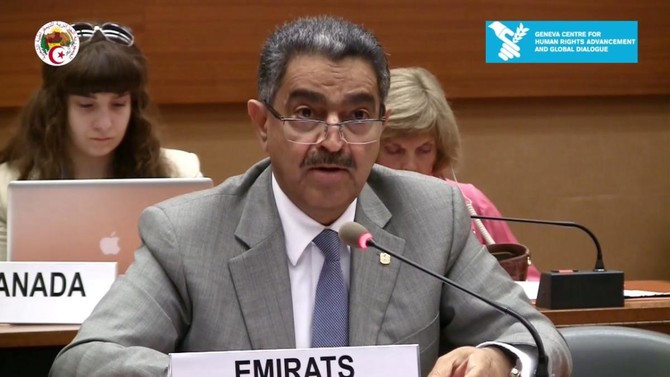
File Photo of Ambassador Obaid Salem Saeed Al Zaabi, Permanent Representative of the United Arab Emirates (UAE) to the U.N. Geneva. (Reuters)
Updated 28 February 2018
Follow

Qatar must end support for terror if it wants boycott lifted, UN council told

LONDON: The boycott on Qatar by its Middle East neighbors has been dismissed as a regional issue not worthy of debate at the UN Human Rights Council.

The UAE’s ambassador to the United Nations in Geneva, Obaid Salim Al-Zaabi, delivered a statement to the council on Wednesday on behalf of the UAE, Saudi Arabia, Bahrain and Egypt. The four countries have maintained a boycott on Qatar since April last year over Doha’s alleged support for terrorism.

Earlier, Qatar’s foreign minister, Mohammed bin Abdulrahman Al-Thani, urged the UN to take action to halt the blockade on the Gulf state.

Al-Zaabi told the council that the Qatari minister’s speech included a lot of “fallacies.”

“(Doha’s) efforts to promote this secondary crisis as a major international issue should not be acknowledged,” the UAE ambassador said.

“We believe this small political crisis between our countries and Qatar should be resolved within the framework of the existing Kuwaiti mediation efforts, led by Sheikh Sabah Al-Ahmad Al-Jaber Al-Sabah.”

A delegation from the UN Office of the High Commissioner for Human Rights visited Qatar in November, 2017, and two months later issued a report on the impact of the boycott on human rights.

“The Qataris must choose between being a state that is good to its neighbors and seeks to engage in a positive relationship with its surroundings like the rest of the civilized world, or continue to violate international law and regional conventions involved in the fight against terrorism, its supporters and those financing it,” Al-Zaabi said.

UN urges all sides to ‘see reason’ in Iran-US conflict

Updated 53 min 6 sec ago
Follow

UN urges all sides to ‘see reason’ in Iran-US conflict

  • “I deplore the military strikes across Iran this morning by Israel and the USA, and the subsequent retaliatory strikes by Iran,” Turk said
  • “To avert these terrible consequences for civilians, I call for restraint and implore all parties to see reason, to de-escalate”

GENEVA: The United Nations’ rights chief deplored Saturday’s strikes in the Middle East and urged all parties to return to negotiations, saying attacks would only result in “death, destruction and human misery.”
“I deplore the military strikes across Iran this morning by Israel and the United States of America, and the subsequent retaliatory strikes by Iran,” Volker Turk said in a statement.
“As always, in any armed conflict, it is civilians who end up paying the ultimate price.
“Bombs and missiles are not the way to resolve differences but only result in death, destruction and human misery.
“To avert these terrible consequences for civilians, I call for restraint and implore all parties to see reason, to de-escalate, and for a return to the negotiating table where they had been actively seeking a solution only hours earlier,” he said.
“Failing to do so risks an even wider conflict, that will inevitably lead to further senseless civilian deaths and destruction on a potentially unimaginable scale, not just in Iran but across the Middle East region.”
On Thursday, US and Iranian negotiators held indirect talks in Geneva, through Omani mediators, on Tehran’s nuclear program — within sight of Turk’s offices in the Swiss city.
He reminded all parties that the protection of civilians was paramount in armed conflict, insisting that those who violated the rules of war must be held accountable.
Tedros Adhanom Ghebreyesus, head of the World Health Organization, said the agency was concerned by the “grave risk to people’s health” from the expanding conflict.
“The threat of nuclear facilities being impacted is especially worrying,” he said.
“All must be done to reduce any nuclear safety risk, which may affect people in the region,” he added.
“We urge leaders to choose the challenging path of dialogue over the senseless route of destruction.”