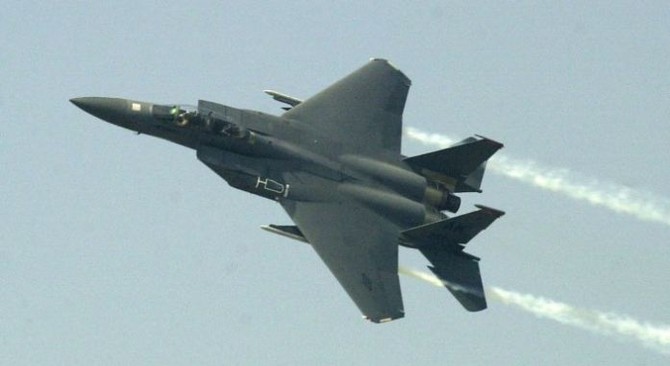
DUBAI: The UAE on Monday said Qatari fighter jets had twice intercepted civilian passenger planes en route to Bahrain in a “clear violation of international law.”
In the first incident the UAE General Authority of Civil Aviation (GCAA) received a message from one of the UAE’s national carriers on Monday morning that one of its aircraft on a flight to Manama on a normal route had been intercepted by Qatari fighters.
The second incident also involved a civilian aircraft during a flight to Bahrain International Airport on a regular scheduled and well-known journey. But the WAM report did not name the airline involved or give further details of the incident.
The report added that the flight was a “regular, scheduled service, on a known flight-path that met all the required and internationally recognized approvals and permits.”
“Qatari fighter jets intercepted an Emirati civilian aircraft during a routine flight to Manama in a flagrant threat to civil aviation safety and in a clear violation of international law,” the GCAA said in a statement published by the state news agency WAM. Arab News tried contacting the GCAA but received no response as well as the Qatar Civil Aviation Authority but also did not get a response.
Saif Al-Suwaidi, Director-General of the UAE General Civil Aviation Authority confirmed on Monday that the two commercial airliners that were intercepted by Qatari fighter jets were regular and scheduled flights with a well-known track, which meet the necessary approvals and internationally recognized permits .
He added that the two incidents occurred while the two planes were approaching Manama airport, as it was about to land in low altitude. "The two Emirates aircraft were intercepted by military fighter jets in a dangerous and prohibited way under international law governing civil aviation."
He explained that "the sudden interception of a civil aircraft by a fighter jet may lead to a reaction from the pilot that could threaten the safety of the passengers and crew."
He confirmed that "the two planes arrived safely to Bahrain and returned to the UAE."
Al-Suwaidi stressed that the course followed by the two aircrafts is "an international shipping route available for air traffic in this region”, and that “there is no prior objection from the State of Qatar to use it."
He added that the UAE General Civil Aviation Authority "is studying all options to respond to this serious breach of the international conventions and legal tools available to the International Civil Aviation Organization as well".
"We will move promptly to ensure the safety and security of our civilian aircraft."
The UAE official explained that "in such cases, an evidence-based complaint is submitted to the International Civil Aviation Organization, for consideration according to their specific procedures.”
He also said that the GCAA is urgently preparing this complaint.
The Bahraini Civil Aviation Authority said that it too will raise a detailed report to the ICAO on what happened. It said that the interception required air traffic controllers to intervene in order to maintain air safety, while the Qatari jets came within two miles of the commercial airline, which they said put the safety of passengers and crew at risk. They added that the second flight, an Etihad Airline flight from Abu Dhabi, is also under investigation.
Meanwhile, the Ministry of Foreign Affairs of Bahrain said in a statement on its website that it strongly condemned the Qatar fighter aircraft intercepting a civilian aircraft from the UAE during its normal flight this morning. The statement said: "It is a clear violation of the relevant international conventions and laws, in particular those of the International Civil Aviation Organization (ICAO) and the provisions of the Chicago Convention on International Civil Aviation and its amendments of 1944.
Saudi Arabia also condemned the attack.
"The Ministry of Foreign Affairs affirms that this rejected hostile behavior by Qatar against civil aircrafts has become frequent in recent times and jeopardizes the safety of civil aviation and poses a threat to the lives of civilians.
"The Ministry of Foreign Affairs stresses the Kingdom of Bahrain's full support for the UAE and its backing for all of its measures to maintain its security and stability, to stop these violations and to repel these breaches by the State of Qatar."
The leader of the Qatari opposition, Sheikh Sultan bin Suhaim Al-Thani, condemned Doha for sending the jets. “Qatar first needs to intercept the Iranian and Israeli planes that are roaming its airspace instead of intercepting a civilian plane belonging to our brothers,” he said in his remarks via his Twitter account.
“The Qatari government spares no effort to escalate matters. When they meet, they start shouting and wailing and playing the victim's role,” he added.
#قطر_تعترض_طايره_امارتيه
كان الاولى لها ان تعترض الطائرات الإيرانية والإسرائيلية التي تجوب أجوائها بدلا من اعتراض
طائرة مدنية لاخواننا العزل
الحكومة القطرية لا تألوا جهدا في تصعيد الأمور وعندما تقابل بالمثل تبدأ بالصراخ والعويل ولعب دور الضحية— سلطان سحيم آل ثاني (@sultansalthani) January 15, 2018
But a Qatari foreign ministry official later denied the claim according to news reports.
And Sheikh Saif Bin Ahmed Al-Thani, the director of Qatar’s government communications office, said on his official Twitter account that the charge was “completely untrue.”
On Friday, Qatar filed a complaint with the United Nations about an alleged violation of its airspace in December by an Emirati military aircraft.
Qatari authorities said the violation on Dec. 21, which the UAE denied, lasted one minute.
The UAE is home to two major national carriers, Abu Dhabi-based Etihad and Dubai-based Emirates. But the Associated Press said that both airlines declined to comment.
US Air Force Central Command, which is based at the sprawling Al-Udeid Air Base in Qatar, also did not immediately have any report about any incident involving a commercial aircraft in the region, said Lt. Col. Damien Pickart, an Air Force spokesman – adding that the US did not routinely monitor flights and operations of the Qatari airforce.
The Qatar crisis began June 5 with Bahrain, Egypt, Saudi Arabia and the UAE cutting off Doha's land, sea and air routes over its alleged support of extremists and close ties with Iran. Qatar has long denied funding extremists. It recently restored full diplomatic relations with Iran.
(With AP, AFP and Reuters)