

LONDON: When a Qatari newspaper boasted that a group of visiting British politicians had praised Doha’s record on workers’ rights, there was just one problem: The British MP named as leader of the delegation was not even in the country at the time.
The Peninsula daily, quoting Qatar’s state-run news agency QNA, claimed Alistair Carmichael MP led the All-Party Parliamentary Group (APPG) visit to Qatar two weeks ago. But Carmichael’s office on Wednesday said he did not make the trip.
“He wasn’t there,” said the MP’s assistant from his office in the House of Commons in London. Just to make certain, he added, “I can confirm he wasn’t there.”
On its website on Feb. 15, the Qatari daily ran a QNA report claiming a British “parliamentary delegation” had “praised the efforts of Qatar in the field of protecting and enhancing workers’ rights.”

Alistair Carmichael was not in Qatar as claimed by The Peninsula.
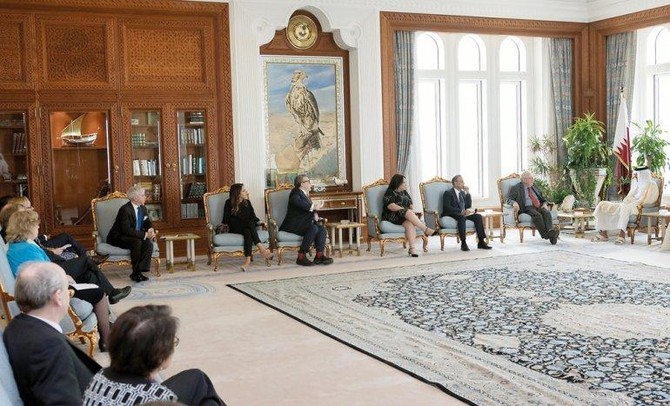
Plaudits were supposedly heaped upon Doha during the delegation’s meeting with Ali bin Samikh Al-Marri, chairman of Qatar’s National Human Rights Committee.
While the meeting may have taken place, Carmichael was not in the room — or even in the country. A photograph of the meeting published on The Peninsula’s website was taken from so far away that it is impossible to distinguish the MPs who were present.
Carmichael, the Liberal-Democrat chief whip in the House of Commons, is chairman of the British-Qatar Group in Parliament and has visited the country on at least one occasion.
Qatar’s Ministry of Foreign Affairs footed the bill for flights, accommodation and food, which came to between £51,000 ($71,330) and £52,500, for a three-day visit in February 2016.
The group has not yet published an account of benefits received in 2017.
Asked how Carmichael might feel about being misrepresented in what amounts to fake news, the MP's office said the report in The Peninsula was “strange.”
It is not the first time Qatari media outlets have issued false reports about UK politicians visiting the country.
The Qatar News Agency (QNA) in September claimed that the “British Parliamentary Inquiry Committee” had been “charged by the British Parliament to investigate the violations of the siege imposed on the State of Qatar.”
But no committee of that name exists, and the UK Parliament made no order for such a visit, officials confirmed to Arab News last year.
Earlier this month, there were further false claims and inaccuracies regarding a visit to Qatar by British MPs last September under the auspices of the National Human Rights Committee.
It was reported that following their visit, 15 British MPs signed a petition calling for the blockade on Qatar to be lifted, and submitted it to Prime Minister Theresa May.
But one of the signatories, Martyn Day of the Scottish National Party, explained that in reality, what the British MPs signed was an early day motion.
This is a proposal, submitted by a member of Parliament, for a debate in the House of Commons at the earliest opportunity, but stipulating no fixed time. The main purpose is to draw attention to a particular subject — at least briefly, since early day motions are rarely debated.
Day’s office told Arab News: “This was a parliamentary motion to show concern about the blockade on Qatar and the impact of that blockade on the residents and citizens of those in Qatar and their human rights.”
But it did not amount to a petition to the prime minister, as claimed by Qatar’s National Human Right Committee.
A statement by the committee dated Feb. 3 said the British MPs visited the Ministry of Endowments and Islamic Affairs to learn about a "ban" on Qataris performing Hajj — a blatant falsehood.
Far from preventing Qataris from performing the holy pilgrimage, King Salman had invited Qatari pilgrims to travel to the Kingdom on Hajj at his own expense and ordered private jets to be sent to Doha to transport Qatari pilgrims to the holy sites.
The land border between Saudi Arabia and Qatar at Salwa was opened and Qatari pilgrims were allowed to pass through with no electronic permits required.
The National Human Right Committee’s claims about the British MPs’ concerns over the humanitarian situation in Qatar were also undermined by the inclusion of some elementary errors, such as referring to the House of Commons — the lower chamber of the British Parliament — as “the British House of Representatives.”
It also misspelled both the first and family name of the prime minister as “Teresa Mai.”


