UK inquest into Qatar World Cup death cites ‘unsafe’ site

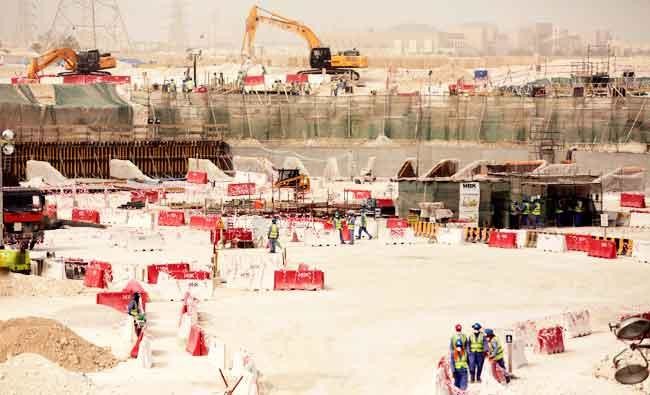
In this photo taken during a government organized media tour, laborers work at the Al-Wakra Stadium that is under construction for the 2022 World Cup, in Doha, Qatar, in this May 4, 2015 file photo. (AP)
Updated 28 February 2018
Follow

UK inquest into Qatar World Cup death cites ‘unsafe’ site

LONDON: Work practices at a Qatar World Cup stadium construction site where a British worker died last year were “downright dangerous,” a coroner in Britain probing the death said Tuesday.
Zachary Cox, who was born in Johannesburg but later lived in Britain, plummeted 39 meters (128 feet) when a hoist he was using to put in place a suspended walkway broke at the Khalifa International Stadium in Doha in January, 2017.
British coroner Veronica Hamilton-Deeley found the rope-access technician had fallen head first, sustaining brain injuries and a broken neck, after a safety harness had also snapped.
Brighton and Hove Coroner’s Court, in southern England where Cox had lived — heard new working practices, including the use of extra hoists to speed up construction after problems with some of the heavy metal platforms, had preceded the fatal incident.
Hamilton-Deeley called the conditions “inherently unsafe.”
“The site managers at the stadium knew or should have known that they were effectively requiring a group of their workers to rely on potentially lethal equipment,” she said.
“(The new system) was chaotic, unprofessional, unthinking and downright dangerous.”
Relatives of Cox, 40, told the coroner they have been fighting for answers from officials at the stadium’s main contractor, Midmac-Six Construct Joint Venture, and want an independent inquiry and the involvement of Britain’s Foreign Office.
In a statement after the inquest, Cox’s sisters-in-law Ella Joseph and Hazel Mayes demanded “reassurance that those responsible for making the decisions that ultimately led to Zac’s death will be held to account and justice will be served.
An initial investigation into the death, compiled by the contractor and referenced in an annual workers’ welfare report released last June, found concerns over the construction of the high platform from which Cox fell.
The joint venture did not respond to a request for comment from AFP.
Local authorities in Qatar are also conducting their own probe.
Colleague Graham Vance, from South Africa, was initially arrested over Cox’s death and kept in Qatar for 10 months but has since been cleared of any wrongdoing.
Khalifa was the first World Cup stadium to be opened in Qatar, hosting its first major event, the Emir Cup, last May.
It will also be the site of the 2019 world athletics championships.


Bangladesh mourns Khaleda Zia, its first woman prime minister

Updated 30 December 2025
Follow

Bangladesh mourns Khaleda Zia, its first woman prime minister

  • Ousted ex-premier Sheikh Hasina, who imprisoned Zia in 2018, offers condolences on her death
  • Zia’s rivalry with Hasina, both multiple-term PMs, shaped Bangladeshi politics for a generation

DHAKA: Bangladesh declared three days of state mourning on Tuesday for Khaleda Zia, its first female prime minister and one of the key figures on the county’s political scene over the past four decades.

Zia entered public life as Bangladesh’s first lady when her husband, Ziaur Rahman, a 1971 Liberation War hero, became president in 1977.

Four years later, when her husband was assassinated, she took over the helm of his Bangladesh Nationalist Party and, following the 1982 military coup led by Hussain Muhammad Ershad, was at the forefront of the pro-democracy movement.

Arrested several times during protests against Ershad’s rule, she first rose to power following the victory of the BNP in the 1991 general election, becoming the second woman prime minister of a predominantly Muslim nation, after Pakistan’s Benazir Bhutto.

Zia also served as a prime minister of a short-lived government of 1996 and came to power again for a full five-year term in 2001.

She passed away at the age of 80 on Tuesday morning at a hospital in Dhaka after a long illness.

She was a “symbol of the democratic movement” and with her death “the nation has lost a great guardian,” Bangladesh’s interim leader Muhammad Yunus said in a condolence statement, as the government announced the mourning period.

“Khaleda Zia was the three-time prime minister of Bangladesh and the country’s first female prime minister. ... Her role against President Ershad, an army chief who assumed the presidency through a coup, also made her a significant figure in the country’s politics,” Prof. Amena Mohsin, a political scientist, told Arab News.

“She was a housewife when she came into politics. At that time, she just lost her husband, but it’s not that she began politics under the shadow of her husband, president Ziaur Rahman. She outgrew her husband and built her own position.”

For a generation, Bangladeshi politics was shaped by Zia’s rivalry with Sheikh Hasina, who has served as prime minister for four terms.

Both carried the legacy of the Liberation War — Zia through her husband, and Hasina through her father, Sheikh Mujibur Rahman, widely known as the “Father of the Nation,” who served as the country’s first president until his assassination in 1975.

During Hasina’s rule, Zia was convicted in corruption cases and imprisoned in 2018. From 2020, she was placed under house arrest and freed only last year, after a mass student-led uprising, known as the July Revolution, ousted Hasina, who fled to India.

In November, Hasina was sentenced to death in absentia for her deadly crackdown on student protesters and remains in self-exile.

Unlike Hasina, Zia never left Bangladesh.

“She never left the country and countrymen, and she said that Bangladesh was her only address. Ultimately, it proved true,” Mohsin said.

“Many people admire Khaleda Zia for her uncompromising stance in politics. It’s true that she was uncompromising.”

On the social media of Hasina’s Awami League party, the ousted leader also offered condolences to Zia’s family, saying that her death has caused an “irreparable loss to the current politics of Bangladesh” and the BNP leadership.

The party’s chairmanship was assumed by Zia’s eldest son, Tarique Rahman, who returned to Dhaka just last week after more than 17 years in exile.

He had been living in London since 2008, when he faced multiple convictions, including an alleged plot to assassinate Hasina. Bangladeshi courts acquitted him only recently, following Hasina’s removal from office, making his return legally possible.

He is currently a leading contender for prime minister in February’s general elections.

“We knew it for many years that Tarique Rahman would assume his current position at some point,” Mohsin said.

“He should uphold the spirit of the July Revolution of 2024, including the right to freedom of expression, a free and fair environment for democratic practices, and more.”