UNITED NATIONS: The United States and three European allies condemned Iran on Tuesday after the United Nations found Tehran had violated the arms embargo on Yemen by failing to block supplies of missiles and drones to Houthi militia.
Britain, France, Germany and the United States urged Iran to “immediately cease all activities that are inconsistent or would violate” the UN resolution that established the arms embargo in 2015.
The joint condemnation came a day after Russia vetoed a British-drafted resolution renewing sanctions on Yemen and citing “particular concern” about a report’s findings on Iran.
The report by a UN panel of experts in January concluded that Iran was in violation after determining that missiles fired by the Houthis at Saudi Arabia last year were made in Iran.
Russia, however, questioned the findings and blocked the resolution, saying the report did not contain conclusive evidence of Iran’s violation of the arms embargo.
“We condemn Iran’s non-compliance, as described by the panel, which poses serious risks to peace and stability in the region,” said the joint statement released by the US mission.
All four countries are signatories to the Iran nuclear deal of 2015.
In response to Tuesday’s condemnation, the Iranian Foreign Ministry said in a statement, “for three years now the behavior of the United States and Britain at the UN Security Council has been harmful, and tantamount to legitimizing the aggressors in Yemen.”
The statement said these countries were stoking “Saudi aggression” in Yemen by acting as the kingdom’s main backers and arms suppliers.
The Russia veto was a setback for the United States as it pushes the Security Council to take a stronger stance toward Iran over its role in regional conflicts and missile tests.
The US administration maintains that Iran is not living up to its commitments under the nuclear deal, which President Donald Trump has criticized as the “worst ever.”
The British-drafted resolution that was strongly backed by the United States was vetoed by Russia after 11 countries voted in favor at the 15-member Security Council.
China and Kazakhstan abstained and Bolivia voted against it.
A Saudi-led coalition supporting Yemen’s government has been fighting the Houthis since 2015 in a war that has created what the United Nations describes as the world’s worst humanitarian crisis.
The council earlier heard the UN director of aid operations, John Ging, describe living conditions in Yemen as “catastrophic,” with a growing risk of famine and a severe outbreak of cholera.


![]()
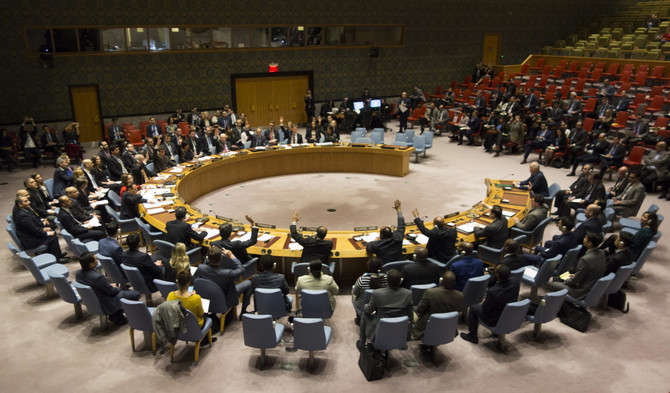
After Russian veto, US and allies condemn Iran over missiles to Yemen
After Russian veto, US and allies condemn Iran over missiles to Yemen


Latest updates



© 2026 SAUDI RESEARCH & PUBLISHING COMPANY, All Rights Reserved And subject to Terms of Use Agreement.