UNITED NATIONS: The UN Security Council on Sunday was considering two draft resolutions on Yemen after Russia put forward a rival text aimed at blocking action against Iran over missiles sent to the country’s Houthi rebels.
The council is set to vote on Monday on renewing sanctions on Yemen for a year, but a British-drafted text also calls for “additional measures” in response to a UN report which found that Iran had violated the arms embargo on Yemen.
The rival Russian-drafted text presented to the council on Saturday and seen by AFP would extend the sanctions regime on Yemen until February 2019 without any reference to the UN report’s findings on Iran and possible action targeting Tehran.
Diplomats said Russia could veto the British text, allowing for a vote on its own draft resolution.
Negotiations were continuing on Sunday.
The report by a UN panel of experts concluded that Iran was in violation of the 2015 arms embargo after determining that missiles fired by the Houthis at Saudi Arabia last year were made in Iran.
Russia maintains that the report’s findings are not conclusive enough to justify action against Iran.
Britain, backed by the United States and France, had initially sought to condemn Iran, but that was dropped in negotiations.
The last draft resolution expresses “particular concern” that “weapons of Iranian origin were introduced in Yemen after the imposition of the targeted arms embargo” and that Iran is in “non-compliance” with UN resolutions.
The council would express “its intention to take additional measures to address these violations,” according to the British-drafted text.
It adds that “any activity related to the use of ballistic missiles in Yemen” meets the criteria for imposing UN sanctions.
Iran has repeatedly denied arming the Houthis in Yemen, despite claims by the United States and Saudi Arabia that the evidence of an arms connection is irrefutable.
Russia, which has traditionally friendly relations with Iran, is providing military support along with Tehran to Syrian President Bashar Assad.
Russian Ambassador Vassily Nebenzia on Wednesday said the draft resolution should focus on renewing the mandate of sanctions monitors for Yemen instead of taking aim at Iran.
“It’s a resolution about the extension of the working group, not about Iran. So we should concentrate on extending the working group first,” he said.
While the report found that Tehran had violated the embargo by failing to block the shipments, the experts said they were unable to identify the supplier.
US Ambassador Nikki Haley is pushing for council action to rein in Iran and prevent the war in Yemen from escalating into a broader regional conflict.
In a New York Times editorial last week, Haley wrote that “the UN panel has given the world a chance to act before a missile hits a school or a hospital and leads to a dangerous military escalation that provokes a Saudi military response.”
A Saudi-led coalition supporting Yemen’s government has been fighting the Houthis since 2015 in a conflict that has led to what the United Nations describes as the world’s worst humanitarian crisis.
Russia can block council action by using the veto power it enjoys as one of the five permanent Security Council members, along with Britain, China, France and the United States.


![]()
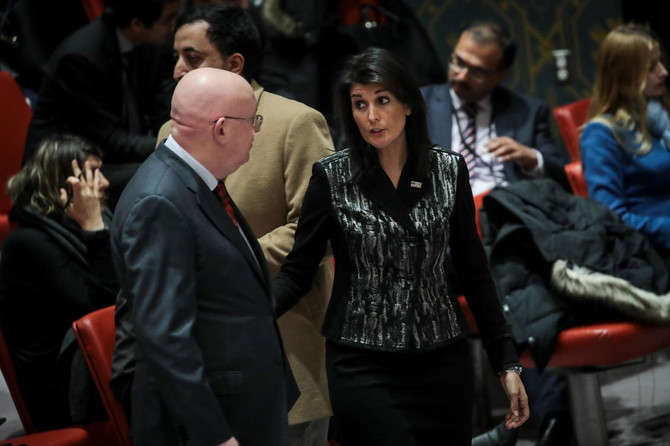

Russia moves to block Iran missile criticism in UN resolution on Yemen
Russia moves to block Iran missile criticism in UN resolution on Yemen
Trump warns Iran of ‘very traumatic’ outcome if no nuclear deal
WASHINGTON: US President Donald Trump threatened Iran Thursday with “very traumatic” consequences if it fails to make a nuclear deal — but Israeli Prime Minister Benjamin Netanyahu said he was skeptical about the quality of any such agreement.
Speaking a day after he hosted Netanyahu at the White House, Trump said he hoped for a result “over the next month” from Washington’s negotiations with Tehran over its nuclear program.
“We have to make a deal, otherwise it’s going to be very traumatic, very traumatic. I don’t want that to happen, but we have to make a deal,” Trump told reporters.
“This will be very traumatic for Iran if they don’t make a deal.”
Trump — who is considering sending a second aircraft carrier to the Middle East to pressure Iran — recalled the US military strikes he ordered on Tehran’s nuclear facilities during Israel’s 12-day war with Iran in July last year.
“We’ll see if we can get a deal with them, and if we can’t, we’ll have to go to phase two. Phase two will be very tough for them,” Trump said.
Netanyahu had traveled to Washington to push Trump to take a harder line in the Iran nuclear talks, particularly on including the Islamic Republic’s arsenal of ballistic missiles.
But the Israeli and US leaders apparently remained at odds, with Trump saying after their meeting at the White House on Wednesday that he had insisted the negotiations should continue.
- ‘General skepticism’ -
Netanyahu said in Washington on Thursday before departing for Israel that Trump believed he was laying the ground for a deal.
“He believes that the conditions he is creating, combined with the fact that they surely understand they made a mistake last time when they didn’t reach an agreement, may create the conditions for achieving a good deal,” Netanyahu said, according to a video statement from his office.
But the Israeli premier added: “I will not hide from you that I expressed general skepticism regarding the quality of any agreement with Iran.”
Any deal “must include the elements that are very important from our perspective,” Netanyahu continued, listing Iran’s ballistic missile program and its support for armed groups such as the Palestinian movement Hamas, Yemen’s Houthi rebels and Hezbollah in Lebanon.
“It’s not just the nuclear issue,” he said.
Despite their differences on Iran, Trump signaled his strong personal support for Netanyahu as he criticized Israeli President Isaac Herzog for rejecting his request to pardon the prime minister on corruption charges.
“You have a president that refuses to give him a pardon. I think that man should be ashamed of himself,” Trump said on Thursday.
Trump has repeatedly hinted at potential US military action against Iran following its deadly crackdown on protests last month, even as Washington and Tehran restarted talks last week with a meeting in Oman.
The last round of talks between the two foes was cut short by Israel’s war with Iran and the US strikes.
So far, Iran has rejected expanding the new talks beyond the issue of its nuclear program. Tehran denies seeking a nuclear weapon, and has said it will not give in to “excessive demands” on the subject.
Speaking a day after he hosted Netanyahu at the White House, Trump said he hoped for a result “over the next month” from Washington’s negotiations with Tehran over its nuclear program.
“We have to make a deal, otherwise it’s going to be very traumatic, very traumatic. I don’t want that to happen, but we have to make a deal,” Trump told reporters.
“This will be very traumatic for Iran if they don’t make a deal.”
Trump — who is considering sending a second aircraft carrier to the Middle East to pressure Iran — recalled the US military strikes he ordered on Tehran’s nuclear facilities during Israel’s 12-day war with Iran in July last year.
“We’ll see if we can get a deal with them, and if we can’t, we’ll have to go to phase two. Phase two will be very tough for them,” Trump said.
Netanyahu had traveled to Washington to push Trump to take a harder line in the Iran nuclear talks, particularly on including the Islamic Republic’s arsenal of ballistic missiles.
But the Israeli and US leaders apparently remained at odds, with Trump saying after their meeting at the White House on Wednesday that he had insisted the negotiations should continue.
- ‘General skepticism’ -
Netanyahu said in Washington on Thursday before departing for Israel that Trump believed he was laying the ground for a deal.
“He believes that the conditions he is creating, combined with the fact that they surely understand they made a mistake last time when they didn’t reach an agreement, may create the conditions for achieving a good deal,” Netanyahu said, according to a video statement from his office.
But the Israeli premier added: “I will not hide from you that I expressed general skepticism regarding the quality of any agreement with Iran.”
Any deal “must include the elements that are very important from our perspective,” Netanyahu continued, listing Iran’s ballistic missile program and its support for armed groups such as the Palestinian movement Hamas, Yemen’s Houthi rebels and Hezbollah in Lebanon.
“It’s not just the nuclear issue,” he said.
Despite their differences on Iran, Trump signaled his strong personal support for Netanyahu as he criticized Israeli President Isaac Herzog for rejecting his request to pardon the prime minister on corruption charges.
“You have a president that refuses to give him a pardon. I think that man should be ashamed of himself,” Trump said on Thursday.
Trump has repeatedly hinted at potential US military action against Iran following its deadly crackdown on protests last month, even as Washington and Tehran restarted talks last week with a meeting in Oman.
The last round of talks between the two foes was cut short by Israel’s war with Iran and the US strikes.
So far, Iran has rejected expanding the new talks beyond the issue of its nuclear program. Tehran denies seeking a nuclear weapon, and has said it will not give in to “excessive demands” on the subject.
Latest updates


Recommended


© 2026 SAUDI RESEARCH & PUBLISHING COMPANY, All Rights Reserved And subject to Terms of Use Agreement.