OPEC chief expects 2018 oil market balance

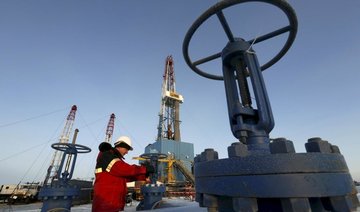
Oil producers from OPEC and non-OPEC countries struck a historic deal in late 2016 to cut output by 1.8 million barrels per day. (AFP)
Updated 27 February 2018
Follow

OPEC chief expects 2018 oil market balance

ABU DHABI: OPEC chief Suhail Al-Mazrouei said Tuesday he expected the global oil market to be balanced this year, as producers continue to trim production following a 2014 market crash.
“I am optimistic that this year, we will achieve a market balance” between supply and demand, Mazrouei, also the energy minister of the United Arab Emirates, told the Global Financial Markets Forum in Abu Dhabi.
Oil producers from OPEC and non-OPEC countries struck a historic deal in late 2016 to cut output by 1.8 million barrels per day, following a surplus in crude supply that sent prices crashing in 2014.
Compliance to the cuts hit 133 percent in January, which Mazrouei said exceeded the percentage required in the deal. The compliance rate was 129 percent in December and 122 percent in November.
Oil prices have rebounded to around $70 a barrel as a result of the policy.
Mazrouei said cooperation between oil producers including Russia had reached levels that were “more than expected.”
The minister said earlier this month that OPEC aimed to forge longer-term partnership with non-OPEC producers to stabilize the market.
Mazrouei warned however that with the balance returning to the oil market and demand picking up, the energy sector would require hefty investment in the near future — not only by the oil-rich Gulf states, but also international oil companies.
“We need to add 15 million barrels daily by 2040 to meet demand,” he said, putting the needed investment at $10.5 trillion.


Saudi POS spending rises 4.5% to $3.8bn in late February: SAMA 

Updated 4 sec ago
Follow

Saudi POS spending rises 4.5% to $3.8bn in late February: SAMA 

RIYADH: Saudi Arabia’s point-of-sale spending rose 4.5 percent to SR14.5 billion ($3.8 billion) in the week ending Feb. 28, even as the number of transactions declined.

According to the latest data from the Saudi Central Bank, also known as SAMA, the total number of transactions fell 4.6 percent to 210.53 million during the period.

Freight transport and postal services recorded the largest jump, surging 50.4 percent to SR121.35 million. Apparel and clothing followed with a 44.2 percent gain to SR1.9 billion. 

Personal care transactions grew 21.7 percent, while books and stationery advanced 8.3 percent. Hotel receipts also increased 11.1 percent to SR376.26 million. 

Pharmacies and medical supplies registered a 23.5 percent rise to SR254.51 million, while medical services edged up 10.2 percent to SR531.56 million. 

Food and beverage purchases declined 11.4 percent to SR2.33 billion, though the segment still accounted for the largest share of POS activity. Restaurants and cafes followed with a 1.8 percent drop to SR1.22 billion. 

The Kingdom’s key urban centers reflected the broader trend. Riyadh, which accounted for the largest share of POS activity, recorded a 2.5 percent increase to SR4.86 billion, compared with SR4.75 billion the previous week. Transactions in the capital totaled 65.7 million, down 5.9 percent week on week. 

In Jeddah, transaction values climbed 5.6 percent to SR2 billion, while Dammam posted a 1.6 percent uptick to SR689 million. 

Weekly POS figures tracked by SAMA offer insight into consumer behavior and the continued expansion of digital payments across Saudi Arabia. 

The data also highlights the expanding reach of POS infrastructure, extending beyond major retail hubs to smaller cities and service sectors, supporting broader digital inclusion initiatives.  

The growth of digital payment technologies aligns with Saudi Arabia’s Vision 2030 objectives, promoting electronic transactions and contributing to the Kingdom’s broader digital economy.