Oil rises on IMF economic growth outlook, OPEC-Russia supply cuts

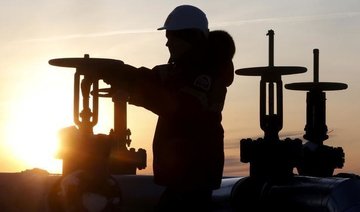
OPEC and Russia’s oil supply curbs began in January last year and are set to hold throughout 2018. (Reuters)
Updated 23 January 2018
Follow

Oil rises on IMF economic growth outlook, OPEC-Russia supply cuts

SINGAPORE: Oil prices rose on Tuesday, lifted by healthy economic growth as well as the ongoing supply restraint by a group of exporters around OPEC and Russia.
Spot Brent crude futures were at $69.41 at 0409 GMT, up 38 cents, or 0.55 percent, from their last close, not far off the January 15 three-year high of $70.37 a barrel.
US West Texas Intermediate (WTI) crude futures were at $63.99 a barrel, up 42 cents, or 0.7 percent, from their last settlement. WTI hit its highest since December 2014 on January 16 at $64.89 a barrel.
Traders said oil markets were generally well supported by healthy economic growth.
The International Monetary Fund (IMF) on Monday revised upward its forecast for world economic growth in 2018 and 2019, to 3.9 percent for both 2018 and 2019, a 0.2 percentage point increase from its last update in October.
The “economic outlook and seasonally colder weather has led to firmer oil demand growth, facilitating the continuation of a fall in oil inventories toward OPEC’s recent five-year average target,” BNP Paribas said in a note.
This growth, which is also translating into more oil consumption, comes at a time of supply curbs by the Organization of the Petroleum Exporting Countries (OPEC) and Russia, which began in January last year and are set to hold throughout 2018.
“The outlook for 2018 is roughly balanced for most of the year, but inventories are set to rise in Q4’18,” the French bank said, adding that it has hiked its 2018 oil price forecasts by $10 a barrel and expects WTI to average $60 a barrel and Brent $65.
But there have also been signs of a possible crude oil downward price correction.
Crumbling refinery profits, first in Asia and now also in Europe and the United States, as a result of rising feedstock prices and plentifully available fuel products, point to lower crude orders going forward.
In the longer term, investors are preparing for large-scale changes in oil demand coming from the rise of electric vehicles.
Bank of America Merrill Lynch said this week in a note to investors that “we see peak oil demand by 2030 on electric vehicles ... Electric vehicles will have replaced conventional (vehicles) by 2050.”
The bank also said that “when gasoline demand peaks by 2025 (and total oil by 2030), refinery utilization rates may decline permanently and refining margins suffer heavily.”


Saudi Arabia, Japan trade rises 38% between 2016 and 2024, minister says

Updated 11 January 2026
Follow

Saudi Arabia, Japan trade rises 38% between 2016 and 2024, minister says

RIYADH: Trade between Saudi Arabia and Japan has increased by 38 percent between 2016 and 2024 to reach SR138 billion ($36 billion), the Kingdom’s investment minister revealed.

Speaking at the Saudi-Japanese Ministerial Investment Forum 2026, Khalid Al-Falih explained that this makes the Asian country the Kingdom’s third-largest trading partner, according to Asharq Bloomberg.

This falls in line with the fact that Saudi Arabia has been a very important country for Japan from the viewpoint of its energy security, having been a stable supplier of crude oil for many years.

It also aligns well with how Japan is fully committed to supporting Vision 2030 by sharing its knowledge and advanced technologies.

“This trade is dominated by the Kingdom's exports of energy products, specifically oil, gas, and their derivatives. We certainly look forward to the Saudi private sector increasing trade with Japan, particularly in high-tech Japanese products,” Al-Falih said.

He added: “As for investment, Japanese investment in the Kingdom is good and strong, but we look forward to raising the level of Japanese investments in the Kingdom. Today, the Kingdom offers promising opportunities for Japanese companies in several fields, including the traditional sector that links the two economies: energy.”

The minister went on to note that additional sectors that both countries can also collaborate in include green and blue hydrogen, investments in advanced industries, health, food security, innovation, entrepreneurship, among others.

During his speech, Al-Falih shed light on how the Kingdom’s pavilion at Expo 2025 in Osaka achieved remarkable success, with the exhibition receiving more than 3 million visitors, reflecting the Japanese public’s interest in Saudi Arabia.

“The pavilion also organized approximately 700 new business events, several each day, including 88 major investment events led by the Ministry of Investment. Today, as we prepare for the upcoming Expo 2030, we look forward to building upon Japan’s achievements,” he said.

The minister added: “During our visit to Japan, we agreed to establish a partnership to transfer the remarkable Japanese experience from Expo Osaka 2025 to Expo Riyadh 2030. I am certain that the Japanese pavilion at Expo Riyadh will rival the Saudi pavilion at Expo Osaka in terms of organization, innovation, and visitor turnout.”

Al-Falih also shed light on how Saudi-Japanese relations celebrated their 70th anniversary last year, and today marks the 71st year of these relations as well as how they have flourished over the decades, moving from one strategic level to an even higher one.