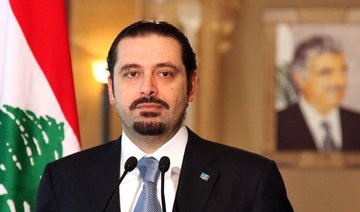
BEIRUT: Lebanon’s Prime Minister Saad Al-Hariri vowed on Monday to hold intensive meetings to complete the 2018 budget in line with a March 5 deadline set by the parliament speaker.
The finance minister has said Lebanon will not be able to ask international donors for support at forthcoming conferences unless it first passes the 2018 budget to show backers that Beirut is serious about reforming the heavily indebted state.
“The country needs reforms, the budgets of ministries should be reduced and we have to send real positive signs to the states participating in the forthcoming international conferences,” Hariri said in a statement from his press office on Monday.
Lebanon hopes to win billions of dollars of international investment at a Paris conference due to take place on April 6. It is seeking funding for a 10-year $16 billion capital investment program aimed at lifting economic growth.
Lebanon’s public debt was estimated above 150 percent of GDP at the end of 2017, and is expected to rise rapidly with a budget deficit above 10 percent over the forecast horizon, the International Monetary Fund said this month.
The country has one of the world’s highest debt-to-GDP ratios in the world and its economic growth is very weak, battered by domestic tensions and conflict in neighboring Syria. Political deadlock had left it without a government budget from 2005 until it agreed one last year.
The IMF report said passing the 2018 budget and preparing for the Paris conference could provide opportunities to launch much-needed reforms.
Hariri said: “We will hold consecutive sessions to finish it before the date set by Speaker Nabih Berri on March 5, because everyone will be busy afterwards to prepare for the parliamentary elections.”
Parliamentary elections are due to take place on May 6.

Lebanon’s PM vows push to finish 2018 budget
Hamas says technocratic committee key to consolidating Gaza truce
- A senior Hamas official on Thursday welcomed the formation of a technocratic committee to govern post-war Gaza, saying it would help consolidate the ceasefire and prevent a return to fighting
GAZA: A senior Hamas official on Thursday welcomed the formation of a technocratic committee to govern post-war Gaza, saying it would help consolidate the ceasefire and prevent a return to fighting.
Egypt, a mediator in indirect ceasefire talks between Israel and Hamas, announced the formation of a 15-member Palestinian technocratic committee that would operate under the overall supervision of a so-called “Board of Peace,” to be chaired by US President Donald Trump.
“The formation of the committee is a step in the right direction,” said Bassem Naim, a senior leader in the Palestinian Islamist movement.
“This is crucial for consolidating the ceasefire, preventing a return to war, addressing the catastrophic humanitarian crisis and preparing for comprehensive reconstruction,” he said.
Hamas has exercised total control over public life in Gaza since 2007.
It has repeatedly said it does not seek a role in any future governing authority in Gaza and would limit its involvement to monitoring governance.
Naim said Hamas was ready to hand over administration of the Gaza Strip to the national transitional committee and to facilitate its work.
“The ball is now in the court of the mediators, the American guarantor and the international community to empower the committee,” he said.
He urged them to counter what he described as Israeli Prime Minister Benjamin Netanyahu’s attempts to “stall or obstruct” the next stages of the ceasefire.
Since the ceasefire took effect on October 10, Gaza has been split by a so-called “Yellow Line,” marking the boundary between territory controlled by Hamas and areas under Israeli military authority.
Washington’s top envoy, Steve Witkoff, said on Wednesday the ceasefire had moved into its second stage.
Key elements of the second stage include the gradual withdrawal of Israeli forces from Gaza, the demilitarization of the territory including the disarmament of Hamas, and steps to address the humanitarian crisis through accelerated aid deliveries and reconstruction.
The US-proposed Board of Peace is expected to be led on the ground by Bulgarian diplomat and politician Nickolay Mladenov, who has recently held talks with Israeli and Palestinian officials.
Mladenov previously served as the United Nations envoy for the Middle East peace process from early 2015 until the end of 2020.
Media reports say Trump is expected to announce the members of the Board of Peace in the coming days, with the body set to include around 15 world leaders.
Egypt, a mediator in indirect ceasefire talks between Israel and Hamas, announced the formation of a 15-member Palestinian technocratic committee that would operate under the overall supervision of a so-called “Board of Peace,” to be chaired by US President Donald Trump.
“The formation of the committee is a step in the right direction,” said Bassem Naim, a senior leader in the Palestinian Islamist movement.
“This is crucial for consolidating the ceasefire, preventing a return to war, addressing the catastrophic humanitarian crisis and preparing for comprehensive reconstruction,” he said.
Hamas has exercised total control over public life in Gaza since 2007.
It has repeatedly said it does not seek a role in any future governing authority in Gaza and would limit its involvement to monitoring governance.
Naim said Hamas was ready to hand over administration of the Gaza Strip to the national transitional committee and to facilitate its work.
“The ball is now in the court of the mediators, the American guarantor and the international community to empower the committee,” he said.
He urged them to counter what he described as Israeli Prime Minister Benjamin Netanyahu’s attempts to “stall or obstruct” the next stages of the ceasefire.
Since the ceasefire took effect on October 10, Gaza has been split by a so-called “Yellow Line,” marking the boundary between territory controlled by Hamas and areas under Israeli military authority.
Washington’s top envoy, Steve Witkoff, said on Wednesday the ceasefire had moved into its second stage.
Key elements of the second stage include the gradual withdrawal of Israeli forces from Gaza, the demilitarization of the territory including the disarmament of Hamas, and steps to address the humanitarian crisis through accelerated aid deliveries and reconstruction.
The US-proposed Board of Peace is expected to be led on the ground by Bulgarian diplomat and politician Nickolay Mladenov, who has recently held talks with Israeli and Palestinian officials.
Mladenov previously served as the United Nations envoy for the Middle East peace process from early 2015 until the end of 2020.
Media reports say Trump is expected to announce the members of the Board of Peace in the coming days, with the body set to include around 15 world leaders.
© 2026 SAUDI RESEARCH & PUBLISHING COMPANY, All Rights Reserved And subject to Terms of Use Agreement.


