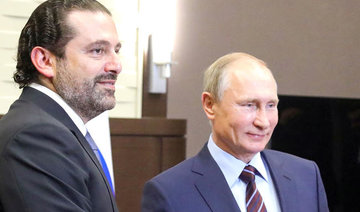
BEIRUT: Lebanese Prime Minister Saad Al-Hariri announced his resignation on Saturday, taking the Lebanese people, especially the politicians, by surprise.
Al-Hariri accused Iran and Hezbollah of dominating Lebanon, adding: “We are living in a climate similar to the atmosphere that prevailed before the assassination of martyr Rafik Al-Hariri. I have sensed what is being plotted covertly to target my life.”
In the speech, which was broadcast by Lebanese TV channels, Al-Hariri told the Lebanese that the nation was “living under tragic circumstances caused by external interferences.”
He said that “groups that do not want anything good for you dominated you, supported from outside the borders. These groups sowed sedition among the people of one country, threatened the authority of the state, established a state within the state and ended up by controlling it and having the upper hand and the final say in the affairs of Lebanon and the Lebanese people.”
Al-Hariri attacked Iran directly, saying: “I refer explicitly and unequivocally to Iran, which sows sedition, devastation and destruction in any place it settles in, as proven by its interferences in the internal affairs of the Arab countries, in Lebanon, Syria, Iraq, Bahrain and Yemen, driven by a deep hatred of the Arab nation and an overwhelming desire to destroy and control it.
“Unfortunately, it found among the sons of these countries some people who put their hands in its hand, openly declaring their loyalty to it, and their will to kidnap Lebanon, with the values and ideals it represents, from its Arab and international surrounding. I mean Hezbollah, the Iranian arm, not only in Lebanon but also in the Arab countries.”
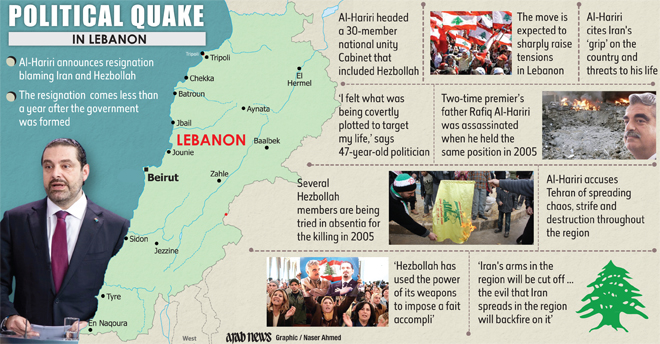
Al-Hariri stressed that “Over the past decades, Hezbollah has unfortunately managed to impose a fait accompli in Lebanon by the force of its weapons, which it alleges is a resistance weapon. This weapon is directed to our Syrian and Yemeni brothers, in addition to the Lebanese. I do not need to list these interventions.
“Their magnitude appears daily and we suffer from it, not only on the Lebanese internal level but also on the level of our relations with our Arab brethren, and the latest example of that is Hezbollah's cell in Kuwait. Lebanon and the great Lebanese people became in the eye of the storm and subjected to international condemnations and economic sanctions because of Iran and its arm, Hezbollah.
“We all read what the head of the Iranian regime pointed to,” Al-Hariri added, “that Iran controls the fate of the countries in the region and that Iraq, Syria, Lebanon, North Africa and the Arab Gulf cannot take any decisive step without Iran, and I responded to that at the time. I want to tell Iran and its followers that they are losing in their interferences in the Arab nation affairs.
“Our nation will rise just as it did before and the hands that want to harm it will be cut, and just as Bahrain and Yemen responded, each and every part of our precious nation will do the same and evil will go back to its sender.”
Al-Hariri noted that when he accepted the responsibility of being the prime minister, he was seeking “the unity of the Lebanese, to end political division and restore the sovereignty of the Lebanese people. This caused me harm and I did not reply, for the sake of Lebanon and the Lebanese people. But unfortunately, this pushed Iran and its allies toward more interference in our internal affairs, violation of the state authority and imposition of fait accompli.”
The resignation came as a shock to political parties in Lebanon.
In a statement, the Lebanese presidential office said that President Michel Aoun was informed by Al-Hariri in a phone call “from outside the country” of his resignation, adding that the president now awaits Al-Hariri’s return to the country to clarify the circumstances of his resignation and proceed accordingly. Aoun, who was supposed to start an official visit to Kuwait on Sunday, has postponed it.
Mustapha Allouch, a Lebanese politician and member of the Future Movement, told Arab News that the resignation of Al-Hariri was “a surprise but not strange,” adding that “the resignation was discussed long time ago as a choice.”
Allouch stressed that “the resignation is not just linked to the possibility of assassination, but also to the refusal of Hezbollah, which is an Iranian-affiliated militia, to change over the years, despite all the settlements which Al-Hariri offered in the past few years.”
Allouch expected a “reshuffle of cards in the short run, and the situation depends on the way of confronting Hezbollah on the regional and international levels.”
Former Lebanese President Michel Suleiman tweeted: “We have entered a tunnel which requires all officials to close their ranks. Lebanon and its people deserve sacrifice.”
“Lebanon is too small and weak to bear the economic and political burden of the resignation,” said Walid Jumblatt, leader of the leader of the Progressive Socialist Party. “I will continue to be among those who call for dialogue between Saudi Arabia and Iran despite all difficulties.”
Antoine Zahra, the leader of the Lebanese Forces bloc in the Lebanese Parliament, believes that “Al-Hariri was politically and administratively embarrassed to the point of no return.”
Zahra added that there has been “an accumulation of positions and attempts to lay hands on the general policies of the government as well as the Lebanese policies in order to annex Lebanon to the Iranian axis.”
Zahra said that the “crisis of forming the government will continue for months.”
Gebran Bassil, leader of the Free Patriotic Movement, called upon all “officials, ministers, members of Parliament, and leaders in the movement to keep silent and refrain from commenting on Hariri's resignation at the moment.”
The resignation caused some concern about the value of the Lebanese pound. However, the Lebanese Minister of Economy, Raed Khoury, assured in a statement that there is “no fear on the Lebanese pound and that the financial, economic and security situation is stable.”
Khoury added that “Lebanon went through greater crises and preserved its stability.”