Saudi Arabia, Turkey to work closely on local defense industry

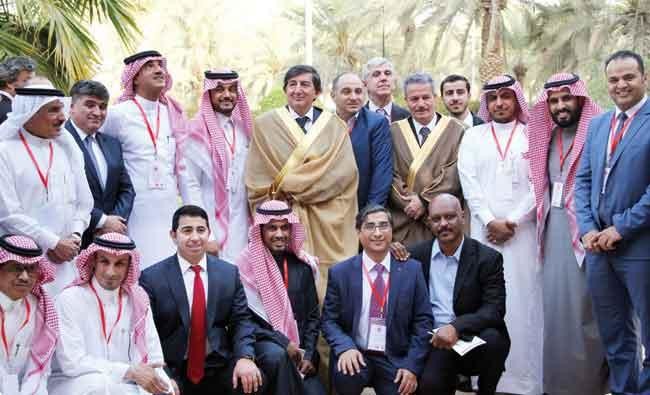
Turkish Ambassador Erdogan Kok, center, poses for photo in traditional Saudi dress with Turkish executives and local journalists at his house in Riyadh. (AN photo)
Updated 24 February 2018
Follow

Saudi Arabia, Turkey to work closely on local defense industry

RIYADH: Turkey, the guest-of-honor country at the Saudi armed forces exhibition (AFED 2018), has shown keen interest in working closely with Saudi Arabia to build Saudi defense capabilities.
Such a move will help the Kingdom to develop an indigenous defense industry, and to design as well as manufacture defense platforms, products and technology within the framework of Vision 2030.
This was disclosed by Turkish Ambassador Erdogan Kok on Saturday. Kok pointed out “a total of 24 top-notch Turkish companies will display a large number of products, including military hardware and service components, at the exhibition.” He said a high-ranking delegation comprising officials of the Turkish Defense Ministry and industry leaders led by Dr. Ismail Demir, chief of the Turkish defense industry, will participate in the opening ceremony of AFED 2018.
Kok pointed out that strategic ties between Turkey and Saudi Arabia in the fields of defense and military cooperation are flourishing. He said that the week-long AFED exhibition will serve as a unique tool for deepening military‑technical cooperation between the countries. This is a significant step as developing a military industrial base is an ambitious and attainable goal in Vision 2020.
The envoy said “Demir will hold talks with high-ranking Saudi leaders and senior officials on the sidelines of the AFED.” He also noted that “the next meeting of the Saudi-Turkish Coordination Council, which discusses and deliberates all aspects of bilateral relations between the two countries, will take place in Riyadh soon.”
Turkey, which has the second-largest standing military in NATO, has fielded advanced communications and information systems with focus on helicopters, unmanned aerial vehicles and sensors, said a report released on this occasion.


Saudi Arabia, UAE and allies condemn Gaza ceasefire violations

Updated 7 sec ago
Follow

Saudi Arabia, UAE and allies condemn Gaza ceasefire violations

RIYADH: Saudi Arabia on Sunday led renewed regional condemnation of Israel’s repeated violations of the ceasefire in Gaza, which have resulted in the killing and wounding of more than 1,000 Palestinians.

In a joint statement, the foreign ministers of the Kingdom, the UAE, Indonesia, Pakistan and Turkiye said the breaches represented a dangerous escalation that risked inflaming tensions and undermining efforts to restore calm and stability, the Saudi Press Agency reported.

They joined Qatar, Jordan and Egypt, who on Saturday condemned what they described as ongoing ceasefire violations and warned they threatened de-escalation efforts and regional stability.

The ministers said the latest developments come at a critical moment, as regional and international efforts intensify to advance the second phase of the peace plan proposed by US President Donald Trump and implement UN Security Council Resolution 2803, SPA added.

They warned that the repeated violations pose a direct threat to the political process and could derail attempts to create the conditions for a more stable phase in Gaza, both in security and humanitarian terms. They stressed the need for full adherence to the ceasefire to ensure the success of the next phase of the peace plan.

The statement called on all parties to assume their responsibilities during this sensitive period, exercise maximum restraint, sustain the ceasefire, and avoid any actions that could undermine current diplomatic efforts. It also urged steps to facilitate early recovery and reconstruction in the Gaza Strip.

Reaffirming their commitment to a just, comprehensive and lasting peace, the ministers said this must be based on the Palestinian people’s inalienable right to self-determination and the establishment of an independent state, in line with international law, relevant UN Security Council resolutions and the Arab Peace Initiative.