TOKYO: Japan’s core consumer inflation was steady in January from a year earlier in a sign a strengthening economy has yet to prompt companies to raise prices, a challenge policymakers have yet to overcome despite years of massive stimulus.
Subdued inflation has forced the Bank of Japan to maintain ultra-loose policy even as the economic recovery gathers momentum, suggesting it will lag behind its global peers in dialing back its crisis-era stimulus.
A recent Reuters poll showed more than half of Japanese firms do not plan to raise base pay in annual wages talks this year, and the recent market sell-off could give them further excuse to delay pay hikes.
That adds to growing challenges for BOJ Governor Haruhiko Kuroda as he prepares for his second term in April with the central bank — bound by an elusive target — unable to withdraw stimulus even as the cost of prolonged easing rise.
“With wage growth still muted, a marked pick-up in service inflation is not on the cards,” said Marcel Thieliant, senior Japan economist at Capital Economics. “The upshot is that the BOJ’s 2 percent inflation target remains out of reach.”
The nationwide core consumer price index, which includes oil products but excludes volatile fresh food costs, rose 0.9 percent in January from a year earlier, data showed on Friday.
That was roughly in line with private forecasts and matched the pace of gains in the previous two months, due mostly to increases in gasoline and fuel costs.
An index excluding the effect of fresh food and energy — closely watched by the BOJ as a measurement of demand-driven price growth — saw inflation accelerate to 0.4 percent in January from 0.3 percent in the previous month.
Yoshiki Shinke, chief economist at Dai-ichi Life Research Institute, said the results reflect a tug-of-war between firms seeking to increase prices to pass on rising costs, and those wary of doing so for fear of scaring away consumers.
“This balance won’t change for a while, so prices may not rise or fall that much for some time,” he said.
Japan’s economy expanded at an annualized 0.5 percent in October-December, posting its longest continuous expansion since the 1980s boom, thanks to robust capital spending.
But inflation remains distant from the BOJ’s 2 percent target as companies hold off on raising prices and wages, citing uncertainty over the economic outlook.
While inflation has been absent or tepid in many advanced economies over the last couple of years despite a revival in growth, Japan is only just starting to emerge from nearly two decades of deflation.
Prime Minister Shinzo Abe has been pushing companies to raise wages by 3 percent or more to spur consumer spending, piling pressure on firms to spend their huge cash pile to broaden the benefits of the strengthening economy.
There is scant sign companies will pay heed with recent yen gains threatening to hurt manufacturers’ export-driven profits.
Slow wage growth could put a dampener on consumption, which has failed to show any sustainable gains in recent months. It rose 0.5 percent in October-December, failing to make up for a 0.6 percent slump in the previous quarter.
Some analysts say a recent spike in vegetable and grocery prices, blamed in part to bad weather, may also dent consumption.
Annual overall consumer inflation, which includes volatile fresh food costs, accelerated to 1.4 percent in January from 1.0 percent in December. That was the highest level since July 2014, when stripping away the effect of a 2014 sales tax hike.
Underscoring Japan’s sticky deflationary mindset, major supermarket chain operator Seiyu on Thursday announced plans to cut prices of roughly 500 food items by an average 7 percent.
“There’s a strong chance the recent sharp rise in fresh food prices is hurting consumer sentiment. That’s why the momentum for demand-driven price growth remains weak,” said Takeshi Minami, chief economist at Norinchukin Research Institute.
The road ahead for the BOJ looks rocky. As other central banks head for an exit, the BOJ could struggle to persuade investors it will be in no rush to follow in the footsteps of its overseas peers.
“As we have seen with the euro this year, it is the anticipation of monetary policy swings, not their implementation, that drives markets, and the BOJ has further to swing to achieve normalization than either the United States or the euro,” ING chief Asia economist Robert Carnell said in a research note.


Japan’s stagnant inflation set to keep BOJ exit from stimulus distant
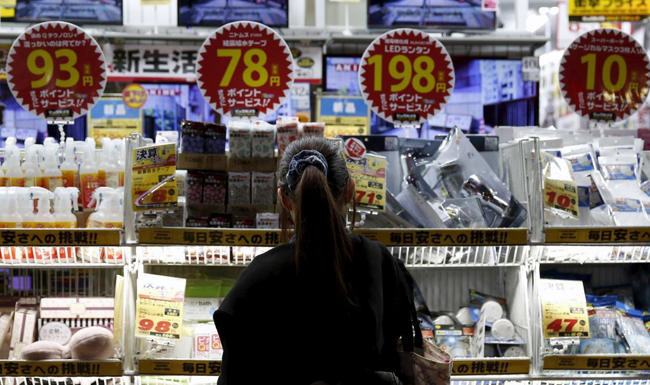
Japan’s stagnant inflation set to keep BOJ exit from stimulus distant


GCC chambers plan Gulf Guarantee project to boost intra-regional trade
DAMMAM: The Federation of GCC Chambers, in cooperation with the Customs Union Authority, intends to launch the Gulf Guarantee Project to provide a unified mechanism for exports and trade transactions and to enhance the efficiency of intra-GCC trade, which reached about $146 billion by the end of 2024, Saleh Al-Sharqi, Secretary-General of the federation, told Al-Eqtisadiah.
Al-Sharqi said, on the sidelines of his meeting with media representatives at the federation’s headquarters in Dammam, that the initiative represents a qualitative leap in supporting intra-GCC trade by facilitating transit movement through a single point, contributing to cost reduction, accelerating the flow of goods, and enhancing the reliability of trade operations among Gulf markets.

He explained that the federation recently launched a package of strategic initiatives, including the Tawasul initiative aimed at strengthening communication among Gulf business owners and supporting the building of trade and investment partnerships, in addition to the Gulf Business Facilitation initiative, which seeks to address challenges facing Gulf investors and traders, simplify procedures, and improve the business environment across member states.
He noted that these initiatives fall within an integrated vision to address obstacles hindering investment and intra-regional trade flows by developing regulatory frameworks, activating communication channels between the public and private sectors, and supporting Gulf economic integration in line with the objectives of the Gulf Common Market.
In a related context, the Secretary-General affirmed the direction of GCC countries to leverage artificial intelligence technologies to support trade and investment flows, stressing the importance of establishing a unified Gulf committee for artificial intelligence to coordinate efforts and exchange expertise among member states. He said the federation will support this direction in the coming phase, drawing on leading international experiences, particularly the Chinese experience in this field.
Regarding the recently announced electric railway project between Riyadh and Doha, Al-Sharqi revealed that technical and advisory committees are working to complete the necessary studies for the project, confirming that it will positively impact passenger and freight movement between the two countries, enhance Gulf logistical integration, and support regional supply chains.
On investment opportunities available to Gulf nationals in the Syrian market, he said the federation is coordinating with private sector representatives in Syria to overcome obstacles that may face the flow of Gulf investments, in addition to working to provide adequate guarantees to protect these investments and ensure a stable and attractive investment environment.
In response to a question from Al-Eqtisadiah about the impact of tariffs imposed by the US on imports of iron, steel, and aluminum, he said that economic and technical committees in GCC countries are continuously monitoring the repercussions of these tariffs on the Gulf private sector, assessing their effects, and taking the necessary measures to protect it from any potential negative impacts.
Al-Sharqi also pointed to the launch of two specialized committees in the transport and logistics sectors and in real estate activities, given their pivotal role and active contribution to Gulf gross domestic product, stressing that developing these two sectors is a fundamental pillar for enhancing economic diversification and increasing the competitiveness of GCC economies.
He added that during the past year the federation held more than 40 meetings and official engagements with Gulf and international entities, participated in nine regional and international events to strengthen the presence of the Gulf private sector on the global stage, and signed 12 agreements and memoranda of understanding with Gulf, regional, and international entities to open new horizons for economic and investment cooperation.
During the same year, the federation launched four digital platforms to support the Gulf private sector, bringing the total number of its digital platforms to eight serving the business community across member states.
The Secretary-General affirmed that the federation will continue working with relevant economic entities to unify procedures and regulations, reduce non-tariff barriers, and accelerate mutual recognition of products and standard specifications, in a way that enhances the competitiveness of the Gulf economy and supports the growth of intra-GCC trade.