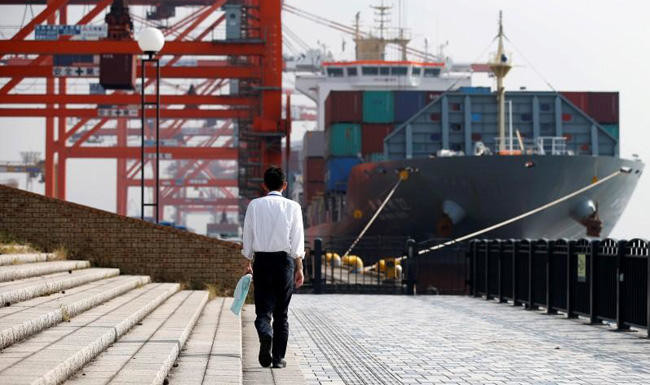
TOKYO: Buoyant sales of cars and electronics led Japan’s exports to a 14th straight month of growth in January but manufacturers’ business confidence slid — highlighting fears of the rising yen disrupting an export-led recovery.
The trade data came on the heels of the Reuters Tankan survey that found Japanese manufacturers’ confidence deteriorated sharply in February, pointing to global stock market turmoil and the yen undermining business sentiment.
Such variable indicators underscore the challenge facing the Bank of Japan’s leadership trio — reappointed Governor Haruhiko Kuroda and two new deputies — as they work to stimulate the economy out of decades of stagnation.
The low mood of manufacturers in the Tankan survey was at odds with Ministry of Finance data out on Monday showing that exports grew 12.2 percent year-on-year in January, topping the prior month’s 9.3 percent gain and economists’ estimate of a 10.3 percent increase.
Monday’s news also followed gross domestic product data out last week showing Japan recorded its eighth straight quarter of economic expansion over October-December.
A strong currency eats into Japanese manufacturers’ profits and could disrupt the virtuous cycle of business investment, consumer spending and growth that authorities have struggled to set in motion.
“Our consolidated profits have deteriorated because of a strong yen,” a manager of a transport equipment maker wrote in the survey.
Economists believe global demand should continue to drive Japanese exports and broader economy in the coming months, even though the rising yen clouds the outlook.
Sustained yen appreciation of 5 percent would lower GDP-based real exports by 0.2 percent in the first year, 1.1 percent in the second and 1.2 percent in the third year, which may not be fatal but could not be ignored, said Yoshimasa Maruyama, chief economist at SMBC Nikko Securities.
“We don’t forecast exports to sputter but need to bear in mind the risk that a strong yen may curb their driving force.”
The Reuters Tankan sentiment index for manufacturers stood at 29 in February, down from the previous month’s 11-year high of 35, the survey conducted January 31 to February 14 found. The monthly poll closely tracks the Bank of Japan’s key quarterly tankan.
Monday’s trade data showed exports to China, Japan’s biggest trading partner, jumped 30.8 percent year-on-year in January, due in part to an export surge before the Lunar New Year that happened later than last year. The gain was led by semiconductor production, equipment, car engines and hybrid cars.
Shipments to Asia as a whole, which account for more than half of Japan’s exports, grew 16.0 percent in the year to January.
US-bound shipments rose 1.2 percent in the year to January, led by steel, batteries and medicines, while car shipments declined 3.9 percent. The small rise in US-bound exports followed a 3.0 percent gain in the previous month.
Japan’s trade surplus with the US fell an annual 12.3 percent in January to 349.6 billion yen, a second declining month.
The overall trade balance swung to a deficit of ¥943.4 billion, the first trade deficit in eight months.
“Net exports may return to growth this quarter,” said Marcel Thieliant, senior Japan economist at Capital Economics.
“Looking ahead, the export climate index climbed to a fresh high last month and suggests that external demand remains healthy. We’ve penciled in a 4.5 percent rise in export volumes this year.”


![]()
Japan exports grow, but manufacturers’ confidence slips amid fears of rising yen
Japan exports grow, but manufacturers’ confidence slips amid fears of rising yen



Latest updates


© 2026 SAUDI RESEARCH & PUBLISHING COMPANY, All Rights Reserved And subject to Terms of Use Agreement.