LONDON: The UK government is in talks with US counterparts over what to do with two men from London detained in Syria on suspicion of terrorism.
British Home Secretary Amber Rudd has said the two men, Alexanda Kotey and El Shafee Elsheikh, should go on trial, according to media reports. However, Rudd has not confirmed if the suspects will be brought back to the UK.
The accused are the surviving members of a group of four Britons — nicknamed the “Beatles” because of their English accents — who joined Daesh after 2012, and are said to have participated in the torture and beheading of Western hostages. The former Londoners were arrested in Syria.
As both British and American citizens are thought to have been killed by the group, the UK and US have competing jurisdiction over them.
“What we’re looking at is making sure they do face justice, and that they do face the full force of the law for their terrible crimes. We’re working with the Americans to find out how that will be done,” Rudd told media on a trip to the Middle East.
It has been reported that the two suspects have been stripped of their British citizenship, although officials at the Home Office have refused to comment on individual cases.
The British government previously rejected the idea of repatriating the two Daesh fighters, with Defense Secretary Gavin Williamson saying the pair had turned their backs on British ideas and values.
“Do I want them back in the United Kingdom? No, I don’t,” Williamson reportedly said.
The US government is understood to have said that putting the pair into Guantanamo Bay is not an option.
The uncertainty over how to deal with Alexanda Kotey and El Shafee Elsheikh highlights the different pressures faced by the US and British administrations.
Although US President Donald Trump said during his election campaign that he would fill Guantanamo Bay with “bad dudes,” in reality Guantanamo is a sensitive topic.
“The American response (to the arrested suspects) is rooted in the problems they’ve faced over Guantanamo Bay… if they were to take irregular combatants from Syria, Iraq, if they’re non-US citizens that exaggerates the pressure not to take people who are not from the US. They don’t want to take on other nation’s problems,” Dr. Peter Lee, director of security and risk research, at the University of Portsmouth, told Arab News.
The issue is compounded by Trump’s America First policy and his tough stance on immigration.
“The UK context is tied into the number of terror incidents that have happened in the UK and EU over past couple of years. Also, Brexit was about control, who comes into the country, so bringing a proven (extremist) into the country is difficult,” Lee said.
A third factor is the European Court of Human Rights and whether Kotey and Elsheikh are legally entitled to return to the UK, even as potentially stateless citizens.
Lee believes that the deciding factor for bringing the men back to British shores may be Brexit, conversely: “The last thing the British government needs is another course of antagonism with the EU at the time of Brexit negotiations.”
The British government is facing a mounting problem with returning extremists. Last September Gilles de Kerchove, the EU’s counter-terror coordinator, warned there could be around 25,000 extremists in the UK.


![]()
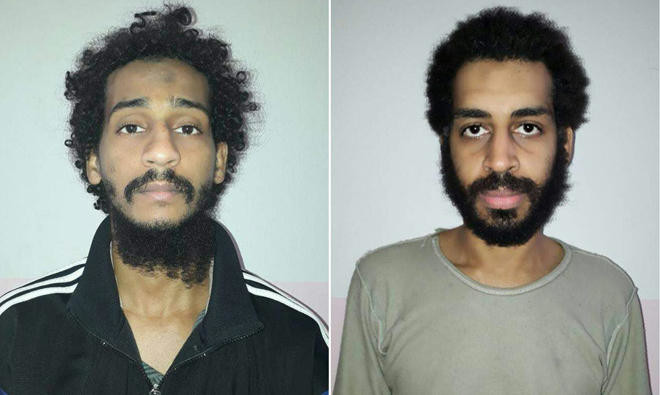
UK, US discuss fate of British Daesh suspects
UK, US discuss fate of British Daesh suspects

Latest updates



© 2026 SAUDI RESEARCH & PUBLISHING COMPANY, All Rights Reserved And subject to Terms of Use Agreement.