LONDON: Oxfam revealed Tuesday it was investigating 26 new cases of sexual misconduct since the crisis erupted over its handling of a 2011 prostitution scandal in Haiti, which the British charity called a “wake-up call.”
Chief executive Mark Goldring told a parliamentary committee in London that the cases varied in their seriousness, while 16 related to its international operation.
“They range in time frame from more recent events to long historic events where people did not report them at the time,” he said.
Goldring added he believed the latest cases had emerged as “a direct response to the publicity” around the Haitian scandal.
“We really want people to come forward,” he added.
The Oxfam chief was unable to provide further details on the cases when pressed by British lawmakers.
The committee said it would be conducting its own inquiry into abuses in the foreign aid sector.
Three of Oxfam’s most senior leaders repeatedly apologized for the charity’s handling of an internal investigation into the use of prostitutes by staff in Haiti following the devastating 2010 earthquake.
Caroline Thomson, chair of trustees, said: “It’s right to admit this has been a real wake-up call.”
The charity revealed 7,000 regular donors had been lost since the scandal emerged following reporting by The Times newspaper.
It said safeguards had been put in place following the 2011 probe, but admitted they had not gone far enough.
Thomson vowed to take “personal responsibility” for ongoing reform: “I have decided that we need to have more focus on safeguarding.”
Last week, Oxfam unveiled an action plan to tackle sexual harassment and abuse, including creating a new vetting system for staff.
The charity formally also apologized to Haiti on Monday over the scandal and for failing to report the matter adequately.
“Oxfam should have reported the matter to the Haitian authorities,” Goldring told lawmakers.
“It was not for Oxfam to decide whether a crime had been committed ... that was the wrong decision.”


Oxfam probes new sexual misconduct cases as MPs grill bosses
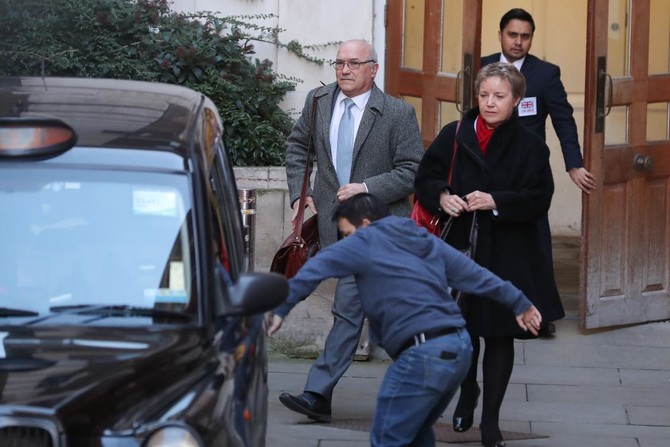
Oxfam probes new sexual misconduct cases as MPs grill bosses



Blair pressured UK officials over case against soldiers implicated in death of Iraqi
- Newly released files suggest ex-PM took steps to ensure cases were not heard in civilian court
- Baha Mousa died in British custody in 2003 after numerous assaults by soldiers over 36 hours
LONDON: Former UK Prime Minister Tony Blair pressured officials not to let British soldiers be tried in civil courts on charges related to the death of an Iraqi man in 2003, The Guardian reported on Tuesday.
Baha Mousa died in British Army custody in Basra during the Iraq War, having been repeatedly assaulted by soldiers over a 36-hour period.
Newly released files show that in 2005 Antony Phillipson, Blair’s private secretary for foreign affairs, had written to the prime minister saying the soldiers involved would be court-martialed, but “if the (attorney general) felt that the case were better dealt with in a civil court he could direct accordingly.”
The memo sent to Blair was included in a series of files released to the National Archives in London this week. At the top of the memo, he wrote: “It must not (happen)!”
In other released files, Phillipson told Blair that the attorney general and Ministry of Defence could give details on changes to the law they were proposing at the time so as to avoid claims that British soldiers could not operate in a war zone for fear of prosecution.
In response, Blair said: “We have, in effect, to be in a position where (the) ICC (International Criminal Court) is not involved and neither is CPS (Crown Prosecution Service). That is essential. This has been woefully handled by the MoD.”
In 2005, Cpl Donald Payne was court-martialed, jailed for a year and dismissed from the army for his role in mistreating prisoners in custody, one of whom had been Mousa.
Payne repeatedly assaulted, restrained and hooded detainees, including as part of what he called “the choir,” a process by which he would kick and punch prisoners at intervals so that they made noise he called “music.”
He became the first British soldier convicted of war crimes, admitting to inhumanely treating civilians in violation of the 2001 International Criminal Court Act.


