

Oxfam unveils action plan after ‘stain’ of sex scandal

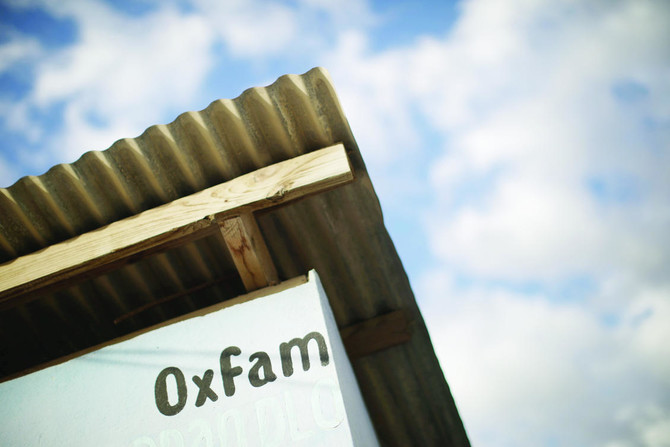
An Oxfam sign is seen on a kiosk that was used to distribute water in Corail, a camp for displaced people of the 2010 earthquake, on the outskirts of Port-au-Prince, Haiti, on Tuesday. (Reuters)
Updated 16 February 2018
Follow

Oxfam unveils action plan after ‘stain’ of sex scandal

LONDON: British charity Oxfam unveiled an action plan on Friday to tackle sexual misconduct following the “stain” of a prostitution scandal but the man at the center of the allegations denied organizing orgies.
The aid group said it would create an independent commission which will have the power to access records and interview staff in a bid to stamp out abuse and impose stricter controls on employees.
“We are going to create a vetting system,” Winnie Byanyima, executive director of Oxfam International, told the BBC.
“I’m really inviting anyone who has been a victim of abuse by anyone in our organization to come forward.”
Oxfam will triple funding to more than $1 million (€800,000) to improve safeguarding, while also doubling the number of staff in this area and increasing investment in gender training.
The new plan comes a week after revelations that Oxfam staff used prostitutes while working in Haiti following a devastating 2010 earthquake and a wave of subsequent allegations of sexual misconduct.
The charity’s deputy chief executive Penny Lawrence has resigned and three Oxfam global ambassadors including South Africa’s Archbishop Desmond Tutu have quit their roles as a result of the scandal.
“What happened in Haiti and afterwards is a stain on Oxfam that will shame us for years, and rightly so,” Byanyima said, adding: “From the bottom of my heart I am asking for forgiveness.”
Oxfam fired four staff members for gross misconduct and allowed three others to resign following an internal inquiry into what happened in Haiti in 2011.
But Roland van Hauwermeiren, Oxfam’s director in Haiti at the time and one of the three who resigned from the charity, dismissed the allegations.
“I have never been into a brothel, a nightclub or a bar in that country,” the 68-year-old Belgian national said in a four-page letter published on the website of Belgian VTM News.
“There were numerous men and women who tried to get into my house with all sorts of excuses to demand money, work, or to offer sexual services. But I never gave into these advances,” he said.
Van Hauwermeiren, who has taken part in an internal enquiry at the British charity, said he told Oxfam that he had “had intimate relations some three times at (his) house.”
“This was with an honorable, mature woman, who was not an earthquake victim nor a prostitute. And I did not give her any money,” he said, adding that he was however “deeply ashamed” of the liaison.
In comments to reporters at the newspaper Het Nieuwsblad, who tracked him down in an unidentified town on the Belgian coast, Van Hauwermeiren said there were “lots of lies and exaggerations” in media reports.

“The hardest thing is that my family has rejected me,” he said.
The charity has denied covering up the Haiti affair, which has prompted a drop in donations and led the British government to threaten to cut funds to organizations which try to hide sex scandals.
The charity admitted Thursday it rehired one of those sacked in Haiti just months later and is now checking whether any complaints were subsequently made.
Gurpreet Singh worked as a consultant in Ethiopia from October to December 2011, a decision Oxfam said was “a serious error and should never have happened.”
The charity on Friday said it was also investigating allegations of sexual misconduct at a hotel in the Philippines after a destructive typhoon in 2013.
Oxfam’s regional director for Asia Lan Mercado earlier this week told the BBC she was aware of cases of sexual abuse involving staff in Bangladesh, Nepal and the Philippines between 2009 and 2013.
Oxfam has come under fire for failing to inform other aid organizations of the allegations against its staff including Van Hauwermeiren, who went on to work for French charity Action Against Hunger in Bangladesh.
“We need to make sure anyone guilty of such gross misconduct is not able to move between different organizations, exposing more vulnerable people to risk,” said Byanyima.
In response, Oxfam on Friday said it would create a global database of accredited referees to crack down on forged or unreliable references from past or current employees.


US says Mexican cartel drones breached Texas airspace

Updated 4 sec ago
Follow

US says Mexican cartel drones breached Texas airspace

  • Drone breach comes some five months into a US military campaign targeting alleged drug-smuggling boats
  • US media also reported that the El Paso airspace closure may have been caused by the US military

HOUSTON: The Trump administration said Wednesday that Mexican cartel drones caused the temporary closure of a Texas airport, but some Democratic lawmakers pushed back, suggesting US military activity was responsible for the disruptive shutdown.
The report of the drone breach comes some five months into a US military campaign targeting alleged drug-smuggling boats, and could provide a pretext for President Donald Trump to follow through on his threats to expand the strikes to land.
Trump has specifically threatened to attack cartels inside Mexico, which said it had “no information” on drones at the border.
The US Federal Aviation Administration (FAA) said late Tuesday the airspace over the Texas border city of El Paso would be shut to all aircraft for 10 days, citing unspecified national “security reasons,” only to lift the closure after less than 24 hours.
Transportation Secretary Sean Duffy said in a post on X that the FAA and the Defense Department “acted swiftly to address a cartel drone incursion,” adding: “The threat has been neutralized, and there is no danger to commercial travel in the region.”
A US administration official meanwhile said the breach was by “Mexican cartel drones,” and that US forces “took action to disable the drones,” without providing specifics.
But Democratic Representative Veronica Escobar, whose district includes El Paso, questioned the Trump administration’s explanation, saying it was “not what we in Congress have been told.”
“The information coming from the administration does not add up and it’s not the information that I was able to gather overnight and this morning,” Escobar told journalists.
And top Democratic lawmakers from the House Committee on Transportation suggested the Pentagon may have been responsible for the situation, saying defense policy legislation allows the US military to “act recklessly in the public airspace.”
The lawmakers called for a solution that ensures “the Department of Defense will not jeopardize safety and disrupt the freedom to travel.”

- War against ‘narco-terrorists’ -

US media also reported that the El Paso airspace closure may have been caused by the US military, with CNN saying the shutdown was the result of Pentagon plans to use a counter-drone laser without coordinating with the FAA.
The Pentagon referred questions on the closure to the FAA, which said when it announced the move that “no pilots may operate an aircraft in the areas” covered by the restrictions and warned of potentially “deadly force” if aircraft were deemed a threat.
It updated its guidance Wednesday morning, saying on X that the closure was lifted.
Trump’s administration insists it is effectively at war with “narco-terrorists,” carrying out strikes on alleged traffickers in the Caribbean and eastern Pacific, while the US president has repeatedly said he plans to expand the strikes to land.
Mexican President Claudia Sheinbaum opposes US military intervention in her country but has so far managed to negotiate a fine diplomatic line with Trump.
She has stepped up extradition of cartel leaders to the United States and reinforced border cooperation amid tariff threats from Trump, for whom curbing illegal migration from Mexico was a key election promise.
Sheinbaum told a news conference Wednesday that she had “no information on the use of drones at the border,” but that her government was investigating.
The United States began carrying out strikes on alleged drug-trafficking boats in September, a campaign that has killed at least 130 people and destroyed dozens of vessels in the Caribbean Sea and eastern Pacific Ocean.
US officials have not provided definitive evidence that the vessels are involved in drug trafficking, prompting heated debate about the legality of the operations, which experts say amount to extrajudicial killings.
Trump also ordered a shocking special forces raid in Caracas at the beginning of January to capture Venezuelan leader Nicolas Maduro, whom Washington accused of leading a drug cartel.