TOKYO: Japan’s exports to China and Asia hit record levels as shipments rose for a 13th straight month in December and manufacturing growth hit a four-year high in January, pointing to an economy that powered through the fourth quarter and into 2018.
The Ministry of Finance (MOF) said on Wednesday that exports rose 9.3 percent in December from a year earlier, versus a 10.1 percent gain seen by economists and following a 16.2 percent gain in November.
A survey out on Wednesday showed Japanese manufacturing activity expanded in January at the fastest pace in almost four years, reporting solid output and employment levels.
Wednesday’s data comes after the Bank of Japan offered a more upbeat view of inflation expectations on Tuesday, showing its conviction a strengthening recovery will gradually push price growth to its 2 percent target.
By value, exports reached ¥7.3 trillion in December, the biggest amount since September 2008 when the last global financial crisis erupted.
Policymakers hope robust external demand for Japanese goods can help stoke a virtuous cycle of business investment, consumer spending and growth in Japan’s economy, the world’s third largest.
“We still think that net trade supported GDP growth last quarter” as export volumes likely outpaced imports, said Marcel Thieliant, senior Japan economist at Capital Economics.
“Given that consumer spending rebounded last quarter, the upshot is that GDP should have recorded another strong rise last quarter.” Exports to China, Japan’s biggest trading partner, rose 15.8 percent year-on-year in December led by semiconductor production equipment and electronics parts, hitting a record ¥1.5 trillion.
Shipments to Asia as a whole, which account for more than half of Japan’s exports, grew 9.9 percent in the year to December, led by China-bound semiconductor manufacturing equipment and mobile phone parts and steel shipments to Taiwan, reaching a record ¥4.1 trillion in value.
Wednesday’s data comes as Tokyo and Washington kick off working-level trade talks this week, putting the focus on Japan’s trade surplus after the US imposed tariffs on South Korean washing machines and Chinese solar panels.
Eleven countries aiming to forge an Asia-Pacific trade pact after the US pulled out of an earlier version are set to sign an agreement in Chile in March, a big win for Tokyo which is pushing for multilateral rather than bilateral trade frameworks.
Wednesday’s trade data showed exports to the US rose 3.0 percent in the year to December, led by construction and mining machinery and steel, following a 13.0 percent gain in the previous month.
Japan’s trade surplus with the US fell an annual 1.0 percent in December to ¥712 billion, posting the first decline in six months.
For the whole of 2017, Japan’s overall exports grew 11.8 percent from a year before to ¥78.3 trillion, led by South Korea’s demand for semiconductor production equipment, US-bound car shipments and steel exports to Taiwan.
US-bound exports rose 6.8 percent to ¥15.1 trillion in 2017, led by cars and car parts, bringing Japan’s trade surplus with the US to ¥7 trillion.


![]()
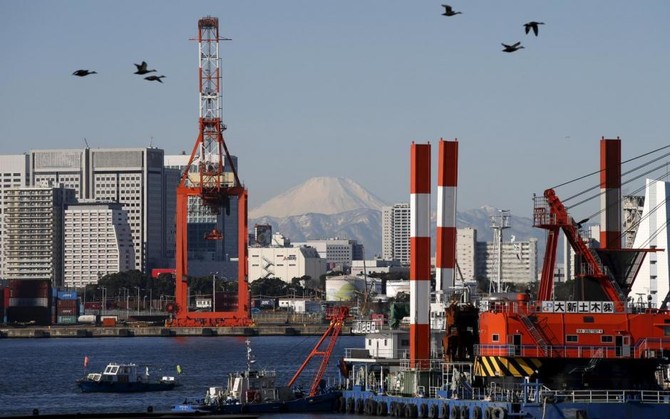
Japan’s record exports and manufacturing growth point to powerhouse economy
Japan’s record exports and manufacturing growth point to powerhouse economy



Latest updates


Recommended


© 2026 SAUDI RESEARCH & PUBLISHING COMPANY, All Rights Reserved And subject to Terms of Use Agreement.