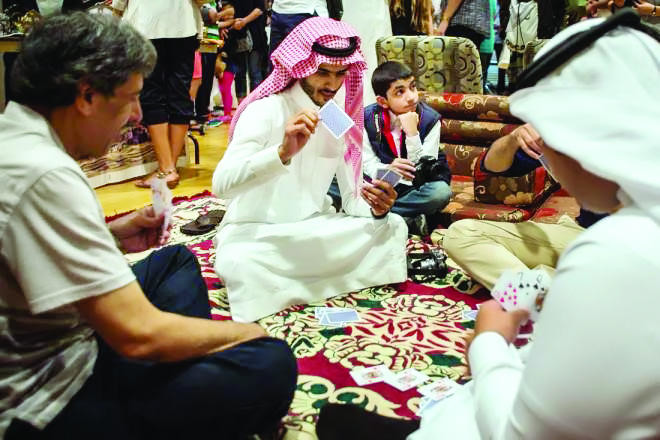
JEDDAH: For decades, Baloot has been one of the most popular card games among the Arabian Gulf youth, and Saudis in particular. People of all ages play it, but it is mostly popular among young men.
It is similar to the French Belote. Some say it is originally a French game, others believe it is Indian. Some sources say that Baloot entered the Kingdom more than 100 years ago, and spread rapidly in Saudi society.
There are those who say the name of the game came from the English word “plot,” which means a plan or a deal, and this describes how the game is played.
The game has many rules that may slightly differ from one region to another. Players need time to master the game. To play it you need only playing cards, and four players familiar with the rules of the game.
The four players are divided into two teams, two players each. Baloot uses 32 cards only, cards with numbers from 2 to 6 are excluded from the game.
One player distributes 32 cards and each player gets five cards each. The two players facing each other work as a team to win as many high-ranking cards as possible.
The main goal is to win the rounds in which high-ranking cards are played. The players collect cards by “eating” the cards of the opponent.
The game is played by two systems, San and Hokom, and the first is stronger than the second. The systems differ in the way the cards are ordered from strong to weak.
Hamad Al-Harbi, 26, is from Riyadh. He has been playing Baloot for more than 12 years. “The reason for Baloot’s popularity is the availability of playing cards — if you have them you can play — and that it does not need any physical effort or a certain suitable place,” he told Arab News.
“It is not an easy game. The player needs skill and there is a lot of competition and enjoyment,” he added.
Amen Sembawi, 59, from Jeddah, has been playing Baloot for more than 30 years. He told Arab News: “I am extremely happy that finally, Baloot has had the chance to be known internationally. Good players need to be alert, smart and skillful because it is a highly competitive game.”
Sembawi added: “Baloot is very popular. People play it everywhere, during friendly meetings, family gatherings, and weddings too. Each group who usually play together may make their own rules and they are called Bashkah.
“A new player needs first to learn about Baloot rules, watch others playing it, then practice it until he or she masters the game.”
The General Sports Authority announced that Riyadh will host the first Baloot championship at the King Abdullah Petroleum Studies and Research Center, from April 4-18.
The top four players will receive prize money totaling more than SR1 million ($270,000), including SR500,000 for the winner.


![]()
Why Baloot is so popular with Saudis
Why Baloot is so popular with Saudis
- Baloot game said to have entered the Kingdom more than 100 years ago
- People play the game everywhere, during friendly meetings, family gatherings, and weddings too



Latest updates


© 2026 SAUDI RESEARCH & PUBLISHING COMPANY, All Rights Reserved And subject to Terms of Use Agreement.