BARCELONA: On a chilly April night in Germany’s football heartland the Ruhr valley, Malaga CF were denied a place in the Champions League semifinals by two controversial stoppage-time goals. Defeat to Borussia Dortmund was hard to accept, but what seemed clear was that a wealthy new European football power had emerged to challenge the Spanish and continental elites.
That was five years ago. Today, the outlook is very different. Malaga are facing domestic relegation and the promises of the club’s Qatari president, Sheikh Abdullah bin Nasser bin Abdullah Al-Ahmed Al-Thani, ring hollow, his name no longer venerated in the Mediterranean port city.
Last month posters appeared on the walls of Malaga’s 30,000-capacity stadium urging Al-Thani to leave, the club’s fans seemingly tired of his histrionics and failings since acquiring the club for €36 million ($45 million) in June 2010.
“When he first came to Malaga, he was king and we would shout in his honor,” said a long-standing supporter who declined to be named. “But with the results of the past few years, Malaga’s performances have steadily disappointed and have now reached a very low ebb.”

On Saturday, the side lost 1-0 to Atletico Madrid, leaving Los Boquerones seven points adrift from safety at the bottom of Spain’s La Liga with just 13 points from 23 games. Among Europe’s biggest five leagues, only Italy’s Benevento, a provincial team playing its first season of top-flight football, has a worse record.
Malaga’s summer sales of key midfielders Ignacio Camacho and Pablo Fornals, plus striker Sandro Ramirez, for a combined €33 million ($40.7 million) left now-departed coach Michel with a woeful squad that has racked up more red cards than wins in La Liga this season.
With just two points and two goals from their past eight outings, the club are a mess, and seven January signings — five loan players, one free transfer, and a second-division defender bought for €500,000 — seem unlikely to arrest the decline of a club Al-Thani vowed would become soccer royalty.
“It will take time, but our objective is for Malaga to be one of the greatest teams in Spain,” Al-Thani said in an October 2010 television interview in which he implied he had opted to buy Malaga, rather than Liverpool, which was sold the same year to American investors for about £300 million ($420 million).
Those boasts, and his status as a Qatari royal and chairman of the privately owned Nasir Bin Abdullah & Sons (NAS Group), one of Qatar’s largest companies, led to widespread assumptions that Al-Thani possessed incredible wealth. CNN described him as one of the Gulf’s richest men, but his actions over the past eight years suggest otherwise.
Now rarely seen in Malaga amid rumors he is unable to leave Qatar, Al-Thani remains prolific on social media, and his enthusiasm for Malaga appears undimmed, despite his ownership of the club in dispute pending a court ruling.
“For me it’s everything. It’s not just a team, it’s my life,” he told the club’s television channel in July 2016. “We hope to see them at the top of La Liga. We will work hard with the team.
“We don’t want to make a big jump and then drop again … we’re looking to be in the Champions (League) or Europa League. We can do this. There is a new strategy … but I don’t give you the numbers.”

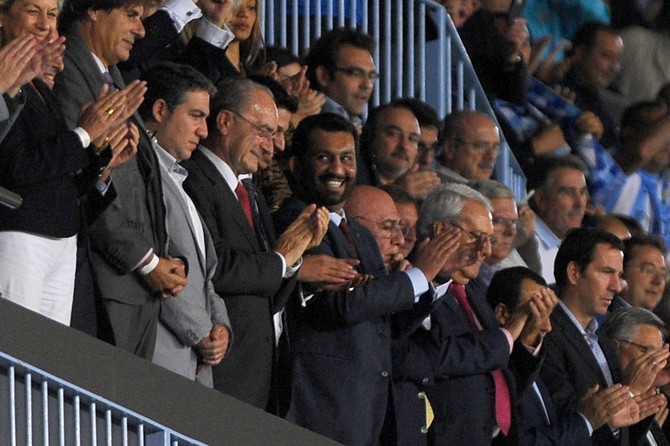
Sheikh Abdullah bin Nasser bin Abdullah Al-Ahmed Al-Thani bought Malaga in 2010 for $45 million and much was expected, but the club now finds itself in a financial mess. (AFP)
Whatever the details, the plan failed, and the numbers that do matter, aside from Malaga’s paltry league points total, are the player sales that have generated a net transfer profit of €141.4 million from 2012-13 onwards, according to transfermarkt.com.
That alleged asset stripping has proved too much to bear for the official supporters’ group, which in January wrote an open letter to Al-Thani lamenting his failure to bring in adequate replacements for the players offloaded.
“You made us believe that we will grow big, to levels that never before has the fan club enjoyed,” the letter said. “But like a house of cards, without solid foundations the project started to crumble into the chaotic situation of today.”
Things had begun so differently, with Al-Thani clocking up a net transfer spend of €74 million during his first two seasons in charge. Among the arrivals were the likes of Argentina’s Martin Demichelis, Brazilian Julio Baptista and some of Spain’s most promising young players in Isco, Santi Cazorla and Nacho Monreal.
In 2010-11, during Al-Thani’s maiden campaign, the club finished 11th, its highest position in six years. The following year, former Real Madrid trainer Manuel Pellegrini led the Andalusians to their best-ever result, a fourth-placed finish and qualification for the Champions League.
Off the pitch, progress also seemed swift. In December 2010, Al-Thani announced plans to build a 65,000-seat stadium to replace the publicly owned La Rosaleda, telling the Spanish AS newspaper he was close to buying the land for the new ground, which would include a five-star hotel. It has yet to be built.
The first indications of trouble came early in his reign, with players revealing they had not been paid on time. Clubs including Osasuna and Villarreal, who had sold players to Malaga, made similar complaints, prompting Spain’s football authorities to prohibit Malaga from signing players as unpaid tax dues swelled.
The ban was lifted after Cazorla was sold to repay some of these debts, while Monreal and Salomon Rondon were also among those offloaded in summer 2012 to ease a deepening financial crisis.
Malaga, which declined to answer questions from Arab News, were ultimately banned from European competition for the 2013-14 season because of overdue debts, but the club shrugged off those setbacks to reach the Champions League quarterfinals in 2012-13, Dortmund’s late revival preventing them from reaching the last four.
The midfielder Isco, the talisman of that European campaign, was swiftly sold to Real Madrid for €30 million, while mercurial winger Joaquin and Demichelis were among another dozen departures.
“After the Champions League run, he put less and less money into the club,” said the supporter. “There was a lot of money made on transfers and we don’t know where it has gone because there is this never-ending debt. The club was supposed to be debt-free, but the problem keeps resurfacing.”

Malaga's Adrian Gonzalez during the warm up before the match with Atletico Madrid. (REUTERS)
In 2012, Malaga officials approached Marbella-based BlueBay Hotels to see if the company could help get the club’s finances in order in return for taking a stake.
“The sheikh was really frightened because the debt was €130 million and the club was losing more or less €50 million annually, so every year the debt would increase,” said a source.
A new company was created in which Al-Thani would own 51 percent and BlueBay the remainder. The sheikh sold his 97 percent stake in Malaga for one euro to this new company, which assumed responsibility for the club’s debts and outstanding taxes.
Al-Thani also promised a further €30 million to help repay the debts if necessary, according to court documents cited by Diario Sur newspaper. He would remain president, while BlueBay would manage the club. Spain’s Higher Sports Council approved the ownership structure in August 2013.
However, BlueBay opted not to renew the expensive contracts of players and coaches, including Baptista, who was earning around €5 million annually. Pellegrini and his backroom staff were costing €10 million per year in wages — a quarter of the club’s income.
“With Malaga’s budget at around €40 million, it was not meant to be a club in the Champions League but maybe eighth to 11th in La Liga and some seasons play in the Europa League,” said the source.
In April 2014, with the club in better shape, Al-Thani announced the BlueBay deal had never materialized, evicted the hotel and resort chain from club premises, and then transferred the shares in the jointly owned holding company to another owned solely by him.
BlueBay, which declined to comment, launched a civil case in 2015 in a bid to force Al-Thani to comply with their agreement. The judge gave a provisional order preventing the sheikh, whose firm NAS Group did not respond to requests for comment, from selling the club shares until the case is resolved.
Al-Thani then filed a criminal case against BlueBay and two of his former advisers, Abdullah Ghubn and Moayad Shatat, claiming they conspired to defraud him of his shares. This was likely a stalling tactic and was dismissed in December 2017, with the matter now returning to the civil courts for a likely resolution this year, said the source.
Furthermore, in January 2016, Nasser Al-Thani, a Malaga director, was given a three-year suspended jail sentence in Qatar for writing bounced cheques worth 850,000 Qatari riyals ($234,000), according to La Opinion de Malaga newspaper. He used those cheques to buy a luxury car, subsequently paying the amount owed in June 2016 to avoid jail, although the case remains open.
As well as failing in soccer, the sheikh’s €400 million redevelopment of Marbella’s marina, 60 kilometers west of Malaga, has come to nothing. The project was unveiled in 2011 but soon ran into trouble as Malaga’s financial problems also began to surface. In November 2017, Andalusia’s high court annulled the tender granted to Al-Thani after his company missed payments and failed to make good on its plans, according to media reports.
As the eldest brother, Al-Thani, a former director of Doha Bank, was the manager of the family’s wealth and is believed to have invested much of this plus some loans from Qatari banks into Malaga CF.
Al-Thani awarded generous salaries to himself and some of his children who were given positions at the club. The board of directors, which comprises Al-Thani and three of his children, were paid a combined €1.44 million last season, according to the sports daily Marca. Plans to increase those payments were scrapped following fan disquiet.
“The strategy now is to milk the club and, as you can see, the quality of the team has declined markedly. All the players that have some value have been sold,” said the source. “The magic word ‘sheikh’ made people blind to the reality that there’s nothing behind his bluster. There’s no intelligence running the club right now and nobody there knows what to do.”