Kurdish doctors report suspected Turkish gas attack in Syria

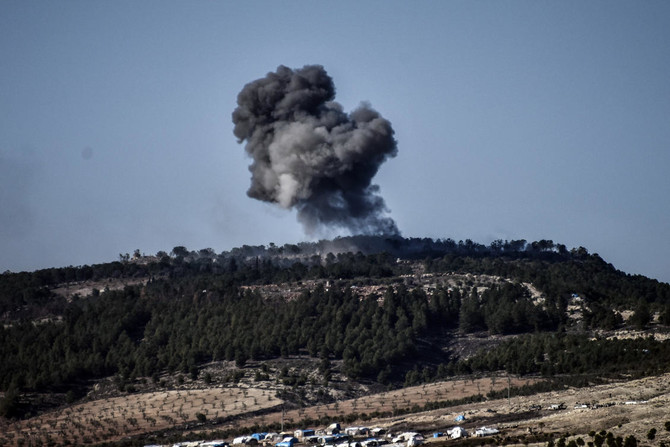
In this Jan. 28, 2018 file photo, a plume of smoke rises from inside Syria, during Turkish forces bombardment, on the Kurdish-controlled enclave of Afrin, Syria, as seen from the border with Syria, in Kilis, Turkey. (AP)
Updated 17 February 2018
Follow

Kurdish doctors report suspected Turkish gas attack in Syria

BEIRUT: Six civilians suffered breathing difficulties and other symptoms indicative of poison gas inhalation after an attack launched by Turkey on the Kurdish-controlled enclave of Afrin, Syrian Kurdish news outlets and Syria’s state-run news agency reported Saturday.
The news outlets quoted local doctors in Afrin as saying the hospital treated six cases of people who suffered shortness of breath, vomiting and skin rashes. The Syrian Observatory for Human Rights monitoring group also quoted local doctors in its report.
The claims could not be independently confirmed, and videos released from the hospital showed people being fitted with oxygen masks who did not otherwise show symptoms of gas attack inhalation such as twitching, foaming at the mouth or vomiting.
SANA on Saturday said Turkey fired several shells containing “toxic substances” on a village in Afrin on Friday night, causing six civilians to suffer suffocation symptoms.
The Turkish military repeated in a weekly statement published Saturday that it does not use internationally “banned ammunition” in its Afrin operation and said, “the Turkish Armed Forces does not keep such ammunition in its inventory.”
The army also said it is careful to not harm civilians and only targets “terrorists” and their positions in the Afrin region.
A Turkish diplomatic source said that Turkey never used chemical weapons in its operations in Syria, and takes the utmost care of civilians.
“These are baseless accusations. Turkey never used chemical weapons. We take utmost care about civilians in Operation Olive Branch,” the source said.
The source also described the accusations of wounding six civilians through a suspected gas attack as “black propaganda.”
The Turkish military launched an aerial and ground offensive on Afrin, in northwestern Syria, on Jan. 20. It says the aim of the operation is to push out the Kurdish militia known as the People’s Protection Units, or YPG, from the enclave. Turkey considers the group to be a terrorist group and an extension of the Kurdish insurgents it fights inside Turkey.
SANA, as well as Kurdish news outlets including Kurdistan 24, quoted doctor Khalil Sabri at the Afrin hospital as saying the attack occurred on the village of Aranda and that victims suffered shortness of breath, skin rashes, vomiting and low blood pressure.


Syrian government and SDF agree to de-escalate after Aleppo violence

Updated 23 December 2025
Follow

Syrian government and SDF agree to de-escalate after Aleppo violence

  • Turkiye views the US-backed SDF, which controls swathes of northeastern Syria, as a ⁠terrorist organization and has warned of military action if the group does not honor the agreement

DAMASCUS: Syrian government forces and the Kurdish-led Syrian Democratic Forces agreed to de-escalate on Monday evening in the northern city of Aleppo, after a wave of attacks that both sides blamed on each other left at least two civilians dead and several wounded.
Syria’s state news agency SANA, citing the defense ministry, said the army’s general command issued an order to stop targeting the SDF’s fire sources. The SDF said in a statement later that it had issued instructions to stop responding ‌to attacks ‌by Syrian government forces following de-escalation contacts.

HIGHLIGHTS

• SDF and Syrian government forces blame each other for Aleppo violence

• Turkiye threatens military action if SDF fails integration deadline

• Aleppo schools and offices closed on Tuesday following the violence

The Syrian health ministry ‌said ⁠two ​people ‌were killed and several were wounded in shelling by the SDF on residential neighborhoods in the city. The injuries included two children and two civil defense workers. The violence erupted hours after Turkish Foreign Minister Hakan Fidan said during a visit to Damascus that the SDF appeared to have no intention of honoring a commitment to integrate into the state’s armed forces by an agreed year-end deadline.
Turkiye views the US-backed SDF, which controls swathes of northeastern Syria, as a ⁠terrorist organization and has warned of military action if the group does not honor the agreement.
Integrating the SDF would ‌mend Syria’s deepest remaining fracture, but failing to do ‍so risks an armed clash that ‍could derail the country’s emergence from 14 years of war and potentially draw in Turkiye, ‍which has threatened an incursion against Kurdish fighters it views as terrorists.
Both sides have accused the other of stalling and acting in bad faith. The SDF is reluctant to give up autonomy it won as the main US ally during the war, which left it with control of Daesh prisons and rich oil resources.
SANA, citing the defense ministry, reported earlier that the SDF had launched a sudden attack on security forces ⁠and the army in the Sheikh Maqsoud and Ashrafiyah neighborhoods of Aleppo, resulting in injuries.
The SDF denied this and said the attack was carried out by factions affiliated with the Syrian government. It said those factions were using tanks and artillery against residential neighborhoods in the city.
The defense ministry denied the SDF’s statements, saying the army was responding to sources of fire from Kurdish forces. “We’re hearing the sounds of artillery and mortar shells, and there is a heavy army presence in most areas of Aleppo,” an eyewitness in Aleppo told Reuters earlier on Monday. Another eyewitness said the sound of strikes had been very strong and described the situation as “terrifying.”
Aleppo’s governor announced a temporary suspension of attendance in all public and private schools ‌and universities on Tuesday, as well as government offices within the city center.