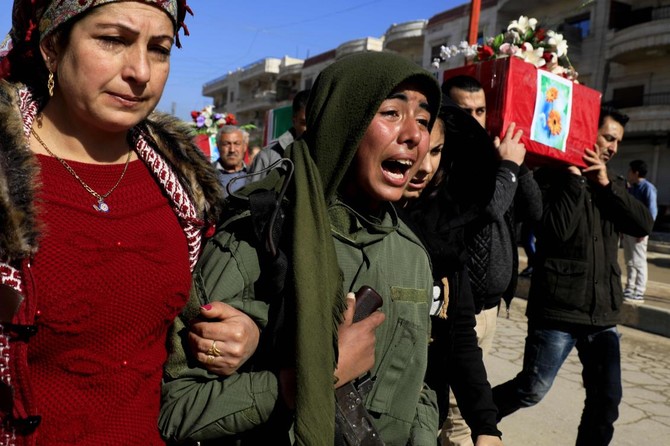
AFRIN: Ammunition belts slung over their shoulders, voices cracking from the chanting, dozens of young Syrian Kurds amassed in Afrin’s town square to enlist in the “resistance” movement against a Turkish-backed assault.
They wore mismatched military gear, some in jeans and others with scarves wrapped around their faces.
A few admitted it was the first time they had ever touched a weapon, but said they felt compelled to defend their hometown.
“Afrin is where I grew up, just like my parents and my grandparents before me. This is why it’s a duty for me to fight for it,” says Asmaa, 19.
The first-year journalism student at Afrin University decided last month to leave her studies behind and respond to a call to arms by local Kurdish authorities.
Town officials called for a “mass mobilization” of civilians to fight an assault by Turkish troops and allied rebels on the Kurdish People’s Protection Units (YPG) in Afrin.
They estimate hundreds have joined so far — some deployed to the front lines while others have volunteered for hospital shifts or rescue teams that search for survivors after bombardment.
Asmaa, a black-and-white scarf wrapped around her neck, says she enlisted to take part in the fighting.
“Today, I don’t see myself as a student. I see myself as a fighter,” she says assertively.
The crowd around her splits into two lines — one for young men and one for women — and begin marching through Afrin for an impromptu military parade.
As shopkeepers look on, the youth wave YPG flags and chant, “No to occupation!” and “Long live the heroic resisters!“
“There has been an increasing number of volunteers, and each young man or woman can choose which institution they want to volunteer for depending on their experience and capacities,” says Rezan Haddu, a media adviser to YPG in Afrin.
“Some volunteered as YPG fighters, others provide logistical support like food, transportation, and clothes,” he tells AFP.
Turkey and allied Syrian rebels began their cross-border assault on the Afrin region on January 20, and most of the fighting has been concentrated along the mountainous frontier.
Ankara has blacklisted the YPG as a “terror” group for its ties to the Kurdistan Workers’ Party (PKK), which has waged a deadly and decades-long insurgency against the Turkish government.
Local authorities had to act quickly to hold off the offensive, says Jinda Tulhaldan, a leader in the Kurdish Youth Movement’s Afrin branch.
“We give them a week of military training and teach them how to use weapons,” says Tulhaldan.
“We know a week isn’t enough, but we were attacked and had to defend our city with whatever we had in front of us.”
The Afrin region juts out from Syria’s northern Aleppo province, but it is governed under a semi-autonomous system established by Kurdish factions in 2013.
Under that system, people between the ages of 18 and 32 must spend one year in military conscription, says the YPG’s spokesman in Afrin, Birusk Hasakah.
Hasakah says “hundreds” of recruits had now fully enlisted in the YPG and allied groups, including members of local government who had closed public office and taken up arms.
“Others decided to prepare tea and food to distribute to the fronts, and others are volunteering in the hospitals,” he says.
“We were trained in light weapons from the youth center in Afrin,” says Tirij Hassan, a 22-year-old attending the recruitment rally.
“It’s the first time I carry weapons, but I’m happy about it because I’ll be defending Afrin, its people, and its children.”
Turkey says it does everything it can to avoid hitting civilians.
According to the Syrian Observatory for Human Rights, 68 civilians have been killed including 21 children since Turkey launched operation “Olive Branch” last month.
At least three civilians have also been killed by rocket fire from Syria onto Turkish territory.
More than 100 YPG fighters and about the same number of pro-Turkey rebels have also died in the fight, the Britain-based monitor said.
“Turkish warplanes are bombing Afrin. They are bombing civilians and attacking us and our forces,” says Farhad Akid, a 21-year-old agricultural engineering student in the Afrin city center.
“As young men, we’ve pledged ourselves to resist, to protect Afrin and our people. We won’t allow a single Turkish occupier to enter our blessed land.”


![]()
In Syria’s Afrin, locals mobilize to defend hometown against Turkey
In Syria’s Afrin, locals mobilize to defend hometown against Turkey
Latest updates


© 2026 SAUDI RESEARCH & PUBLISHING COMPANY, All Rights Reserved And subject to Terms of Use Agreement.