BAGHDAD: The multi-billion loans and credits offered to Iraq at an international donors conference in Kuwait have raised dozens of questions about what the government will offer in return.
It has also reinforced concerns in Baghdad about the encumbrance of Iraqi monetary policy with the policies of the International Monetary Fund and the World Bank.
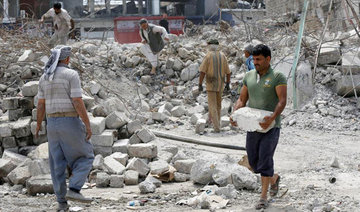
Iraq has estimated the cost of damage caused by Daesh and the three year war against the militants at $88 billion. Some $23 billion is urgently needed to clean the mine-contaminated areas, provide the daily basic services for the affected areas and bring 2.3 million displaced people back to their homes.
In coordination with the United Nations and the International Monetary Fund, Iraq this week held an international conference for reconstruction hosted by Kuwait. The conference, which was attended by more than 2,000 local and international companies from 70 countries, has made Iraq about $30 billion, mostly in sovereign loans.
But the lack of clarity about the loans has opened the door for critics of Iraqi prime minister Haider Abadi.
Abadi said yesterday that Iraq would start next month its negotiations with the countries who had offered the financial assistance.
He said international companies looking to invest in Iraq and local financial institutions would follow the required-facilities that the government has to provide to the companies to start these investment projects.
“No loans will be accepted but within the limits of the (annual Iraqi) budget,” Abadi said. “We are very cautious when it comes to the loans…we have not taken these loans, (as) we are looking for the loans that lead to development, create jobs and add value to the country.”
Prof. Salam Samisem, who specializes in finance and economics, told Arab News that the conference had failed “because it openly showed that the international society does not trust the Iraqi government due to the corruption and the inappropriate environment for investment in Iraq.”
“The government needs the US and other countries to provide credit loans for the international companies to convince them to come and work in Iraq.
“Loans mean interests, guarantees and time tables. How will the government achieve the conditions of the International Monetary Fund and the World Bank? What will the government offer as collateral? What are the benefits and conditions? These all are questions that Abadi must answer before agreeing to accept these loans,” Samisem said.
The dominance of political, sectarian and ethnic quotas on the legislative and executive authorities in Iraq, the absence of legal accountability and weak laws of integrity, means Iraq has been one of the most corrupt countries since 2003.
The investment environment in Iraq is considered hostile for international companies due to the unstable security and political situation and the lack of guarantees necessary to protect the rights of investors, which requires the intervention of the United States as guarantor instead of the Iraqi government, economists told Arab News.
“Investment in mega projects such as infrastructure projects need an integrated tax system and a regular legal collection process. This is not currently available in Iraq and will not be achieved soon,” a senior Iraqi economist told Arab News.
“Abadi has not done his homework before going to the conference. He has not modified the law of Investment in Iraq or limit the corruption rampant in all the governmental departments or provide any guarantees that the investors will be protected and no political or armed hands will reach them.”
Specialists contacted by Arab News said that if Iraq accepted these loans, this would mean that Iraqi monetary policy would be hostage to the policies of the World Bank and the International Monetary Fund.
“Financially, the conference failed and has not achieved its goals. These loans and associated conditions will be a burden on Iraq,” Bassim Antwan, an Iraqi economic analyst said.
“Everything will depend on the negotiator who will negotiate with the investment companies to decide the final conditions of each project separately.
“If the Iraqi negotiator will be strong enough and totally understands what he has to do, he may reduce the risks,” Antwan, said.
Critics of the results of the conference said the loans mean “swarming” Iraq with more debt, especially now that the government has exceeded the maximum limit-determined by the Iraqi Central Bank over the past four years.

Economists in Iraq raise questions over rebuilding loans
Syrian army declares a closed military zone east of Aleppo as tensions rise with Kurds
ALEPPO, Syria: The Syrian army on Tuesday declared an area east of the northern city of Aleppo a “closed military zone,” potentially signaling another escalation between government forces and fighters with the Kurdish-led Syrian Democratic Forces.
Several days of clashes in the city of Aleppo last week that displaced tens of thousands of people came to an end over the weekend with the evacuation of Kurdish fighters from the contested neighborhood of Sheikh Maqsoud.
Since then, Syrian officials have accused the SDF of building up its forces near the towns of Maskana and Deir Hafer, about 60 km (37 mi) east of Aleppo city, something the SDF denied.
State news agency SANA reported that the army had declared the area a closed military zone because of “continued mobilization” by the SDF “and because it serves as a launching point for Iranian suicide drones that have targeted the city of Aleppo.”
On Saturday afternoon, an explosive drone hit the Aleppo governorate building shortly after two Cabinet ministers and a local official held a news conference on the developments in the city. The SDF denied being behind the attack.
The army statement Tuesday said armed groups should withdraw to the area east of the Euphrates River.
The tensions come amid an impasse in political negotiations between the central state and the SDF.
The leadership in Damascus under interim President Ahmad Al-Sharaa signed a deal in March with the SDF, which controls much of the northeast, for it to merge with the Syrian army by the end of 2025. There have been disagreements on how it would happen.
Some of the factions that make up the new Syrian army, formed after the fall of former President Bashar Assad in a rebel offensive in December 2024, were previously Turkiye-backed insurgent groups that have a long history of clashing with Kurdish forces.
The SDF has for years been the main US partner in Syria in fighting against the Daesh group, but Turkiye considers the SDF a terrorist organization because of its association with the Kurdistan Workers’ Party, or PKK, which has waged a long-running insurgency in Turkiye. A peace process is now underway.
Despite the long-running US support for the SDF, the Trump administration in the US has also developed close ties with Al-Sharaa’s government and has pushed the Kurds to implement the March deal.
Shams TV, a station based in Irbil, the seat of northern Iraq’s semi-autonomous Kurdish region, had been set to air an interview with Al-Sharaa on Monday but later announced it had been postponed for “technical” reasons without giving a new date for airing it.
Several days of clashes in the city of Aleppo last week that displaced tens of thousands of people came to an end over the weekend with the evacuation of Kurdish fighters from the contested neighborhood of Sheikh Maqsoud.
Since then, Syrian officials have accused the SDF of building up its forces near the towns of Maskana and Deir Hafer, about 60 km (37 mi) east of Aleppo city, something the SDF denied.
State news agency SANA reported that the army had declared the area a closed military zone because of “continued mobilization” by the SDF “and because it serves as a launching point for Iranian suicide drones that have targeted the city of Aleppo.”
On Saturday afternoon, an explosive drone hit the Aleppo governorate building shortly after two Cabinet ministers and a local official held a news conference on the developments in the city. The SDF denied being behind the attack.
The army statement Tuesday said armed groups should withdraw to the area east of the Euphrates River.
The tensions come amid an impasse in political negotiations between the central state and the SDF.
The leadership in Damascus under interim President Ahmad Al-Sharaa signed a deal in March with the SDF, which controls much of the northeast, for it to merge with the Syrian army by the end of 2025. There have been disagreements on how it would happen.
Some of the factions that make up the new Syrian army, formed after the fall of former President Bashar Assad in a rebel offensive in December 2024, were previously Turkiye-backed insurgent groups that have a long history of clashing with Kurdish forces.
The SDF has for years been the main US partner in Syria in fighting against the Daesh group, but Turkiye considers the SDF a terrorist organization because of its association with the Kurdistan Workers’ Party, or PKK, which has waged a long-running insurgency in Turkiye. A peace process is now underway.
Despite the long-running US support for the SDF, the Trump administration in the US has also developed close ties with Al-Sharaa’s government and has pushed the Kurds to implement the March deal.
Shams TV, a station based in Irbil, the seat of northern Iraq’s semi-autonomous Kurdish region, had been set to air an interview with Al-Sharaa on Monday but later announced it had been postponed for “technical” reasons without giving a new date for airing it.
© 2026 SAUDI RESEARCH & PUBLISHING COMPANY, All Rights Reserved And subject to Terms of Use Agreement.