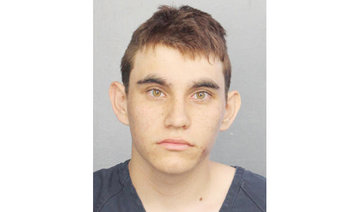
PARKLAND, Fla: Nikolas Cruz jumped out of an Uber car and walked toward building 12 of the Marjory Stoneman Douglas High School, carrying a black duffel bag and a black backpack. A man inside the school spotted Cruz and knew he was a former student, a troubled kid. He radioed a co-worker, and within a minute heard gunshots.
The 19-year-old was wearing a maroon shirt, black pants and a black hat. The man, whose name was blacked out from a sheriff’s affidavit, told detectives Cruz was moving “purposefully.”
Cruz slipped into the building, entered a stairwell and extracted a rifle from his bag, authorities said. He shot into four rooms on the first floor — going back to spray bullets into two of the rooms a second time — then went upstairs and shot a single victim on the second floor. He ran to the third floor, where according to a timeline released by the Broward County Sheriff’s Office, three minutes passed before he dropped the rifle and backpack, ran back down the stairs and quickly blended in with panicked, fleeing students.
Florida State Sen. Bill Galvano, who visited the third floor, said authorities told him it appeared that Cruz tried to fire point-blank out the third-floor windows at students as they were leaving the school, but the windows did not shatter. Police told Galvano that it was not that difficult to open the windows.
“Thank God he didn’t,” Galvano said.
From the time Cruz entered the building until the time he left, only six minutes passed. During that brief time, he shot more than two dozen people, including 17 fatally.
After the rampage, he walked to a Wal-Mart and bought a drink at a Subway restaurant, then went to a McDonald’s.
About 40 minutes later, a deputy saw him walking down a suburban South Florida street and grabbed him. He did not put up a fight.
The details of Wednesday’s carnage at the Parkland, Florida, high school emerged a day later from witnesses and law enforcement reports.
Among the dead: Assistant football coach Aaron Feis, slain while shielding students from bullets; Joaquin Oliver, a student known for his unique look and who once dyed his hair bleach-blonde with tiger stripes; Alyssa Alhadeff, an avid soccer player and student; and 35-year-old geography teacher Scott Beigel, who helped students enter a locked classroom, only to be shot himself.
Among at least 1,000 people attending a candlelight vigil near the school Thursday night, some openly sobbed as the victims’ names were read aloud. At one point, people began chanting, “No more guns! No more guns!“
Dressed in the school’s red color, some held flowers while others wielded signs asking for action to fight school violence, including gun control.
“Kids don’t need guns. No guns under 21,” read one sign.
Ernest Rospierski, a teacher at the school, took several bracing breaths at the vigil as he talked to a reporter about the horror in the halls.
“Bang bang bang — all of a sudden the shooting stopped,” he said. “I looked down. He was reloading. I yelled, ‘Run!’ And then I ran behind as many kids as I could.”
Authorities have not described any specific motive, except to say that Cruz had been kicked out of the high school, which has about 3,000 students and serves an affluent suburb where the median home price is nearly $600,000. Students who knew him described a volatile teenager whose strange behavior had caused others to end friendships.
Cruz was ordered held without bond at a brief court hearing. He wore an orange jumpsuit with his hands cuffed at his waist. His public defender did not contest the order and had her arm around Cruz during the short appearance. Afterward, she called him a “broken human being.”

A six-minute fatal rampage for shocked Florida high school

Youth voters take center stage in Bangladesh election after student-led regime change
- About 45% of Bangladeshis eligible to vote in Thursday’s election are aged 18-33
- Election follows 18 months of reforms after the end of Sheikh Hasina’s 15-year rule
DHAKA: When he goes to the polls on Thursday, Atikur Rahman Toha will vote for the first time, believing that this election can bring democratic change to Bangladesh.
A philosophy student at Dhaka University, Toha was already eligible to vote in the 2024 poll but, like many others, he opted out.
“I didn’t feel motivated to even go to vote,” he said. “That was a truly one-sided election. The election system was fully corrupted. That’s why I felt demotivated. But this time I am truly excited to exercise my voting rights for the first time.”
The January 2024 vote was widely criticized by both domestic and international observers and marred by a crackdown on the opposition and allegations of voter fraud.
But the victory of the Awami League of ex-Prime Minister Sheikh Hasina was short-lived, as a few months later the government was ousted by a student-led uprising, which ended the 15-year rule of Bangladesh’s longest-serving leader.
The interim administration, led by Nobel laureate Muhammad Yunus, took control in August 2024 and prepared a series of reforms to restructure the country’s political and institutional framework and organize the upcoming vote.
About 127.7 million Bangladeshis are eligible to cast their ballots, according to Election Commission data, with nearly a third of them, or 40.4 million, aged 18-29. Another 16.9 million are 30-33, making it a youth–dominated poll, with the voters hopeful the outcome will help continue the momentum of the 2024 student-led uprising.
“We haven’t yet fully transitioned into a democratic process. And there is no fully stable situation in the country,” Toha said. “After the election we truly hope that the situation will change.”
For Rawnak Jahan Rakamoni, also a Dhaka University student, who is graduating in information science, voting this time meant that her voice would count.
“We are feeling that we are heard, we will be heard, our opinion will matter,” she said.
“I think it is a very important moment for our country, because after many years of controversial elections, people are finally getting a chance to exercise their voting rights and people are hoping that this election will be more meaningful and credible. This should be a fair election.”
But despite the much wider representation than before, the upcoming vote will not be entirely inclusive in the absence of the Awami League, which still retains a significant foothold.
The Election Commission last year barred Hasina’s party from contesting the next national elections, after the government banned Awami League’s activities citing national security threats and a war crimes investigation against the party’s top leadership.
The UN Human Rights Office has estimated that between July 15 and Aug. 5, 2024 the former government and its security and intelligence apparatus, together with “violent elements” linked to the Awami League, “engaged systematically in serious human rights violations and abuses in a coordinated effort to suppress the protest movement.”
It estimated that at least 1,400 people were killed during the protests, with the majority shot dead from military rifles.
Rezwan Ahmed Rifat, a law student, wanted the new government to “ensure justice for the victims of the July (uprising), enforced disappearances, and other forms of torture” carried out by the previous regime.
The two main parties out of the 51 contesting Thursday’s vote are the Bangladesh Nationalist Party and Jamaat-e-Islami. Jamaat, which in 2013 was banned from political participation by Hasina’s government, heads an 11-party alliance, including the National Citizen Party formed by student leaders from the 2024 movement.
“I see this election as a turning point of our country’s democratic journey … It’s not just a normal election,” said Falguni Ahmed, a psychology student who will head to the polls convinced that no matter who wins, it will result in the “democratic accountability” of the next government.
Ahmed added: “People are not voting only for their leaders; they are also voting for the restoration of democratic credibility. That’s why this election is very different.”