MANILA: The body of a Filipino housemaid found stuffed in a freezer in an abandoned apartment in Kuwait was flown home to her grieving family Friday, as attention focused on the plight of millions of mostly poor Filipinos toiling abroad.
As Joanna Daniela Demafelis’ remains were wheeled to the Manila airport’s cargo bay, her sister broke into tears and embraced the casket before being pulled back and consoled. A brother wept quietly, speechless and overwhelmed by emotion.
“I hope my sister will be given justice,” Demafelis’ brother, Jojit Demafelis, later told reporters.
Demafelis’ body was found recently in a Kuwait City apartment that had reportedly been abandoned for more than a year. Philippine President Rodrigo Duterte said her body bore torture marks and there were indications she was strangled.
Her death is the latest overseas tragedy to befall a worker from the Philippines, a major labor exporter with about a tenth of its 100 million people working abroad. The workers have been called the country’s heroes because the income they send home has propped up the Southeast Asian nation’s economy for decades, accounting for about 10 percent of annual gross domestic product.
Philippine officials are under increasing pressure to do more to monitor the safety of its worldwide diaspora of mostly housemaids, construction workers and laborers. There are also calls for the government to boost employment and living standards at home, where nearly one in four people live in poverty, so that fewer people need to find work abroad.
Foreign Secretary Alan Peter Cayetano stood with the Demafelis family at the airport Friday and said a prayer.
“Her death is very tragic but will also be a rallying point for all of the government agencies to be more aggressive abroad in helping our OFWs be protected,” Cayetano told reporters, using the acronym for overseas foreign workers.
Duterte has ordered a ban on the deployment of new Filipino workers to Kuwait, where he said some Filipino workers have committed suicide due to abuses.
Cayetano said Kuwait had expressed outrage over Demafelis’ death and promised do everything it could to render justice. He said the Philippines lodged a protest over the case and at least six other recent deaths mostly of Filipino housemaids in Kuwait and asked that the Philippine Embassy be given access to investigations by Kuwaiti authorities.
Demafelis’ family told The Associated Press on Friday that Joanna was 29-years-old and the sixth of nine children born into a poor farming family in the central province of Iloilo. She left for Kuwait in 2014 to be employed by a Syrian and Lebanese husband and wife and had never told anyone back home that she was being mistreated.
Philippine officials say they are re-examining how to better detect and stop abuse of its workers abroad. A Filipino labor officer in Kuwait has been recalled after reportedly failing to adequately help Demafelis’ family when they reported that she was missing.
“If there is a complaint already, even if we can help them, it’s still too late like when they’re already dead,” Cayetano said at a news conference. “They should have been helped when we found out that there was abuse or as soon as they lost contact with their family.”
Still the sheer number of Filipino workers abroad makes monitoring their wellbeing an overwhelming task. That is often complicated by the workers not having proper travel and work documents, such as in Kuwait where nearly 11,000 of the more than 252,000 Filipino workers are in the country illegally or not properly authorized.
The Philippines has banned the deployment of its workers some countries, but many desperate Filipinos chose to stay, even in war-torn Iraq and Syria.
“Despite the offer to repatriate, to pay for their tickets, many chose to stay because there is no employment or less employment possibilities or they’ll earn much less money in the Philippines,” Cayetano said.
He said the long-term solution was for the Philippines to strengthen its economy so Filipinos won’t be forced to look for greener meadows.


![]()
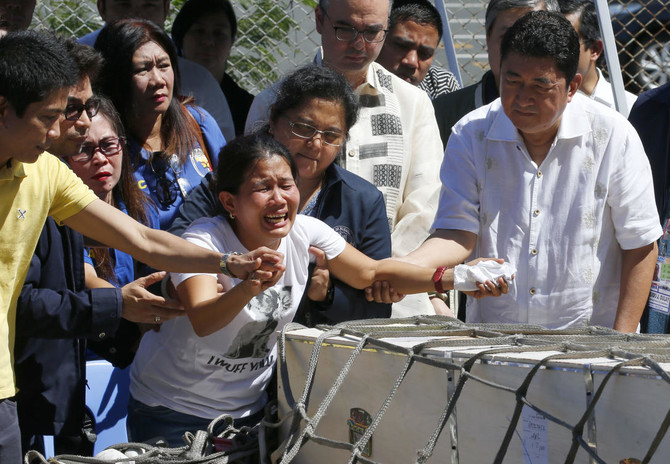
Family grieves Philippine maid found dead in Kuwait freezer
Family grieves Philippine maid found dead in Kuwait freezer



Latest updates


© 2026 SAUDI RESEARCH & PUBLISHING COMPANY, All Rights Reserved And subject to Terms of Use Agreement.