Haley puts UN pressure on Iran over Houthi missiles

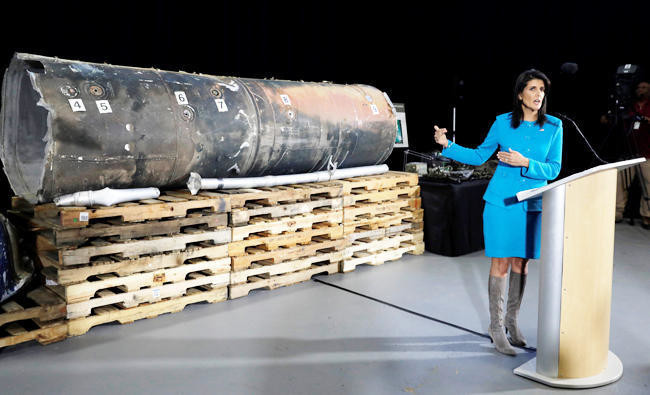
US Ambassador to the United Nations Nikki Haley briefs the media in front of remains of Iranian "Qiam" ballistic missile provided by Pentagon at Joint Base Anacostia-Bolling in Washington. (Reuters)
Updated 17 February 2018
Follow

Haley puts UN pressure on Iran over Houthi missiles

NEW YORK: Washington’s UN Ambassador Nikki Haley on Thursday intensified pressure on Iran over its arming of Yemeni rebels, but it remained unclear whether US efforts for new international action against Tehran would succeed.
Haley said it was “time for the Security Council to act” after the release of a long-awaited report by UN experts that concluded that Iran had violated an arms embargo on Yemen by providing rebels with short-range ballistic missiles and drones.
“This report highlights what we’ve been saying for months: Iran has been illegally transferring weapons in violation of multiple Security Council resolutions,” Haley said after the report’s release on Thursday.
“The United States will continue to call out Iran’s dangerous actions, but the world cannot continue to allow these blatant violations to go unanswered. Iran needs to know that there are consequences for defying the international community.”
Iran has strongly denied arming the Houthi militias, who rule northern Yemen and the capital, Sanaa, and has accused Haley of presenting “fabricated” evidence that a Nov. 4 missile fired at Riyadh airport was Iranian-made.
Iran “failed to take the necessary measures” to stop arms flowing to Houthis, the UN report concludes. It paints a bleak portrait of Yemen disintegrating into several “warring statelets” after three years of civil conflict.
The UN experts accuse all sides of abuses in a war that pits Yemen’s UN-recognized President Abd-Rabbu Mansour Hadi and his military backers in the Arab coalition against the Houthis and those loyal to former Yemeni President Ali Abdullah Saleh, who was killed last year.
Under a UN resolution that enshrines the Iran nuclear deal with world powers, Tehran is barred from selling, supplying or transferring weapons beyond its borders without UN approval. A separate UN resolution bans the arming of top Houthis or those aligned with Saleh.
According to diplomats, Iranian violations are likely to be addressed in a draft resolution renewing sanctions on Yemen, which is set to be adopted by the council later this month. It remains unclear whether Russia will back a move that punishes Iran.
Last month, Russian Ambassador Vassily Nebenzia queried the UN report and said the US had not made a case for UN action against Iran, after Haley showed her Security Council colleagues a display of allegedly Iran-supplied Houthi rocket fragments at a hangar near Washington.
Speaking at NATO headquarters in Brussels on Friday, US Defense Secretary James Mattis continued building the Trump administration’s case against Iran, accusing Tehran of fomenting unrest across from Lebanon to the Gulf. 
After alluding to missiles into Saudi Arabi, problems in Lebanon and Syria “where Iran has propped up Assad” and Yemen “where they’re using it for a launching platform,” Mattis said: “I cannot explain why Iran insists on many of the things it does.”


Secrecy, mines and Israeli strikes complicate removal of Assad-era chemical weapons, says Syrian envoy

Updated 7 sec ago
Follow

Secrecy, mines and Israeli strikes complicate removal of Assad-era chemical weapons, says Syrian envoy

  • Nevertheless, new authorities made significant progress in their work with Organization for the Prohibition of Chemical Weapons, he tells UN Security Council
  • Syrian authorities grant OPCW experts unrestricted access to 23 sites and since October have been hosting the organization’s longest continuous presence in the country

NEW YORK CITY: Syria’s envoy to the UN said on Thursday that secrecy surrounding the nation’s former chemical weapons program, security risks from land mines and other unexploded ordnance, and Israel’s targeting of suspected weapons sites continue to complicate his government’s efforts to eliminate Assad-era chemical weapons.
Speaking at a UN Security Council meeting about Syria’s chemical weapons, Ambassador Ibrahim Olabi said the nation’s new authorities had nevertheless made significant progress over the past year in their work with the Organization for the Prohibition of Chemical Weapons.
Despite what he described as “major challenges,” Syria had moved the issue “from a stage of suspicion and manipulation to one of partnership with the OPCW,” he said, adding: “Syria has achieved a qualitative leap in its cooperation with the OPCW.”
This shift is reflected in recent decisions by the watchdog’s executive council and changing positions among its member states, Olabi noted.
Syria’s chemical weapons program has been under international scrutiny since the early years of the country’s civil war, when repeated chemical attacks killed or injured large numbers of civilians. The deadliest incident occurred in 2013 in the Damascus suburb of Eastern Ghouta, when a sarin attack killed hundreds and triggered international efforts to dismantle the country’s chemical arsenal.
Olabi said the authorities that took over after President Bashar Assad and his regime were toppled in December 2024 were confronting what he called the “heavy legacy of the Assad era,” during which chemical weapons were widely used against civilians. He described the program as an inherited burden rather than a policy of the new government.
“The chemical file is a prime example of these inherited issues, issues of which we were victims,” he added.
Syrian authorities have granted OPCW experts unrestricted access during eight deployments that included visits to 23 sites, he said, and since October have been hosting what he described as the organization’s longest continuous presence in the country.
“This marks the beginning of a sustained presence of the OPCW in Syria,” Olabi added.
Adedeji Ebo, the UN’s deputy high representative for disarmament affairs, said OPCW teams visited 19 locations in Syria last year, four of them previously declared chemical weapons sites and 15 suspected locations, where they conducted interviews and collected samples in their attempts to determine the full scope of undeclared chemical weapons activity.
Some other sites are in dangerous areas, he added, which poses significant risks to both Syrian and international personnel.
“On-site destruction may be required where conditions prevent safe removal,” Ebo said, noting that a recent OPCW decision authorizing expedited on-site destruction of weapons marked a positive step forward.
He also highlighted the reestablishment of Syria’s National Authority for the OPCW and the watchdog’s current, continuous presence in Damascus.
Olabi said Syrian national teams had identified two sites containing empty cylinders previously used to store toxic chemicals and had immediately reported them to the OPCW. Syrian authorities also handed over about 6,000 documents relating to the former regime’s chemical weapons program, he added, and helped arrange interviews with 14 witnesses, including individuals who were involved with the program.
Syrian authorities were also cooperating with international investigators examining chemical attacks by Assad’s government, he said, and accountability and justice for the victims are priorities for the new authorities.
“Syria reiterates its determination to continue the efforts to close this chapter,” Olabi said, adding that there was “no place for chemical weapons in today’s world.”