Oil prices get boost from rebound in global stock markets

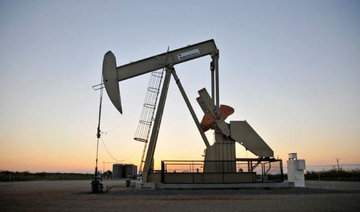
The Organization of the Petroleum Exporting Countries said on Monday it expected world oil demand to climb by 1.59 million barrels per day this year. (Reuters)
Updated 13 February 2018
Follow

Oil prices get boost from rebound in global stock markets

SINGAPORE: Oil prices rose on Tuesday, lifted by a rebound in global stock markets that followed sharp falls last week.
US West Texas Intermediate (WTI) crude futures were at $59.65 a barrel at 0724 GMT. That was up 36 cents, or 0.6 percent, from their last settlement.
Brent crude futures were at $62.99 per barrel, up 40 cents, or 0.6 percent, from the previous close.
“Oil markets attempted a half-hearted recovery overnight on little more than an equity market correlated bounce,” said Stephen Innes, head of trading for Asia-Pacific at futures brokerage Oanda in Singapore.
Stock markets were roiled last week by some of the sharpest falls on record, shaking confidence across markets.
With markets seemingly returning to calmer waters, oil traders said attention was turning to inventory levels to gauge crude supply levels.
“The change in inventories this week will be crucial for determining whether further declines in the oil price are on the cards,” said William O’Loughlin, investment analyst at Australia’s Rivkin Securities.
The private American Petroleum Institute is due to publish crude inventory estimates on Tuesday, while the government US Energy Information Administration (EIA) is set to release its fuel storage and crude production data on Wednesday.
On the demand side, the Organization of the Petroleum Exporting Countries (OPEC) said on Monday it expected world oil demand to climb by 1.59 million barrels per day (bpd) this year, an increase of 60,000 bpd from the previous forecast, reaching 98.6 million bpd.
The rising consumption is being met by increased output from outside OPEC, the Middle East dominated producer club said.
OPEC said the United States and other outside producers would boost supply by 1.4 million bpd this year, up 250,000 bpd from last month and the third consecutive rise from 870,000 bpd in November.
OPEC said because of non-OPEC production growth, oil markets would only return to a supply and demand balance “toward the end of this year.”
In an effort to tighten markets and prop up prices, OPEC and a group of other producer including Russia have been withholding supplies since 2017. The cuts are scheduled to last through 2018.
EIA data shows that world oil markets were in a supply deficit in 2017, due in large part to the OPEC-led supply cuts, but the data shows an expected return of a surplus for large parts of this year.
Sukrit Vijayakar, director of consultancy Trifecta Energy, said that his view on oil prices was “decidedly bearish” given all the market fundamentals.


Saudi Arabia’s cultural sector is a new economic engine between Riyadh and Paris, says ambassador

Updated 25 January 2026
Follow

Saudi Arabia’s cultural sector is a new economic engine between Riyadh and Paris, says ambassador

RIYADH: Culture has become a fundamental pillar in bilateral relations between France and Saudi Arabia, according to the French Ambassador to the Kingdom, Patrick Maisonnave.

Maisonnave noted its connection to the entertainment and tourism sectors, which makes it a new engine for economic cooperation between Riyadh and Paris.

He told Al-Eqtisadiah during the opening ceremony of La Fabrique in the Jax district of Diriyah that cultural cooperation with Saudi Arabia is an important element for its attractiveness in the coming decades.

La Fabrique is a space dedicated to artistic creativity and cultural exchange, launched as part of a partnership between the Riyadh Art program and the French Institute in Riyadh. 

Running from Jan. 22 until Feb 14, the initiative will provide an open workspace that allows artists to develop and work on their ideas within a collaborative framework.

Launching La Fabrique as a space dedicated to artistic creativity

The ambassador highlighted that the transformation journey in the Kingdom under Vision 2030 has contributed to the emergence of a new generation of young artists and creators, alongside a growing desire in Saudi society to connect with culture and to embrace what is happening globally. 

He affirmed that the relationship between the two countries is “profound, even cultural par excellence,” with interest from the Saudi side in French culture, matched by increasing interest from the French public and cultural institutions unfolding in the Kingdom.

Latest estimates indicate that the culture-based economy represents about 2.3 percent of France’s gross domestic product, equivalent to more than 90 billion euros ($106.4 billion) in annual revenues, according to government data. The sector directly employs more than 600,000 people, making it one of the largest job-creating sectors in the fields of creativity, publishing, cinema, and visual arts.

Saudi Arabia benefiting from French experience in the cultural field

Maisonnave explained that France possesses established cultural institutions, while Saudi Arabia is building a strong cultural sector, which opens the door for cooperation opportunities.

This comes as an extension of the signing of 10 major cultural agreements a year ago between French and Saudi institutions, aiming to enhance cooperation and transfer French expertise and knowledge to contribute to the development of the cultural system in the Kingdom.

He added that experiences like La Fabrique provide an opportunity to meet the new generation of Saudi creators, who have expressed interest in connecting with French institutions and artists in Paris and France.

La Fabrique encompasses a space for multiple contemporary artistic practices, including performance arts, digital and interactive arts, photography, music, and cinema, while providing the public with an opportunity to witness the stages of producing artistic works and interact with the creative process.