‘Dirty dancing’ Westerners deported from Cambodia

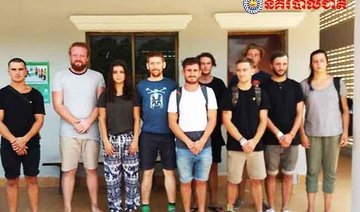
A group of foreigners stand after they were arrested by Cambodian National Police for “dancing pornographically” at a party in Siem Reap town in this January 27 photos. Seven of them have already been deported from the country for offending the standards of morality. (Cambodian National Police via AP)
Updated 12 February 2018
Follow

‘Dirty dancing’ Westerners deported from Cambodia

PHNOM PENH, Cambodia: Seven Westerners arrested last month for allegedly posting pornographic photos on social media of themselves engaged in sexually suggestive dancing have been deported from Cambodia, a court official said Monday.
Yim Srang, a court spokesman in the northwestern province of Siem Reap, said the court decided that the seven — who were freed on bail last week — could no longer stay in Cambodia.
Ten young Westerners — five from the UK, two from Canada, and one each from Norway, the Netherlands and New Zealand — were detained when police raided a commercially organized party at a rented villa in Siem Reap town and found people dancing by a swimming pool at an event described as a pub crawl. Siem Reap is near the famous Angkor Wat temple complex. Three of the 10 considered organizers of the event were denied bail.
Police said those caught in the raid had been “dancing pornographically” and offended Cambodian standards of morality. Offenders face up to a year in jail if convicted of posting allegedly pornographic photos.
Ouch Sopheaktra, one of the group’s lawyers, said the seven Westerners left Cambodia from Wednesday through Friday last week. He said no money had been deposited for their release on bail. Charges against them remain active, however.
“The seven have been ordered to leave Cambodia temporarily and now they have already arrived in their home countries,” Ouch Sopheaktra said.
The only women among the 10 detained people, Canadians Eden Kazoleas and Jessica Drolet, arrived by plane in Toronto on Friday night, and spoke briefly to the press.
“I’m very happy to be home, I’m grateful to be in Canada,” said Kazoleas, a 19-year-old from Alberta. “I look forward to seeing my family and my parents, who have done absolutely everything they could to bring me home.”
Kazoleas thanked Cambodian authorities for their “understanding” during the incident.
“I did not know, nor did I think attending a pool party would be offensive in Cambodian culture,” Kazoleas said. “I apologize to anyone who thinks it was, but ... when I attended the party I was not taking part in any pornographic dancing or anything the media suggests I was doing and I am very disappointed in the way I was represented.”
Drolet, a 26-year-old from Ontario, expressed similar sentiments.
The two women said they were happy to have each other’s company during the ordeal.
“I was lucky to have Jessica in there with me,” Kazoleas said. “As much as I wish she didn’t have to go through it, I couldn’t have done it without her.”


Kremlin rejects European assessment Navalny died of poisoning

Updated 6 sec ago
Follow

Kremlin rejects European assessment Navalny died of poisoning

MOSCOW: The Kremlin said Monday that it “strongly rejected” an assessment by five European countries that Russian opposition leader Alexei Navalny died from poisoning two years ago, as his supporters marked the anniversary of his death in prison.
Navalny, a charismatic anti-corruption campaigner who rallied hundreds of thousands to the streets in protest at the Russian leadership, was Russian President Vladimir Putin’s fiercest domestic opponent for years.
He died in an Arctic prison colony in February 2024 while serving a 19-year sentence for “extremism,” a charge that he and his supporters say was punishment for his opposition work.
Britain, Sweden, France, Germany and the Netherlands issued a joint statement on Saturday saying they believed he had been poisoned with epibatidine — a toxin found in poison dart frogs — and that the Russian state had the “means, motive and opportunity” to administer it.
“We naturally do not accept such accusations. We disagree with them. We consider them biased and baseless,” Kremlin spokesman Dmitry Peskov told reporters, including AFP, during a daily briefing call.
“In fact, we strongly reject them,” he added.
Dozens of people visited his grave in Moscow early Monday, among them foreign diplomats, according to an AFP reporter at the scene.
Some of those who attended wore masks or scarves over their faces.
Russian authorities designated Navalny and his organization “extremist” before his death, and anyone who mentions him or his exiled anti-corruption foundation are liable for prosecution.
Navalny, a Yale-educated lawyer, was the most widely known Russian opposition figure and galvanized thousands of young people to protest against Putin.
He had already survived a suspected poisoning with the Novichok nerve agent in 2020.

- Ecuadoran dart frog -

Navalny’s mother Lyudmila told reporters she felt vindicated by the European statement and called for those responsible to be held accountable.
“This confirms what we knew from the very beginning. We knew that our son did not simply die in prison, he was murdered,” she said outside the cemetery where he was buried in Moscow.
“I think it will take some time, but we will find out who did it. Of course, we want this to happen in our country, and we want justice to prevail,” she added.
Navalny’s widow, Yulia Navalnya, said on Saturday it was now “science proven” that her husband had been murdered.
She had previously said in September that laboratory analysis of smuggled biological samples found that her husband was poisoned.
Epibatidine, found in the Ecuadoran dart frog, causes muscle paralysis and eventual asphyxiation.
Experts have said the toxin can also be produced synthetically, instead of extracting it directly from the frog itself.
The European statement did not say how it was administered or by whom.
Britain’s foreign office said the poison is not found naturally in Russia and that “only the Russian state had the means, motive and opportunity to deploy this lethal toxin.”
Russia’s prison service said he died after going for a walk and falling ill.
Since Navalny’s death, Russia’s opposition has remained largely exiled and fragmented.
Navalny’s widow Yulia vowed to take the mantle of Russia’s opposition in the wake of his death but has struggled to galvanize widespread support.
Inside Russia, Moscow has intensified a crackdown on anybody who had links with the late opposition leader.
In addition to targeting his allies and backers, photographers who covered his court hearings and lawyers who represented him at trial have been sentenced to lengthy prison terms.