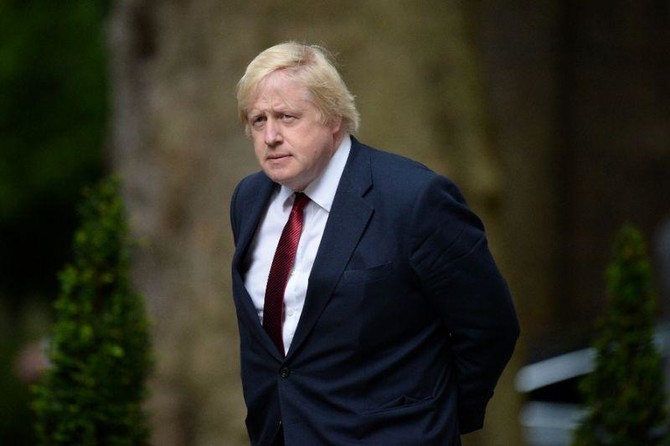
NAYPYIDAW: Britain’s foreign minister Boris Johnson met with Aung San Suu Kyi in Myanmar’s capital on Sunday to press for action on the Rohingya crisis, as the country faces mounting pressure to punish troops accused of atrocities against the Muslim minority.
Johnson spoke with the embattled Myanmar leader, whose reputation among the international community has plunged over her handling of the crisis, in Naypyidaw while on a four-day tour in Asia.
The meeting followed Johnson’s visit to a refugee camp in Bangladesh’s Cox’s Bazar district, where nearly 700,000 Rohingya have sought sanctuary in squalid settlements since a Myanmar army crackdown in northern Rakhine last August.
The UN has accused Myanmar of driving the Muslim minority across the border in an ethnic cleansing campaign. Doctors Without Borders estimates at least 6,700 Rohingya died in the first month of violence.
But Myanmar has staunchly denied the charges and blocked UN investigators from the conflict zone, souring relations with a host of western allies.
Fresh reports of mass graves in Rakhine — and the arrest of two Reuters journalists investigating an alleged massacre — have heaped new pressure on Suu Kyi to condemn the army, who she is in a delicate power-sharing arrangement with.
But the Nobel laureate has refused to change tack and is accused by critics of bunkering down in a siege mentality.
On Sunday Johnson and Suu Kyi “discussed in an open and friendly manner the latest developments in Rakhine State, including planning for the reception of returnees who fled,” Myanmar’s foreign ministry said in a Facebook post alongside photos of the pair meeting.
Ahead of the talks the UK’s foreign office said Johnson would press for an “end to the suffering in Rakhine and the safe and voluntary return of the refugees.”
Johnson is scheduled to visit Rakhine later on Sunday.
Myanmar and Bangladesh have inked a deal to bring refugees back to northern Rakhine, but repatriation has yet to begin.
Many Rohingya do not feel safe returning to a country where they have faced violent persecution and decades of discrimination at the hands of a state that has denied them citizenship.
Others have no home to return to after their villages were torched in the military crackdown.
Johnson is scheduled to fly on to Bangkok Sunday for a two-day visit that will include meetings with junta chief Prayut Chan-O-Cha and the Thai chairman of an advisory board on the Rohingya crisis.
Veteran US diplomat Bill Richardson dramatically stepped down from the board last month, saying he could not in “good conscience” sit on a panel he feared would only “whitewash” the causes of the Rohingya crisis.

UK’s Johnson meets Myanmar’s Suu Kyi on Rohingya crisis
Single ‘digital nation-state’ is not a far-fetched notion, Melania Trump tells UN Security Council
- US first lady argues that AI and global connectivity could reshape education, help reduce conflict and empower children worldwide
- Societies rooted in knowledge foster innovation, tolerance and moral reasoning, while those shaped by ignorance risk disorder and conflict, she says
NEW YORK CITY: The idea of a single digital nation-state is “not so far-fetched,” US First Lady Melania Trump told the UN Security Council on Monday.
She argued that artificial intelligence and global connectivity could reshape education, help reduce conflict and empower children worldwide.
The US holds the rotating presidency of the council for March, and as she presided over its first meeting of the month Trump said technology was erasing borders and creating what she described as a shared intellectual future.
“Perhaps this idea isn’t so far-fetched,” she said, pointing to the rise of digital currencies, blockchain-based payment systems, and AI-driven databases she argued were already transforming media and financial markets.
Trump thanked the US’s fellow council members — the UK, France, Russia, China, Greece, the Democratic Republic of Congo, Denmark, Panama, Liberia, Somalia, Colombia, Pakistan, Bahrain and Latvia — for their role in efforts to maintain international security.
The responsibility for preventing conflict “must be applied evenly and should never be carried out lightly,” she said. Her remarks focused in particular on the role of education as the foundation of peace and stability.
“A nation that makes learning sacred protects its books, its language, its science and its mathematics. It protects its future,” Trump said, arguing that societies rooted in knowledge foster innovation, tolerance and moral reasoning, while those shaped by ignorance risk disorder and conflict.
Education is widely recognized as a fundamental human right, she added, yet many children and young adults around the world remain barred from the chance to attend high school or university. The losses arising from this squandered potential, from potential medical breakthroughs to possible advances in food security and technology, are borne not only by the individual countries involved but by humanity as a whole, she said.
Trump called for the expansion of global access to technology to help bridge the digital divide, noting that about 6 billion people, 70 percent of the world’s population, now use mobile devices and the internet.
“If our nations band together, we can close the technological divide,” she said, describing a world in which a farmer on a remote Greek island, a student in Somalia and a resident of New York City can all tap into centuries of accumulated human knowledge.
AI was democratizing access to information once confined to university libraries, she added, and redefining participation in the global “economy of ideas.”
She continued: “Conflict arises from ignorance. Knowledge creates understanding, replacing fear with peace and unity.”
Trump called on council members to safeguard learning and promote access to higher education, urging them to “build a future generation of leaders who embrace peace through education.”
She added: “The path to peace depends on us taking responsibility to empower our children through education and technology.”