LONDON: Last Sunday, amid the general debate about the award of Tottenham’s first penalty at Anfield, there was much discussion about whether Harry Kane had dived. The following night, there was a similar debate about whether Gerard Deulofeu had dived to win Watford a penalty against Chelsea.
Both situations were similar, in that they involved a goalkeeper diving at the feet of an attacking player, and that both were considered controversial shone a light onto a much wider issue in football.
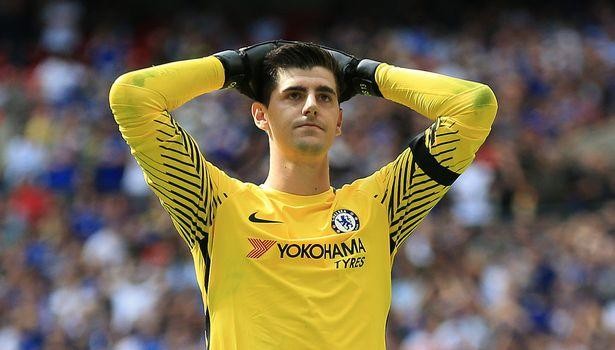
Thibaut Courtois, the Chelsea goalkeeper, was explicit in comparing the two incidents.
“Yesterday, we saw when the goalkeeper comes out and is late you make yourself small but the striker puts his foot there and it’s a penalty, every time this will happen. He left his foot and dives it’s not a penalty,” he said.

There was a debate about whether Gerard Deulofeu had dived to win Watford a penalty against Chelsea.
“I think we all know this kind of player. It happens everywhere in the world, this type of striker sees the goalkeeper coming for the ball, I make myself as small as possible with my belly on the ground and he manufactures the contact. I’m sorry but I don’t think it’s a penalty.”
The key phrase is “he left his foot there.” It’s a clever defense because it is true that forward as they go past defenders often dangle a leg in the hope of, to use Courtois’ phrase, manufacturing contact. That is a very modern, sophisticated development of diving, and it is a huge problem for referees. It also has nothing to do with either the Kane or Deulofeu cases.
Both Courtois and Loris Karius threw themselves toward the ball, leading with their hands and upper body. In both cases the attacking player nudged the ball past them. In both cases the attacking player half-jumped over the goalkeeper and went down after being clipped.
Perhaps both Kane and Deulofeu could have hurdled the goalkeepers successfully. Perhaps both did deliberately ensure that there was sufficient contact to justify them falling over. It does not matter.
In that situation the attacking player has two basic options: He keeps running, hits the keeper hard, wins the penalty and risks being injured; or he jumps, tries to avoid the keeper and risks losing control of the ball. Both situations are penalties. The law is clear that there is no need for contact. It is an offense to “trip or attempt to trip” an opponent. Now you can argue that both Karius and Courtois were going for the ball — they probably were. But if in going for the ball, and missing it, they are in so little control of their bodies that they force an attacking player to take evasive action then they have acted carelessly and so have committed an offense. It is a clear penalty.

Amid the general debate about the award of Tottenham’s first penalty at Anfield against Liverpool last weekend, there was much discussion about whether Harry Kane had dived.
Attacking players can hardly be blamed if they try both to avoid injury and to make sure the referee realizes they have been impeded.
Courtois admitted he was “late.” His argument that he tried to make himself small is ludicrous, and not just because he’s 6’5”. Imagine if an outfield player lunged for the ball and missed it, forcing an opponent to take evasive action. Nobody would doubt that was a foul, and possibly even a yellow or red card. Goalkeepers, though, seem a breed apart, the laws applying to them in different ways.
Perhaps it is a necessary redress after the decades when goalkeepers could be bundled over the goalline by powerful center-forward.
Nobody wants them to be at risk when they come to claim a cross, leaping with arms extended and leaving their ribs exposed. But perhaps the pendulum has swung too far. It seems bewildering, for instance, that Manuel Neuer’s reckless challenge on Gonzalo Higuain in the 2014 World Cup final, kneeing him in the jaw, was not only not a red card but was given as a foul the other way, more confusing still that it is never even spoken about.
Goalkeepers are treated differently. But for everybody, perhaps, it would be useful to forget about notions such as contact and whether a forward is manufacturing an offense and look instead at the defensive player. Is he kicking or attempting to kick? Is he tripping or attempting to trip? Is he impeding? Look at his actions and not the consequences. Kane may have been offside, but both he and Deulofeu were fouled.