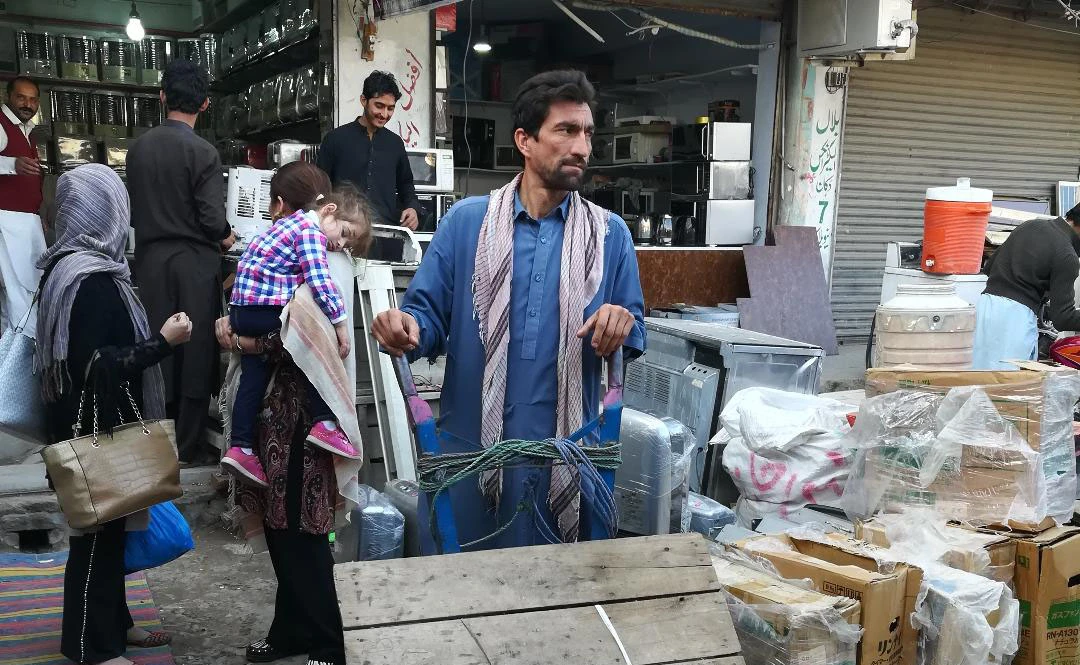
PESHAWAR: Sher Bahadur seems to be in a pensive mood while waiting with his pushcart for customers amid the crowded Karkhano bazaar, the city market made famous by the ready availability of smuggled supplies.
Karkhano is a word of the Pashto language and translates as “industries” in English.
It was established in 1986 and comprises about 35 sections, each of which is like a separate market boasting more than 100 shops.
Bahadur, who hails from a suburban area of Peshawar, is one of the laborers who roam the bazaar offering to carry goods for customers and shopkeepers in order to earn a living.
Earlier, he used to walk a difficult, hilly terrain while carrying smuggled goods on his shoulders from Afghanistan to Pakistan.
“It was too difficult a job and I decided to abandon it when I saw one of the laborers fall from the mountain while carrying goods and die,” Bahadur told Arab News.
“I used to earn Rs600 ($5.46) per one visit, scaling the hill in Landikotal Tehsil (in the Khyber Agency) and returning back to the Pakistani side with goods. But that one visit takes four hours.”
He said he now earns Rs500 to Rs600 a day helping customers and shopkeepers.
Close to Bahadur, Abdur Rehman sits on his pushcart, doing the same job in the market.
“I used to work in the mountains too, bringing different goods from Afghanistan to Pakistan, but I no longer do that,” he told Arab News.
The Karkhano bazaar is an Aladdin’s cave of goods, but some traders say it is no longer “the smugglers’ market” as the proliferation of such items has dropped significantly because of restrictions on the Pakistan-Afghanistan border.
Still one can find everything at the marketplace, from hardware to electronics, dried fruit to clothing and much more.
One trader, Mukhtyar, told Arab News that his dried fruit comes from various countries, including Afghanistan, China and India.
“The tax on dry fruit has increased. Cashews used to be sold for Rs1,500 per kilogram, but it has jumped to Rs2,000 or even above now,” said Mukhtyar, adding that “a small quantity” of his produce still comes through the hilly routes from Afghanistan.
Jespal Singh, hailing from a Sikh community in the Khyber Agency, is also doing business in the market, selling artificial jewelry and cosmetics from Punjab.
Fellow trader Ayub Khan believes the deportation of Afghan nationals and restrictions on the border had caused a loss to local trade.
“Many wealthy Afghans have shifted their resources and bank balances out of Pakistan and this has also caused a decline in local business,” he said.
He added there was a time when finding a shop to rent in Karkhano was next to impossible, but now it is far easier.
Janatullah, a shopkeeper dealing in the sale of hardware, said that previously they used to receive US-made smuggled goods intended for NATO forces in Afghanistan, but not any longer.
Close to one of the godowns of smuggled goods, Khan Wali, a “commission kaar” — the term used for dealers responsible for ensuring the delivery of smuggled goods — told Arab News he had been in the “commission business” in the area for the last 20 years.
“If you pay me for an order of goods to be transported to any part of Pakistan, I can ensure that the goods will reach you,” said Wali.
Noorullah, 32, who runs “Hollywood Cosmetics”, said they have products from China, India, Indonesia and other countries.
He added that, a decade ago, traders from Punjab and other cities of Pakistan used to come to Karkhano for merchandise, but now fewer people from those areas visit the market.
Former smugglers’ paradise remains a trading hub