JEDDAH: France on Wednesday joined an international chorus of condemnation of the Assad regime for using chemical weapons against Syrian civilians.
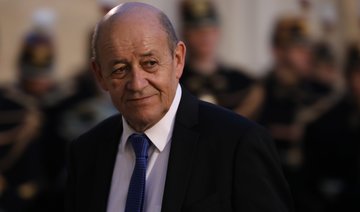
“All indications … tell us today that chlorine is being used by the regime in Syria,” Foreign Minister Jean-Yves Le Drian said.
“I'm weighing my words because as long as we haven’t completely documented this we have to stay prudent,” he said.
Asked how France would respond, Le Drian pointed to the “partnership against impunity” agreed by two dozen countries in January to ensure that perpetrators of chemical attacks in Syria were held accountable.
But he did not allude to any other response, including military retaliation, that France might take against the Assad regime if the attacks are confirmed.
Shortly after taking office last year, French President Emmanuel Macron said chemical attacks in Syria would be a “red line” for France.
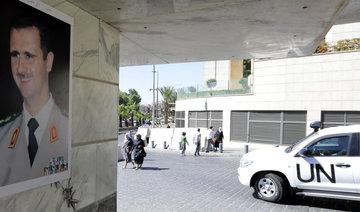
UN war crimes investigators are studying reports that chemical weapons have been used in the opposition-held zones of Eastern Ghouta, near Damascus, and in the northwestern Idlib province.
The Organization for the Prohibition of Chemical Weapons (OPCW) said the accusations “continue to be of grave concern” and it was investigating “all credible allegations.”
The US said this week there was obvious evidence of recent chlorine gas attacks in Eastern Ghouta, a suburb of Damascus that has been under Assad regime siege for more than five years.
Syrian opposition spokesman Yahya Al-Aridi told Arab News there was every indication that the regime of Bashar Al-Assad was committing atrocities. “Le Drian is right,” he said.
Al-Aridi said the OPCW had evidence, which is why its work was being obstructed by Russia, Syria’s ally, and its mission was not renewed.
Russian President Vladimir Putin “has taken the UN Security Council hostage,” Al-Aridi said. “Russia has used its veto to protect the regime 11 times and I don’t think they would hesitate to use it a 12th time. However, I believe there are ways to do things outside the Security Council. There is the General Assembly. Something can be done there to protect Syrian civilians.”
The French foreign minister also accused Iran and Turkey of violating international law in Eastern Ghouta and northern Syria, and called for “the withdrawal of all of those who ought not to be in Syria, including Iranian militia, including Hezbollah.”
Le Drian did not specifically call on Turkey to pull back from an offensive against Kurdish militias in northern Syria, but he said Ankara should not worsen the conflict.
“Ensuring the security of its borders does not mean killing civilians and that should be condemned. In a dangerous situation Turkey should not add war to war,” he said.
Turkey’s EU Minister Omer Celik said Le Drian’s statement reflected “a double standard on the issue of terror.”
“Turkey’s fight conforms to international law,” he said. “Those who violate the law and commit crimes are those who arm the PYD-YPG terror groups.”


![]()

Pressure mounts on Assad over chemical gas attacks
Pressure mounts on Assad over chemical gas attacks

Latest updates


© 2026 SAUDI RESEARCH & PUBLISHING COMPANY, All Rights Reserved And subject to Terms of Use Agreement.