France FM: All Iranian militia, including Hezbollah, must leave Syria

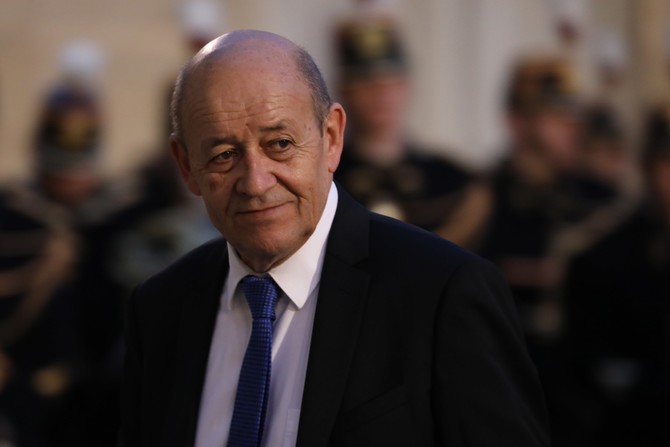
French foreign minister Jean-Yves Le Drian said on Wednesday that all Iranian militia, including Hezbollah, must leave Syria, whose civil war has thrown the Middle East into turmoil. (AFP)
Updated 07 February 2018
Follow

France FM: All Iranian militia, including Hezbollah, must leave Syria

PARIS: French foreign minister Jean-Yves Le Drian said on Wednesday that all Iranian militia, including Hezbollah, must leave Syria, whose civil war has thrown the Middle East into turmoil.
Asked in an interview on BFM TV whether he wanted Turkish armed forces to withdraw from Syria, Le Drian replied that he wanted: "The withdrawal of all of those who ought not to be in Syria, including Iranian militia, including Hezbollah."
Le Drian also said that "all indications" suggest the Syrian regime is using chlorine weapons in its nearly seven-year civil war against rebel forces.
"All indications... tell us today that chlorine is being used by the regime at present in Syria," Le Drian told BFM television.
The French FM also said that Turkey and Iran were among those violating international law by their actions in Syria and warned that Ankara should not add "war to war".
"Ensuring the security of its borders does not mean killing civilians and that should be condemned. In a dangerous situation in Syria, (Turkey) should not add war to war," Le Drian told BFM TV.
International law "is being violated by Turkey, by the Damascus regime, by Iran and those who are attacking eastern Ghouta and Idlib", he said.


Libya to try a gang member linked to a mass grave of 21 migrants for human trafficking

Updated 7 sec ago
Follow

Libya to try a gang member linked to a mass grave of 21 migrants for human trafficking

  • Authorities found evidence that the criminal gang organized illegal migration and trafficked people in Al-Kufra city
  • It remains unclear how the 21 migrants died or when, or exactly when and where they were found

CAIRO: A member of a criminal group linked to a mass grave containing the bodies of 21 migrants will stand trial on a charge of human trafficking, Libya’s attorney general’s office said Friday.
The office said in a statement on Facebook that the gang member was being referred to court.
Authorities found evidence that the criminal gang organized illegal migration and trafficked people in Al-Kufra city in southeast Libya and Ajdabiya city in the eastern part of the country. The attorney general’s statement didn’t identify the gang.
Libya has been a main transit point for migrants fleeing war and poverty in Africa and the Middle East. The country plunged into chaos after a 2011 uprising toppled and killed longtime dictator Muammar Qaddafi.
It remains unclear how the 21 migrants died or when, or exactly when and where they were found. The attorney general’s office released images Friday showing bodies wrapped in black plastic bags, with some remains partially covered in dirt. The Associated Press could not immediately independently verify the images.
The statement said 195 migrants were released by the criminal group after being detained and subjected to torture aimed at extorting ransom from their families. Authorities arrested one of the members of the group, while remaining members are still being pursued, according to the attorney general’s office.
Many migrants who take the risky sea route to reach Europe seeking a better lives do not survive. Most recently, at least 42 people went missing and were presumed dead after a boat carrying migrants capsized off the coast of Libya, according to the International Organization for Migration.
The latest shipwreck adds to the rising death toll in the Central Mediterranean, where more than 1,000 people have died since the beginning of 2025, including over 500 lost off the coast of Libya, according to the IOM’s Missing Migrants Project.
After Qaddafi was killed, Libya was split in two, with rival administrations in the east and west, each backed by armed groups and foreign governments. The western part of the country is governed by Prime Minister Abdul-Hamid Dbeibah’s government in Tripoli, and the administration of Prime Minister Ossama Hammad rules in the east.